What to know about Louisiana’s nuclear energy aspirations
Oct 22, 2026 | 12:23 pm ET
Description
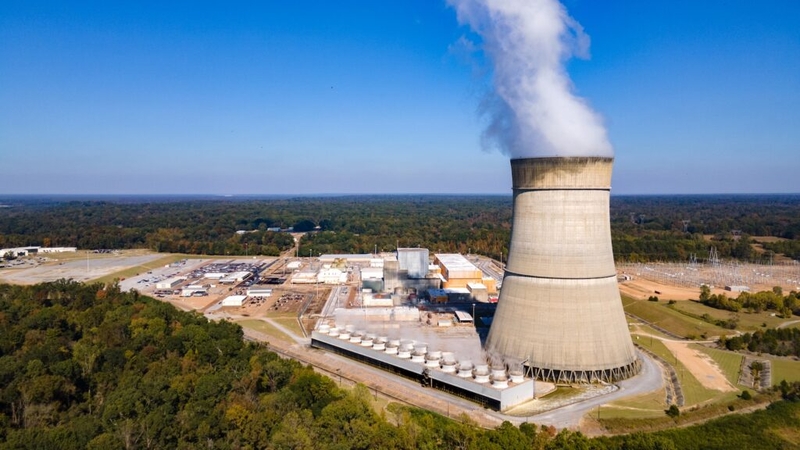
Steam rises from the cooling tower at Entergy's Grand Gulf Nuclear Station, located just south of Vicksburg, Miss.. The power plant provides a portion of its electricity to Louisiana, and state officials here are interested in reprocessing its spent uranium fuel rods from the facility as part of a proposed nuclear lifecycle innovation campus. (Photo courtesy of Entergy Corp.)
Louisiana is one of five states that are finalists for a U.S. Department of Energy initiative to create nuclear lifecycle innovation campuses — developments that would encompass the refinement, use and recycling of nuclear fuel and disposal of waste.
Until this week, the Landry administration has provided few details publicly beyond broad strokes on what such a campus in Louisiana might involve.
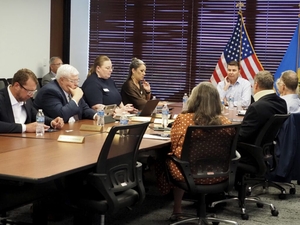
More light was shed Tuesday at a meeting of the state House Committee on Natural Resources, where representatives from the state Department of Conservation and Energy and the Louisiana Economic Development agency told lawmakers about the state’s pitch to the feds. Officials also laid out their overriding goal to entice nuclear industry investment, which they say could potentially produce an additional 25,000 jobs.
Here are six takeaways from that hearing:
1. Only one site will be chosen per state
Idaho, Oklahoma, Tennessee and Utah are the other states competing for a nuclear lifecycle innovation campus. Amanda McClinton, Office of Energy executive director at the state Department of Conservation and Energy, said three states are expected to be chosen by later this year or early 2027 with the possibility of more in at a later date.
The Trump administration has said it “will establish voluntary federal-state partnerships” with the selected states but has yet to spell out whether that involves any financial support or preferential permitting treatment.
Louisiana’s proposal to the Trump administration in May included a multiparish approach to meeting all aspects of a nuclear lifecycle innovation campus.
Specifically, it envisions building a small modular reactor to power a “strategic military asset” in Northwest Louisiana. Entergy’s River Bend nuclear power plant in West Feliciana Parish and engineers at LSU would support uranium enrichment and testing, while salt domes off the coast of Port Fourchon are proposed as a disposal site for nuclear waste.
Stephen Swiber, deputy secretary at the state Department of Conservation and Energy, told lawmakers Tuesday the Trump administration will pick one location per state. Parishes that want to be considered for campuses have been asked to forward resolutions from their legislative bodies to the department, he said.
Swiber said locations that have put their names up for consideration include: St. Charles Parish, home to the Waterford 3 nuclear plant; West Feliciana Parish, where the River Bend nuclear plant is located; neighboring East Feliciana Parish; and the governing body in charge of Port Fourchon.
2. Louisiana sees recycling opportunities.
The uranium rods used in nuclear reactors use only about 5% of the fuel they contain, leaving the remainder and other byproducts available for extraction.
The reprocessing of nuclear fuel rods and disposal of waste material are critical components of Louisiana’s proposal to the Trump energy department because the federal government will subsidize and guide those aspects, Swiber told lawmakers.
“You do have to express willingness and interest to host the final deposition of the waste stream of the processing,” he said.
The United States has never undertaken reprocessing, according to Swiber. France has reprocessed spent fuel rods for more than 60 years and can recover up to 80% of the uranium, he said, which is turned back into fuel for nuclear reactors.
The U.S. Department of Energy is currently working with companies testing methods with the potential to extract even more uranium, he added.
3. Louisiana doesn’t intend to be a dumping ground.
McClinton stressed that Louisiana won’t be on board with any proposal that only involves the storage of nuclear waste from other states or countries. Jason Lanclos, who leads energy sector recruitment for Louisiana Economic Development, reiterated that stance with lawmakers who said this was a chief concern among some of their constituents.
However, Swiber said state officials have been involved in discussions about importing spent uranium rods, reprocessing them to extract the unused uranium and sending the rods back to their country of origin.
There is a huge supply of spent fuel rods in the United States, with most of it stored in indoor containment pools near the reactors where they were used, Swiber said. He cited federal estimates of 100,000 tons across the country.
Swiber told the committee Louisiana would initially be interested in reprocessing used fission material from River Bend, Waterford 3 and the Grand Gulf nuclear station in Port Gibson, Mississippi, which provides a portion of its power to Louisiana. Together, they reported storing roughly 1,600 tons of spent fuel rods as of September, he said.
Louisiana would bury the waste material that results from reprocessing, which would be far smaller in comparison with the used uranium rods, according to Swiber.
“This is a waste reduction measure, not a waste importation measure,” he said.
4. New utility-scale reactors are unlikely.
In addition to the state officials, lawmakers also heard from two energy industry experts from LSU.
Economist Greg Upton, director of the LSU Energy Institute, said the cost to build large-scale nuclear power plants has become prohibitive for utility companies, along with the long timelines needed to complete them. He pointed to the two newest reactors built in the United States, the two units built at the Vogtle Electric Generating Plant in Georgia.
They came online in 2023 and 2024, with four utilities partnering to cover the nearly $37 billion cost. The final price tag was more than double original projections for units that started providing electricity seven years behind schedule.
For the sake of comparison, Upton said the combined rate base for Louisiana’s four largest utilities: Entergy Louisiana, Entergy New Orleans, Cleco and SWEPCO comes to $23.5 billion. The figure represents the sum value of the companies’ physical and financial assets.
Adding nuclear generation would provide Louisiana utilities with a buffer against fluctuation in the price of natural gas, which is used to generate 72% of the state’s electricity, Upton said. But the cost of that cushion would significantly eat into their profits.
“When you pencil those capital cost differences, it’s hard to make the argument to move forward with large-scale nuclear,” Upton said.
Bryan Synder, an environmental science professor at LSU, told legislators the nuclear energy industry is trending toward small modular reactors, which can be built at lower cost, more quickly and strategically placed in remote areas or where industrial power needs are high.
Small modular reactors take less time to build though none are in use yet in the United States. The first to receive federal approval are expected to come online by 2030 at the earliest.
The regulatory steps have pushed the construction timeline for utility-scale reactors beyond 10 years.
“I would be surprised if we saw another large … reactor (built) in the United States,” Snyder said.
5. LED sees nuclear campus as a welcome mat.
Lancos touted plans Turner Industries announced earlier this year to expand its nuclear manufacturing capabilities to meet the anticipated demand for modular reactors. A dollar amount has not been publicly attached to the investment, though the company said it will add 500 jobs at both its Port Allen and New Iberia facilities.
Yet he and other state officials said the objective isn’t necessarily to build more reactors for use in Louisiana.
“We don’t have to have them,” state Rep. Joe Orgeron, R-Cut Off, said. “We just want to be part of the supply chain that builds them out for the rest of the nation.”
Lancos said Louisiana’s finalist status for the lifecycle campus has drummed up interest from other businesses in the nuclear industry that see potential in setting up shop in the state.
“This is about bringing in the state-of-the-art industries that are coming to Louisiana,” he said. “Our phones are ringing, and they’re saying, ‘How can we get involved?’”
6. Changes in state and federal law are needed.
Even if Louisiana were chosen for a nuclear lifecycle innovation campus, whether one materializes will largely depend on the political whims of the executive and legislative branches of federal and state government.
The United States does not have a location where it can permanently store its high-level nuclear waste or spent fuel rods from commercial reactors. A permanent repository in Nevada’s Yucca Mountain, first proposed in 1987, has been stalled since the Obama administration pulled its funding in 2011 under opposition from state residents.
Congress would have to update federal law to allow any other site, such as salt domes near Port Fourchon, to be considered for permanent nuclear waste storage, Swiber said. The Trump administration has floated related legislation this year, but no lawmakers have expressed interest in carrying the proposal. Its chances would probably grow slimmer if Democrats gain control of one or both chambers in the Nov. 3 midterms.
Two Louisiana laws would also need to be updated if the federal government chooses the state for a lifecycle campus. One forbids the importing of spent nuclear fuel and waste, and another bars the U.S. Department of Energy from evaluating salt domes for waste storage sites.
Swiber also mentioned geopolitical factors that will determine the future of nuclear energy growth in the United States.
Most uranium for American reactors comes from Canada, which Trump has engaged in a trade war. Russia was also a significant supplier to the U.S. since the end of the Cold War until the Biden administration issued an embargo in 2024 with limited waivers and caps on import amounts.
“One of those, as you notice, is not the most friendly country, and I’ll actually leave it to you to … infer which one that is because discussions have not gone great north of the border sometimes,” Swiber said.
Baton Rouge, LA