Weighing state’s ambiguous environmental justice standard, judge gives go-ahead to Juniper Ridge
Oct 22, 2026 | 5:09 am ET
Description
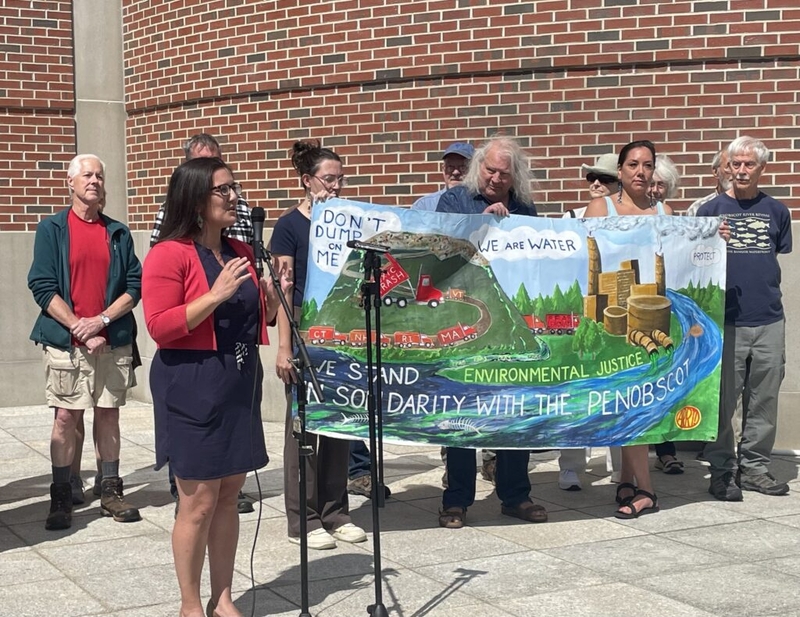
Maulian Bryant, executive director of the Wabanaki Alliance and Penobscot Nation citizen, outside the Penobscot County Judicial Center in Bangor after a July 23, 2026 hearing in the Penobscot Nation's appeal of the Juniper Ridge Landfill expansion's public benefit determination. (Photo by Kaitlyn Budion/Maine Morning Star)
With no clear definition from the state for ‘environmental justice,’ a Penobscot County Superior Court justice said he can only consider state lawmakers’ intentions for the standard. And under that narrow interpretation, he has ruled that the state’s initial approval of the Juniper Ridge Landfill expansion will hold, despite concerns raised by neighboring Penobscot Nation.
The Tribe along with the Conservation Law Foundation appealed the Maine Department of Environmental Protection’s public benefit determination for the second time this year.
In his order Friday, Justice Bruce Mallonee wrote that the court does not offer an independent evaluation of the determination or its “advisability,” but concluded it does not violate state statute.
“We have fought pollution, injustice and decades of harm to heal the Penobscot River, a relative that has sustained our people since time immemorial and continues to sustain communities across Maine,” Penobscot Nation Tribal Chief Kirk Francis said in a statement. “We are not asking the state to undo generations of harm overnight. We are asking it not to take us backward. Our cultural survival is tied to the health of the Penobscot River, and there is too much at stake to keep adding to the harms it already carries.”
Juniper Ridge is owned by the state through the Bureau of General Services, which has an operating contract with NEWSME Landfill Operations, a subsidiary of waste management company Casella.
Sharon Huntley, spokesperson for the Maine Department of Administrative and Financial Services, said in a statement that given the significant role that the landfill “serves in waste disposal in Maine and the dire consequences of a stalled process,” the state is relieved that the determination has advanced, allowing the Bureau of General Services to focus on the expansion application.
Jeff Weld, vice president of communications for Casella, said in a statement Wednesday that the company is pleased with the court’s ruling.
“This decision represents an important step toward ensuring that Maine has the infrastructure and disposal capacity necessary to responsibly manage its solid waste into the future,” Weld said. “We remain committed to working collaboratively with the State of Maine and other stakeholders throughout the remaining permitting process, with a focus on providing safe, reliable and environmentally responsible operations while supporting Maine’s long-term waste management needs.”
The Maine Department of Environmental Protection first issued a positive public benefit determination for the expansion in October 2024, but the Tribe and legal group appealed the decision.
In January, Mallonee struck down that determination, and in March the department again found that the expansion was in the public interest. The groups returned to court in July, where opponents argued the state has continued to fail to meet environmental justice standards.
Environmental justice
In his latest ruling, Mallonee said it “remains a challenge” to determine if the second determination complies with environmental justice, especially because the term is not defined in state law and has not been interpreted by the Maine Supreme Judicial Court.
And environmental justice, which Mallonee described as an “opaque and difficult subject,” is not a factor in later regulatory approval and any “violation must be identified now, on a limited record.”
Mallonee noted the department’s “good faith” efforts to apply its expertise to the concept of environmental justice, but said the determination “shows the limits of that expertise.”
He said that there is no evidence in the record that the location of Juniper Ridge targeted the Penobscot Nation, instead the location was based on convenience, because the landfill was established to serve a nearby paper mill.
But he said the pollution of the Penobscot River has impacted the Penobscot Nation, as the Tribe has lost an important cultural food pathway, a loss that occurs in the larger context of its traditional way of life.
“No analogy known to the court can compare to the loss this record shows the Penobscot Nation has suffered,” Mallonee said.
The Penobscot Nation and Conservation Law Foundation argue that the loss is “definitive,” Mallonee said, and the existing damage to the Tribe’s way of life “prohibits imposing any continuing environmental burden on it, or even risking that that burden might be enhanced.”
But he ultimately concluded that he “cannot reasonably read” the environmental justice standards to be as expansive as they would like.
“Because the statutory terms are (deeply) ambiguous, and the subject matter is beyond the department’s expertise, the court must interpret those terms in accordance with the Legislature’s intention,” Mallonee said.
And under that narrower interpretation, Mallonee ruled that the determination is consistent with environmental justice standards.
Sludge disposal
Mallonee noted that the main change from the department’s original determination was the addition of two “notable” license conditions regarding the treatment of sludge, a wastewater treatment byproduct, that has been contaminated with PFAS, or per- and polyfluoroalkyl substances.
The updated public benefit determination requires Casella to evaluate the availability and capacity of potential future technologies that would reduce the volume of sludge in its annual reports. The department will also establish annual limits on how much sludge, construction debris and oversized bulky waste Juniper Ridge can accept.
Attorneys for the Penobscot Nation and Conservation Law Foundation previously argued that the department relied too heavily on anticipated sludge-drying facilities that are still in development, instead of existing technology that could be implemented sooner.
But Mallonee concluded that the change in the second determination was a “substantial and indeed dramatic departure” from the original. And while it doesn’t “minimize sludge disposal to the degree” the groups would prefer, it does fulfill the waste management requirements at this preliminary stage of planning.
Augusta, ME