Black voter turnout higher than normal for Louisiana’s first day of early voting
Oct 22, 2026 | 5:00 am ET
Description
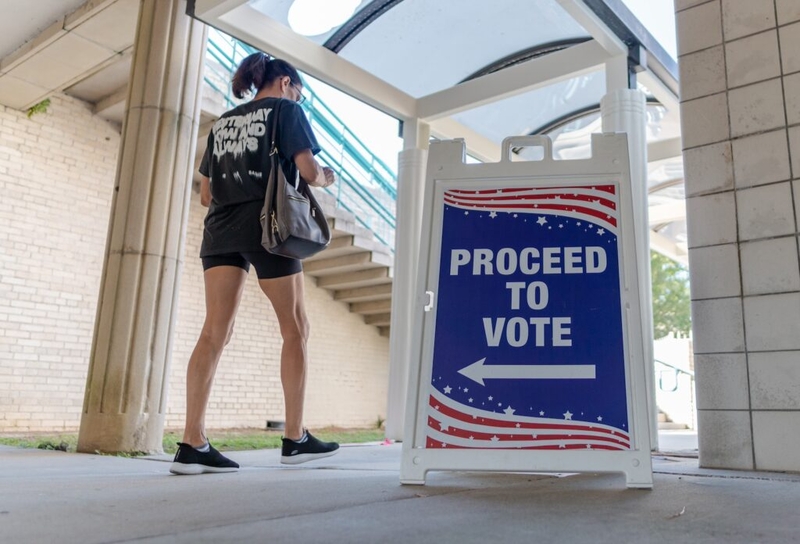
Black voter turnout was higher than normal on the first day of early voting for the Nov. 3 election in Louisiana. (Photo by Matthew Perschall/Louisiana Illuminator)
Black voters made up a larger share of participants on Louisiana’s first day of early voting than they have in almost every other election over the past 18 years, making Democrats cautiously optimistic about the U.S. Senate race.
Secretary of State data show Black voters comprised 32% of the in-person voters Tuesday, the first of seven days of in-person early voting that will take place over the next week ahead of the Nov. 3 election.
Since 2008, the only time Black voter participation on the first day of early voting has been higher was for the 2020 presidential election between Donald Trump and Joe Biden, Louisiana pollster and political analyst John Couvillon said, reaching 32.3%.
Couvillon, who typically works with Republican candidates in Louisiana, said overall participation for the first day of early voting this week was also higher than it has been for most of the past two decades.
Nearly 115,000 people went to the polls Tuesday, a first-day early voting total exceeded recently only in the 2020 (174,00) and 2024 (177,000) presidential elections.
Other states in the South already several days into their early voting period, such as Georgia and North Carolina, are seeing sustained, elevated Black voter turnout, Couvillon said. This could mean Louisiana will continue to see higher Black voter participation throughout the rest of the election, he said.
Louisiana and other Southern states are sometimes immune to Democratic waves that take place in other parts of the country, but the party does appear to be making inroads in this election cycle, according to Couvillon, who does polling for clients in several other states.
“I’m not seeing the Deep South in this partisan island like we saw in 2024,” he said.
Republican political consultant Roy Fletcher of Baton Rouge said one day of early voting data isn’t enough to determine whether Black voter participation will remain elevated.
“Give it three days, we will know,” Fletcher said Wednesday. “By Friday, I’ll be ready to opine on it.”
Black voters are the backbone of the Democratic Party in Louisiana, and high turnout from the Black community is crucial to any party victory.
Democrats have struggled to win statewide elections in recent years. Former Gov. John Bel Edwards, who won races in 2015 and 2019, is the only Democrat to win a statewide race in the past decade.
Yet Democrats said they are seeing more enthusiasm for their U.S. Senate candidate, Jamie Davis, than they have in a statewide race in several years.
Davis, a farmer and former Tensas Parish police juror, is running against Republican U.S. Rep. Julia Letlow of Baton Rouge, to replace U.S. Sen. Bill Cassidy next year. Cassidy lost to Letlow in the GOP primary election in May, and she defeated Treasurer John Fleming in the June runoff.
“This notion that Louisiana is a red state is just a notion,” U.S. Rep. Troy Carter, D-New Orleans, said in an interview Wednesday. “Jamie Davis is in play against all odds.”
LSU political scientist Robert Hogan agreed that Davis is running an unusually strong campaign for a Louisiana Democrat.
“This is an election cycle that we haven’t had in awhile,” Hogan said. “You’ve got a candidate — and this one happens to be an African American — who is quite popular among Democratic activists.”
Letlow’s campaign said they are still confident she will be the victor in the race.
“Julia is going to win because Louisiana voters want a senator who will lower costs, keep the border secure and put Louisiana first, not one who will hand Chuck Schumer control of the Senate,” her campaign said in a statement.
Corinne Williams, Davis’ campaign manager, said Democrats still have a lot of work to do in the election.
“We’re encouraged, but nobody here is counting on anything. We’re running like we’re down,” she said.
Carter, Hogan and U.S. Rep. Cleo Fields, D-Baton Rouge, also said there are other factors that could drive strong Black voter turnout. Democrats, more broadly, are fed up with Trump and upset about the U.S. Supreme Court ruling that upended the Voting Rights Act in the spring.
A Louisiana lawsuit challenging the state’s map of U.S. House districts was the catalyst for overturning decades of protections for majority-Black voting districts at all levels of government across the country. In Louisiana, the decision led to the number of majority-Black U.S. House seats dropping from two to one out of six.
The 6th Congressional District that Fields now represents has been redrawn as a majority white, Republican-leaning seat, which led Fields to decide not to run again. Carter’s 2nd District has remained majority-Black and is the only remaining Democratic-leaning seat in the state.
In an interview, Fields said he believes Black voters are motivated to go to the polls in Louisiana and other states to express their anger over the gutting of the Voting Rights Act.
“I often say to people: ‘Don’t make this make you vote less. Make this make you vote more. Now is the time you stand up,’” Fields said.
Baton Rouge, LA