Grow what you know: Nebraska’s economic opportunity
Oct 21, 2026 | 6:45 am ET
Description
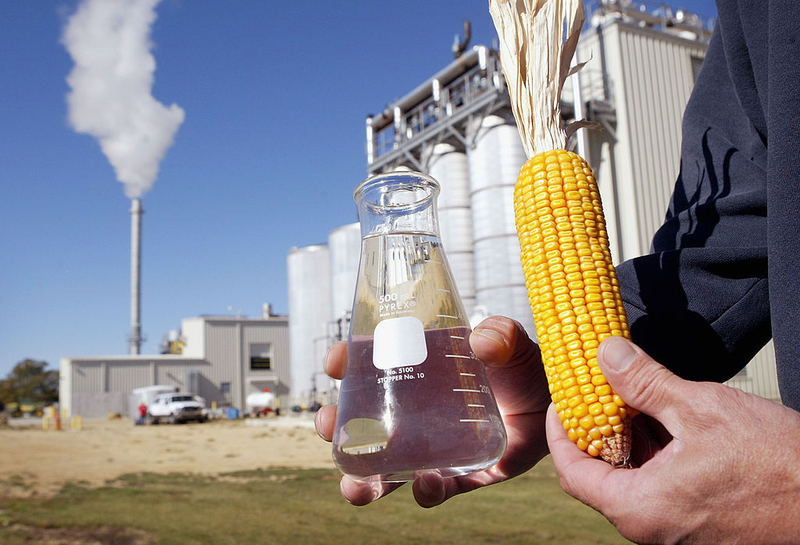
Norm Crain displays an ear of corn and a beaker of 200 proof ethanol produced at the Adkins Energy ethanol production facility October 4, 2004 near Lena, Illinois. (Photo Illustration by Scott Olson/Getty Images)
Nebraska has the ingredients to build a stronger bioeconomy. The opportunity now is to turn those assets into a focused strategy for growth.
Across Nebraska, the biosciences are already at work in human and animal health, agriculture, renewable fuels, biomanufacturing, medical technology and research. The University of Nebraska Medical Center anchors a nationally significant medical and research ecosystem. Nebraska’s corn and soybeans can become higher-value products, from biobased plastics to enzymes and Omega-3. Blair is home to major industrial biomanufacturing operations. Five of the world’s 12 largest animal health companies have facilities here.
These are Nebraska assets that offer nationally important capabilities in industries that will shape how America produces food, improves health, manufactures materials and competes globally.
The question is how Nebraska turns these strengths into more companies, investment and high-quality jobs.
Bio Nebraska, the state’s bioscience trade association, represents more than 125 companies and institutions working across this ecosystem. Earlier this year, we partnered with the Nebraska Corn Board on an assessment of Nebraska’s bioeconomy. We want to move the conversation from what Nebraska has to a more practical question: What does Nebraska need to do next to grow its bioeconomy?
The study began by asking whether Nebraska needs an industrial biomanufacturing pilot facility. Its conclusion is instructive. A new general-purpose facility is not the first move Nebraska should make. Existing national capacity is underused, and Nebraska can gain more by strengthening industry relationships, better using existing facilities and directing investment toward areas where the state has a genuine competitive advantage.
That finding points toward a larger opportunity: Nebraska needs a statewide bioscience and bioeconomy strategy.
States that have built nationally recognized bioscience sectors have been deliberate about it. They identify their strongest clusters, connect research to commercialization, develop specialized talent, attract capital and companies, and make sustained policy and infrastructure investments around areas where they can compete.
Nebraska should study those models and build one suited to our own strengths. That starts with identifying the sectors where Nebraska has the greatest potential to lead and the barriers standing in their way. It means mapping existing facilities and capabilities before building new ones; strengthening connections among universities, industry and entrepreneurs; aligning community college and university programs with workforce demand; examining incentives and access to capital; and determining where targeted public investment can unlock private growth.
Some of that infrastructure is already producing results. Nebraska’s bioscience industry employs nearly 19,000 people, with an average annual wage of roughly $90,000. Our research universities conducted nearly $435 million in bioscience-related research and development in 2023. Programs created through the Business Innovation Act have helped Nebraska startups and small businesses attract additional investment and generate revenue.
Workforce development is moving as well. Metropolitan Community College just launched a biotechnology program, while Southeast Community College’s biotechnology and Central Community College’s mechatronics programs are well-established. These efforts matter because companies need a reliable pipeline of workers, and Nebraskans need visible pathways into the high-quality careers those companies create.
The next step is to connect these pieces around a common economic strategy and protect the investments that make growth possible. That includes commercialization programs such as the Business Innovation Act, workforce development, research capacity and initiatives that expand Nebraska’s STEM talent pipeline.
Nebraska has assets that other states would like to have: agricultural resources, research institutions, global companies, manufacturing capacity, entrepreneurs and a growing skilled workforce. The opportunity is to organize around them.
Nebraska should be more competitive by being disciplined about where we have an advantage, learning from states that have successfully built bioscience economies and making sustained investments in the people, companies and infrastructure most likely to produce growth.
We know what Nebraska is good at. Now we need the strategy to grow it.
Lincoln, NE