Missouri faces growing North American trade uncertainty
Oct 21, 2026 | 6:45 am ET
Description
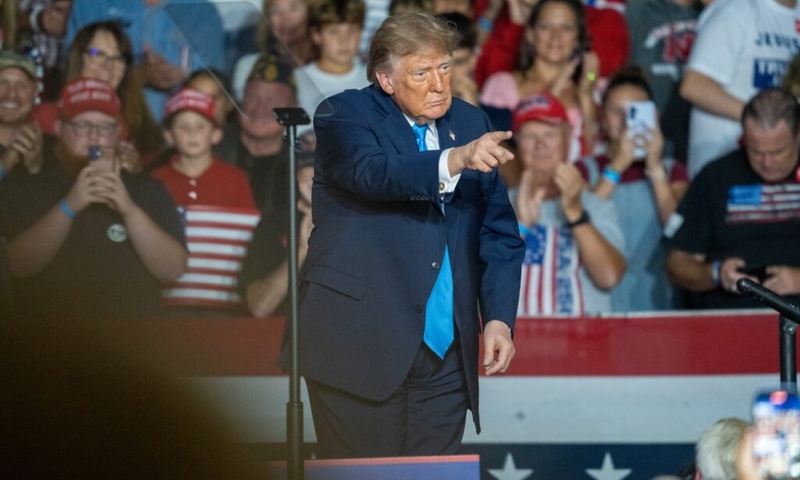
President Donald Trump points into the crowd after headlining a midterms rally in Grand Island, Nebraska, on Oct. 5, at the Nebraska State Fairgrounds, with thousands in attendance (Zach Wendling/Nebraska Examiner).
Just as hopes grew for a breakthrough in United States–Mexico trade talks, an Oct. 15 report by The Wall Street Journal, subsequently reported by Reuters, revealed another roadblock.
The two countries were reportedly close to an agreement to lower U.S. tariffs on Mexican automobiles, steel and aluminum. But disagreements within the Trump administration slowed progress. Commerce Secretary Howard Lutnick reportedly opposed significant reductions in the 25% tariff on Mexican automobiles and the 50% tariffs on steel and aluminum.
The setback follows the breakdown of similar negotiations with Canada, the United States’ other major North American trading partner. Although discussions with Mexico continue, these developments raise concerns about the future of North American trade and the stability of the United States–Mexico–Canada (USMCA) trade agreement.
For Missouri, this is more than a disagreement in Washington. Mexico is Missouri’s second-largest export market, buying billions of dollars’ worth of the state’s farm and manufactured goods each year. From the corn, soybean and rice fields of the Missouri Bootheel to automotive assembly plants in Kansas City and Wentzville, the state’s economy is deeply entwined with North American supply chains. Further deterioration in relations could have significant consequences for Missouri farmers, manufacturers, workers, and consumers.
In 2025, Missouri sold about $4.3 billion worth of goods to Mexico, according to the Missouri Economic Research and Information Center. Together, Canada and Mexico purchased approximately $10.1 billion in Missouri goods, accounting for more than half of the state’s merchandise exports.
Mexico is also Missouri’s leading agricultural export destination, with crops such as corn and soybeans playing an important role in that relationship. For Missouri farmers, the stakes include access to a major foreign market, competitive prices, and the risk that future trade restrictions or retaliation could encourage Mexican buyers to seek alternative suppliers.
Manufacturing faces a different but equally important challenge. Missouri companies export goods to Mexico while importing vehicles, electrical equipment, and manufacturing components. Because production networks often cross international borders, tariffs can increase costs for American manufacturers that depend on Mexican inputs, even when those policies are intended to protect domestic industries.
The consequences extend beyond exporters and manufacturers. Transportation companies, warehouses, equipment suppliers, and local businesses serving agricultural and industrial communities all benefit from cross-border economic activity. Trade disruptions could affect investment, hiring, and household purchasing power. Smaller businesses may be especially vulnerable because they often lack the financial resources to absorb higher costs or quickly identify alternative suppliers and markets.
The latest setback does not mean a broader trade confrontation is inevitable. Negotiations continue and their eventual outcome remains uncertain. Nevertheless, three scenarios illustrate what could be at stake.
The first is a negotiated agreement that addresses both countries’ concerns while preserving North American economic integration. Washington could secure concessions on trade, investment, or market access, while Mexico could obtain relief from some U.S. tariffs on automobiles, steel, and aluminum.
For Missouri, such an agreement could reduce uncertainty for exporters, preserve agricultural market access, and provide manufacturers with greater confidence to invest and expand. Although some trade restrictions might remain, more predictable rules would help businesses make long-term decisions.
A second scenario is prolonged uncertainty. Talks could drag on for months without a comprehensive agreement, leaving existing tariffs and unresolved disputes in place. Even without additional restrictions, uncertainty can impose economic costs. Missouri manufacturers might delay expansion or equipment purchases, while agricultural exporters could hesitate to enter long-term contracts. Such decisions could gradually affect investment, employment, and economic activity across the state.
The most disruptive scenario would involve new U.S. tariffs or restrictions, followed by Mexican retaliation against U.S. exports. If Mexico imposed tariffs on American agricultural products, Missouri farmers could face declining competitiveness and increased pressure on commodity prices.
Manufacturers importing Mexican components could experience higher costs, while exporters might encounter additional barriers. Some domestic producers could benefit from reduced foreign competition, but businesses relying on imported materials could face the opposite effect. Consumers could also pay higher prices for affected vehicles and other products.
Over time, persistent trade barriers could encourage companies to relocate production, diversify suppliers, or develop relationships with alternative markets. Once these adjustments occur, restoring previous trade relationships may prove difficult, even after negotiations succeed.
These risks are particularly significant given the deterioration in United States–Canada trade relations, which I examined in an earlier column. Canada and Mexico are not simply two separate export markets. Together, they form part of an interconnected production and distribution system developed over decades.
This standoff comes at a critical moment for USMCA. During the July 2026 joint review, the United States declined to extend the agreement in its current form for another 16 years, leaving its future subject to annual reviews. Although the agreement remains in force, uncertainty over its long-term direction adds another layer of risk for businesses that depend on stable North American trade relations.
Missouri businesses, however, need not remain passive observers. The Office of the U.S. Trade Representative has opened a public comment period ahead of the 2027 USMCA review, with submissions due January 12, 2027.
Missouri’s agricultural organizations, manufacturers, chambers of commerce, and other business representatives have an opportunity to document the consequences of trade uncertainty and communicate their priorities to federal negotiators.
For a state whose economic future is closely tied to its North American neighbors, remaining silent while the rules of trade are rewritten is a risk Missouri cannot afford to ignore.
Jefferson City, MO