Miller-Meeks, Bohannan spar on Iran war, rising costs in 1st District debate
Oct 20, 2026 | 10:34 pm ET
Description
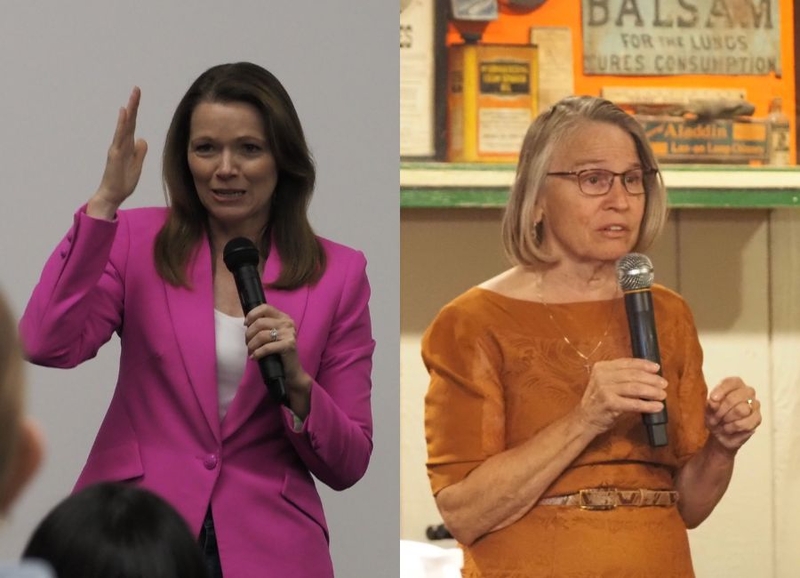
Democrat Christina Bohannan is having a rematch against U.S. Rep. Mariannette Miller-Meeks for Iowa's 1st Congressional District seat in the Nov. 5, 2024 election. (Photos by Robin Opsahl/Iowa Capital Dispatch)
Republican Mariannette Miller-Meeks and Democrat Christina Bohannan emphasized their willingness to break from party lines during the 1st Congressional District debate Tuesday — while also trading barbs on issues like rising costs and immigration.
The two candidates met for a debate hosted by KWQC and KCRG at St. Ambrose University in Davenport, the only live debate scheduled in the highly competitive U.S. House district ahead of Election Day. The seat is held by Miller-Meeks, who has served in the House since 2021 — a seat she has defended against Bohannan, a University of Iowa law professor who she defeated in the last two general elections.
Polls and political forecasters believe this year may be different — the Cook Political Report rates the race as “leans Democrat,” signaling a potential shift in the upcoming election. There has also been signals that Republicans may be viewing the district differently in the final weeks before the election, as the Congressional Leadership Fund, a Republican super PAC, withdrew funding from the race earlier in October.
Though Miller-Meeks has won in recent election cycles, the district which includes Iowa City, Davenport and Burlington has regularly seen close election results. The Republican won her 2024 election by a margin of just under 800 votes following a recount, and won her first election to the House in 2020 by a margin of six votes. In the debate, Miller-Meeks argued she was “an independent thinker, a doctor, and veteran who has put Iowans first” through her service and in Congress — and said her voting record reflects this.
As Iowans struggle with high costs of living and surging fuel prices, Miller-Meeks said she supports pausing U.S. exports of diesel as well as pausing the gas tax. She also said her vote in favor of the 2025 “One, Big Beautiful Bill” helped Iowans by lowering taxes on tips, overtime and Social Security.
“And I brought the largest steel mill in America’s history to Lee County,” Miller-Meeks said, referencing the $15 billion steel mill by Mesabi Metallics planned in southeast Iowa announced by President Donald Trump in late September. “Good paying jobs. It’s not just where prices are, it’s also having the ability to have a job and to be able to afford to pay to have a standard of living. So bringing that steel mill here, with 1,700 permanent jobs at $49 an hour, will be transformational. I’m going to continue to work. It’s not enough, we’ve got more to do. But, you know, we haven’t worked fast enough to overturn the disastrous policies and the high inflation of the last administration, but we’re gonna keep working to do just that.”
Bohannan said Miller-Meeks’ comment shows “she’s still blaming (other) people for her policy decisions.” The Democrat argued her opponent has supported measures that will raise costs for Iowa families during her time in Washington, D.C., pointing to her vote for the OBBB Act — which included cuts to Medicaid — as well as previous votes against measures to restrict Trump’s tariff policies and on war resolutions regarding the U.S. war with Iran.
“She has voted eight times for the tariffs that are driving up costs across the board, she voted five times for the Iran war that’s driving up the cost of fuel and fertilizer — including twice casting the deciding vote to prolong that war,” Bohannan said. “If she had chosen to vote a different way, either one of those times, that war would have ended months ago.”
Bohannan emphasized that the tax component on tips and overtime included in the 2025 Republican tax and spending act is set to expire in two years, but said, “the massive tax breaks that she gave to billionaires and data centers, those don’t have an expiration date.”
“Those have been her priorities while in Congress,” Bohannan said. “So it’s ironic for her to talk about trying to lower costs now. There is a lot that we can do to lower costs — end those tariffs, end the war, let Medicare negotiate for lower drug prices — but we’re not gonna do it as long as the people who are in office, who caused this problem, are still there.”
Miller-Meeks broke party lines in September to vote in favor of the Iran War Powers Resolution, a measure to require congressional approval for Trump to continue the war in Iran. She was joined by six other Republicans — including U.S. Rep. Zach Nunn, representing Iowa’s 3rd Congressional District, who also faces a challenging reelection race. The previous two times the U.S. House voted on Iran war powers resolutions, Miller-Meeks opposed the measure.
In the debate, Miller-Meeks said she had opposed war resolutions prior to September because of the time limit put in place by the 1973 War Powers Act — the measure passed in the aftermath of Vietnam to require congressional approval for continued military operations after 90 days.
“Presidents have 90 days. I gave the president that,” Miller-Meeks said. “We had a ceasefire. When the ceasefire collapsed, the Iranian regime had (been) decapitated, and their nuclear program was severely hampered, I voted to end the Iran war. … As a veteran, I can tell you that needs to be done. It’s heart wrenching to take care of veterans who have been injured in war or to attend the funerals. The president needs to bring a plan to us, and we need to bring diesel prices and gas prices down.”
Miller-Meeks also pointed to her support for Ukraine as it faces a war against Russia — though she criticized the administrations of former Democratic presidents Barack Obama and Joe Biden for the conflicts, saying Russia’s invasions into Ukrainian territory “seems to happen whenever there is a Democrat president.”
“We funded, and I voted to fund, and to assist Ukraine, as they bought weapons from the United States,” Miller-Meeks said. “… But the Biden administration … They didn’t conduct a war. Rather, they funded a war and asked us to help fund a war without any evidence of how they were gonna conduct that. They didn’t allow Ukraine to fire missiles into Russia. And so, this is a war that I think could have ended much earlier with much less loss of life, much less refugee status, and it’s unfortunate that there was not a plan by the Biden administration for how to conduct this and what was expected of the Ukrainians to be able to protect themselves and their sovereignty.”
Bohannan said she also supported Ukraine — but said blaming Democrats, who are out of power, does not address the current U.S. lack of support for the country, or explain actions like Trump’s move to allow import of Russian diesel.
“Look, we should be supporting Ukraine in this war,” Bohannan said. “This was unprovoked aggression by Russia, and … I agree, President Biden did not do enough to end this war earlier. But by the same token, President Trump is not doing enough. And, in fact, now, he is just completely surrendered to Vladimir Putin on these economic sanctions. That makes America look desperate and weak throughout the world, and it is not going to do anything to bring down fuel prices — because we all know that the problem with fuel prices is the war in Iran, which has closed the Strait of Hormuz.”
Bohannan also highlighted her willingness to oppose the Biden administration as proof that she would not be beholden to the Democratic Party if elected. Bohannan said she believed “President Biden was way too slow to secure the border,” and brought up her decision to call for Biden to withdraw from the 2024 presidential election after his “disastrous debate,” she said.
“We are way too divided among parties, and I think we need an independent voice who will stand up to her own party, not be a rubber stamp, and who will work across the aisle,” Bohannan said.
But Miller-Meeks argued her opponent was “extreme” and did not support law enforcement or immigration enforcement policies — a claim Bohannan denied. The Republican also said her track record in Congress shows she will work across the aisle to advance Iowans’ interests.
“When I break with my party, I have voted to cap insulin at $35. I voted to end the Iran war. I voted to protect women,” Miller-Meeks said. “Mainstream policies. When you vote and break with your party, you don’t vote with the Republicans … you vote with the far-left extreme. I’m mainstream, you’re extreme.”
Both candidates agreed that U.S. Sen. Chuck Grassley was an inspirational figure for them in Iowa politics, and both affirmed they will accept the results of the Nov. 3 election.
The major-party candidates in three of Iowa’s four congressional districts have participated in at least one televised debate. The 2nd District candidates have debated twice, including an “Iowa Press” debate Oct. 8. The 4th District candidates debated Oct. 14. The 3rd District candidates are scheduled to debate Oct. 27.
Des Moines, IA