Alaska voters’ privacy could be at risk from state’s handling of voter rolls, judge says
Oct 20, 2026 | 8:55 pm ET
Description
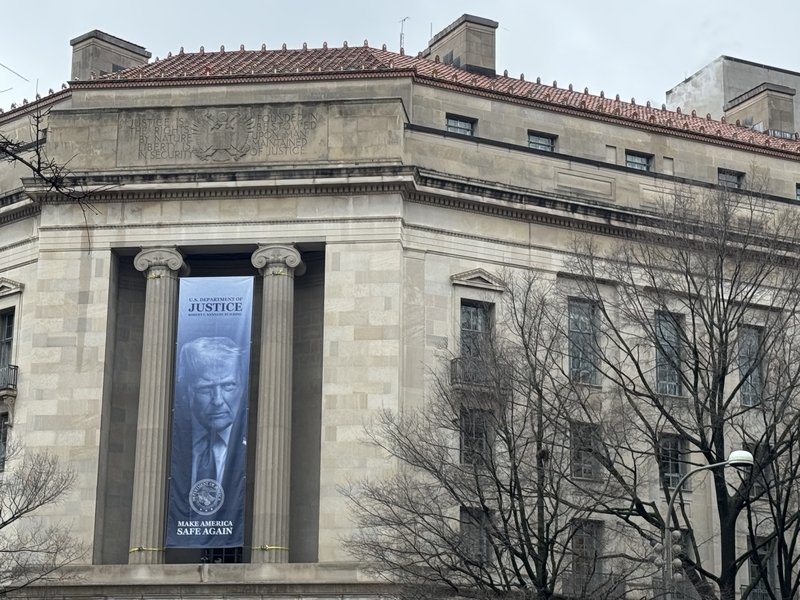
A banner showing President Donald Trump hangs on the Department of Justice on Feb. 20, 2026. (Photo by Shauneen Miranda/States Newsroom)
An Alaska Superior Court judge said last week that the Alaska Division of Elections may have violated the Alaska Constitution’s right to privacy when it handed an uncensored version of the state’s voter list to the U.S. Department of Justice last year.
On Friday, Judge Adolf Zeman turned down the division’s request to dismiss a lawsuit filed this spring by the League of Women Voters, Alaska Black Caucus and the Alaska chapter of the American Civil Liberties Union.
The three groups are arguing that the Division of Elections and Lt. Gov. Nancy Dahlstrom violated the state constitution when they provided an unredacted state voter list — including driver’s license numbers, home addresses and partial Social Security Numbers — at the request of the U.S. Department of Justice.
As part of the handover, the division’s director, Carol Beecher, signed a memo stating that the division will remove voters from the list within 45 days if the DOJ determined they were ineligible to vote. The memo also says the DOJ may share the data with a private contractor and store it out of DOJ control.
Writing last week, Zeman said that the Alaska Division of Elections failed to negotiate restrictions on the DOJ’s influence over Alaska’s voter list.
“Instead, the state has given DOJ carte blanche to submit whenever it pleases, a list of whosoever names it decides, for whatever reason DOJ determines, for any number of eligible voters,” he wrote.
He said that while the state may point to a clause in the memo that says any removal request must be legal, “the court remains unconvinced that such a clause on its own can shield this matter from judicial consideration.”
The plaintiffs had argued that the Department of Justice is creating an unauthorized national voter database and intends to conduct criminal and immigration investigations not otherwise permitted by law.
The state disputed that claim, and attorneys representing the state argued in September that the three plaintiffs lacked the standing to bring a case, that the case wasn’t ripe because the DOJ hasn’t yet requested the removal of any Alaska voters and that sharing the information would not cause “embarrassment, anxiety, humiliation, harassment, or economic and physical reprisals” among Alaskans.
Zeman wrote that the state may claim that plaintiffs are wrong about the potential abuse of Alaskans’ data, “however, on a motion to dismiss, this court is obligated to accept plaintiffs’ claims as true. Therefore, the court finds that the privacy claims survive dismissal.”
He went on to conclude that “given the fundamental nature of the rights at stake, the seriousness of the allegations and the existence of similar litigation in other states, this court shall allow this case to proceed to discovery and fact-finding that will determine whether plaintiffs’ claims have merit.”
Juneau