Maryland to open new waterfront park overlooking the Bay Bridge
Oct 20, 2026 | 8:45 pm ET
Description
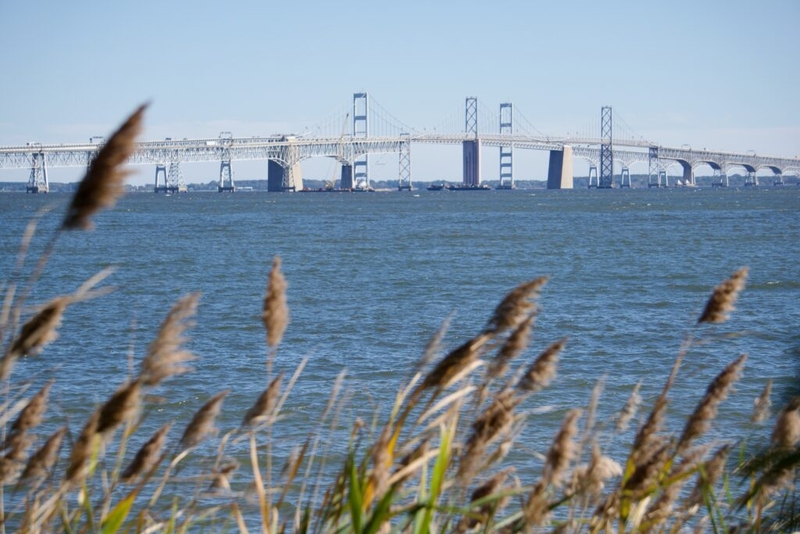
A view Tuesday of the Chesapeake Bay Bridge from the soon-to-open Holly Beach Farm Natural Resources Management Area. (Photo by Christine Condon/Maryland Matters)
Maryland will start accepting online reservations Nov. 6 for a new park overlooking the Chesapeake Bay, less than 10 miles from downtown Annapolis and a stone’s throw from Sandy Point State Park.
The sprawling, 293-acre property, known as Holly Beach Farm, boasts wooded hiking trails, small bayfront beaches, farm fields and a 9-acre freshwater pond — along with scenic views of cars and trucks humming along the Chesapeake Bay Bridge, and sailboats and ships passing beneath it.
For now, the state plans to allow about 20 individuals per day to access the site by reservation only, for activities including hiking and birding, said Paul Peditto, an assistant secretary at the Maryland Department of Natural Resources.
The agency will manage Holly Beach as a natural resources management area, a wilder alternative to state parks, which tend to feature more amenities, larger parking areas and more manicured trails.
But the property, donated to the state by the Chesapeake Bay Foundation in 2023, still needs lots of work. Agency officials say they’ve set aside $3 million for repairs and enhancements.
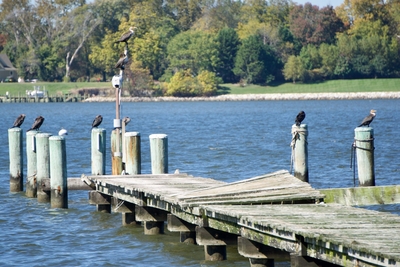
That to-do list includes a lengthened 450-foot fishing pier, with a new 6-foot berth to accommodate larger vessels. The vision, officials say, is to one day attract ferries hosting Annapolis tourists, Sandy Point visitors or groups of local schoolchildren on field trips. But the department is also looking to open the property to a broader swath of boaters, said Maryland Secretary of Natural Resources Josh Kurtz.
“We’re really looking forward to welcoming boaters to come over and anchor and enjoy these little bits of magic right outside of downtown Annapolis,” Kurtz said.
Holly Beach is the sixth new public land the Maryland Park Service has opened or dedicated this year, including Savage Highlands State Park in Garrett County and Freedman’s State Park in Montgomery County.
“This is the sixth and final celebration that the Maryland Park Service will host this year. That is truly a phenomenal accomplishment, and I could not be prouder of my team,” said Maryland Park Service Director Angela Crenshaw.
The idea of turning Holly Beach Farm into a park was met with trepidation from the neighbors who live along the single-lane winding road leading to the new natural resources management area, said Anne Arundel County Executive Steuart Pittman (D). In 2021, Pittman publicly backed a bid by the National Park Trust to obtain the land and open it to public use.
“There was a lot of concern that what the trust was talking about doing, or what the National Park Service might do, would be really turning it into what you think of as a national park, with a highway with a lot of cars coming in and out, and a lot of pavement — and destroy the natural area,” Pittman said.
Maryland officials hope that a lower-key natural resources management area — with limited public access to start — will strike the right balance.
Future plans include the addition of five hunting blinds along the water’s edge, and completion of a host of projects to stabilize several of the park’s eroding shorelines, which have been battered by the windswept waters of the Chesapeake Bay.
Meanwhile, a small in-house construction crew has already been hard at work restoring a waterfront farmhouse on the property that faces that 4.3-mile bridge connecting Annapolis and Kent Island. The hope is to transform the two-story home, which fell into disrepair after it was vacated in 2001, into a rentable meeting space for local organizations.
But when the crew first entered the home, they weren’t sure it was salvageable, said Maynard Woodworth, an engineer and architect who leads the agency’s construction team. Abandoned to the elements, the home had become infested by racoons, and it featured sodden carpets, termite-infested wood, rotting floorboards and a weather-beaten and partially collapsing exterior.
“It took a while, but we feel great that we fixed it up and saved it,” Woodworth said.
Still, the home needs new siding, along with electrical, HVAC and plumbing work. It also needs fresh drywall, painting and other interior improvements. Thus far, the state has spent about $150,000 restoring the house.
When it came to deciding whether to demolish or refurbish the dilapidated house, it was a “toss-up” for DNR officials, Peditto said during a showcase event Tuesday at Holly Beach Farm. But the agency ultimately decided to move forward with the renovation effort, given that erecting an entirely new structure would be more costly.
Holly Beach Farm traces its origins back to 1907, when Sylvester W. Labrot Sr., a businessman from Louisiana began acquiring tracts of land along the Chesapeake in Anne Arundel County.
Initially, the property operated as a dairy farm, but by 1930, it was regarded as one of the largest thoroughbred horse breeding and training operations in the United States, complete with housing for nearly 100 horses and a private one-mile training track.
Upon his death in 1935, Labrot passed the property down to his son William Henderson Labrot, who would negotiate the sale of 725 nearby acres of his family’s land to the state, which became Sandy Point State Park.
And in 2001, Leonie Labrot Gately sold the 326-acre heart of the family’s estate to the Conservation Fund. It would be transferred to the Chesapeake Bay Foundation the next year.
Hilary Harp Falk, who became president and CEO of the foundation in 2022, arrived with “fresh eyes,” she said Tuesday. After a year of careful study, she and the foundation’s board of trustees decided to begin a search for a new steward for the property.
“It was time to allow the property to become something more than CBF had been able to do,” Harp Falk said.
The foundation, which maintains a headquarters in nearby Bay Ridge, had mainly been using the property to host school groups for outdoor education programming. But the foundation recognized the property had more potential for expanded public access, Harp Falk said.
“That is not something that the Chesapeake Bay Foundation has a lot of experience doing. So we’re really excited about that potential,” she said. “Also, it needs a lot of restoration. There are invasive species out here. There is coastal erosion. Those things need attention, and the Maryland Department of Natural Resources is really best-positioned to take those challenges on.”
Annapolis, MD