Supreme Court takes Montgomery County magnet school admission policy case
Oct 19, 2026 | 7:41 pm ET
Description
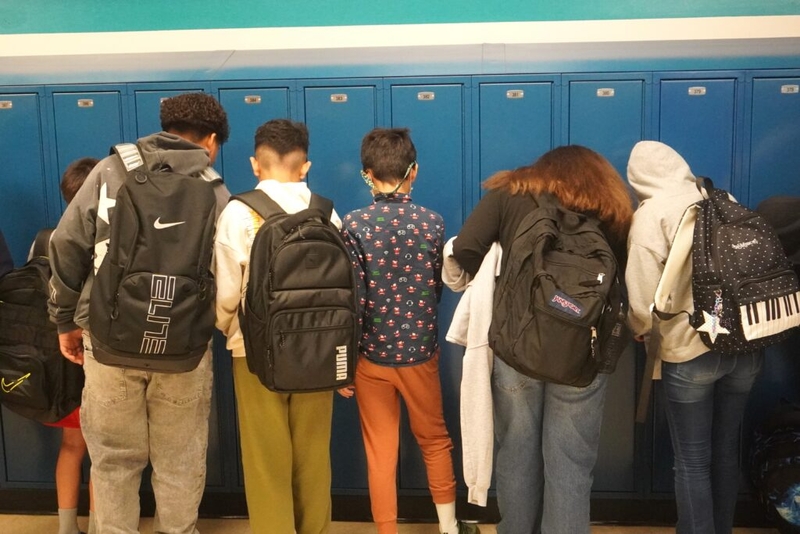
Students at their lockers on Aug. 28 at Montgomery County's Argyle Middle School. Argyle is not one of the magnet middle schools included in a case the U.S. Supreme Court said it will hear. (Photo by William J. Ford/Maryland Matters)
The U.S. Supreme Court agreed Monday to hear a challenge from a group of Montgomery County parents who claim that the county’s lottery system for admission to middle school magnet programs decreases the number of Asian American students in the programs.
The case has been dismissed by lower courts, that said the parents had not proved that the policy “disparately impacts Asian American students” or that it was created with discriminatory intent.
But in agreeing Monday to hear the case, the high court said it would consider whether the parents “challenging a facially neutral admissions policy as racially discriminatory must establish that the targeted racial group suffered an aggregate disparate impact relative to its share of the applicant pool” for their case to proceed.
The case was filed by the Association for Education Fairness challenges the lottery system used for admissions at four county middle schools that offer magnet programs focused on the humanities and STEM – science, technology, engineering and math. A student’s grades and test scores are another component of selection.
The association, which is mostly comprised of Asian Americans parents, filed suit in 2020 concerning the policy that took effect in the 2021-22 school year.
“If you institute a policy intended to increase the enrollment of some groups at the expense of others, you’re discriminating against the group that you are doing it at the expense of,” said Chris Kieser, a senior attorney at Pacific Legal Foundation, which is representing the association.
“You’re using, in this case, geography as a proxy … to get the racial results that you want, and that’s exactly what the Supreme Court said that you can’t do in students for fair admissions,” Kieser said in an interview Monday.
Keiser said there are four magnet middle schools affected: Takoma Park and Eastern are considered in the downcounty area; and Roberto Clemente and Martin Luther King Jr. in the upcounty area.
Montgomery County schools, parents reach settlement in suit over LGBTQ+ books in classes
Liliana López, a spokesperson for Montgomery public schools, said in an email Monday afternoon the court is strictly addressing a “purely legal question and decide what plaintiffs who challenge race-neutral admissions criteria on their face must establish to demonstrate discrimination.”
“Montgomery County Public Schools (MCPS) remains committed to providing equitable access to rigorous opportunities for all students. This commitment will continue uninterrupted as the judicial process proceeds,” her statement said.
But a number of outside groups, such as The Buckeye Institute, based in Columbus, Ohio, and Mountain States Legal Foundation in Lakewood, Colorado, filed legal briefs supporting the association and opposing the county’s policy.
“No State shall … deny any person within its jurisdiction the equal protection of the laws. Students must be treated based on [their] experiences as an individual — not on the basis of race,” they wrote in their brief.
‘Reforms opened doors’
Several other organizations filed briefs in support of the school’s policy, which they said expanded access to the program to previously underserved groups.
In 2018, for example, there were fewer that 10 Black and Latino students in magnet programs at the upcounty schools, Clemente Middle and MLK Jr. Middle. In the first year of the lottery, Black and Latino students accounted for 33% of admissions to MLK Jr. and 41% of magnet program students at Clemente.
Numbers similarly rose in the downcounty schools, where Black and Latino students made up 23% of Takoma Park Middle and 31% of Eastern Middle magnet admissions. By 2021, those numbers had risen to 37% and 40%, respectively.
Four groups – the Montgomery County Branch of the NAACP, Montgomery County Progressive Asian American Network (MoCoPAAN), We Are CASA, and AALEAD (Asian American Youth Leadership Empowerment and Development) released a joint statement on the case Monday.
“These reforms have opened doors for students who too often have been left out of opportunities designed to help them thrive,” the groups said. “A child’s future should not be determined by the poverty level at the school they happen to attend, their family’s knowledge of the admissions process, or how much or little access they have to resources that help them prepare for the future.”
The county’s school board was successful in getting the case dimissed by U.S. District Court Judge Paula Xinis in July 2022, a ruling that was upheld in February by a three-judge panel of the 4th U.S. Circuit Court of Appeals.
But in its reply last month to the county’s filing urging the Supreme Court to reject the case, the association argued that Montgomery County’s policy violates the Equal Protection Clause of the Constitution. They also claim that there is a split between circuit courts on the issue that the Supreme Court must step in to resolve.
“Whether intentional racial discrimination receives strict scrutiny should not depend on the circuit in which it occurs. Only this Court can resolve the conflict once and for all,” the association’s lawyers wrote.
The Pacific Legal Foundation defended plaintiffs in a similar magnet-school admissions case the Supreme Court declined to hear in February 2024. The plaintiffs in that case claimed a policy by the Fairfax County, Virginia, school board would reduce the number of Asian American students attending Thomas Jefferson High School, one of the nation’s top-ranked high schools.
Two of the conservatives on the court, Justices Clarence Thomas and Samuel Alito, said in a joint dissenting opinion that the Fairfax case should have been heard.
“The Court’s willingness to swallow the aberrant decision below is hard to understand. We should wipe the decision off the books, and because the Court refuses to do so, I must respectfully dissent,” Alito wrote.
The Montgomery County middle school case is the second case from Montgomery schools the court has taken up in two years. In June 2025, the court ruled 6-3 in Mahmoud v. Taylor that parents should be allowed to opt their children out of classes that teach LGBTQ+-themed books in classrooms.
No hearing date has been set for the latest case, Association for Educational Fairness v. Montgomery County Board of Education.
Annapolis, MD