Center for Intellectual Freedom head accuses officials of unlawful obstruction
Oct 19, 2026 | 7:38 pm ET
Description
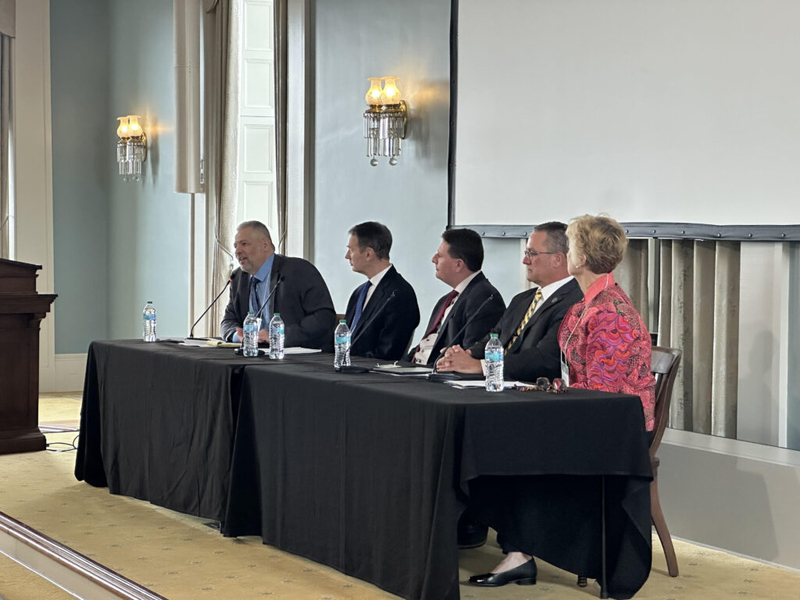
Panelists speaking Dec. 6, 2025, at the Center for Intellectual Freedom at the University of Iowa, from left, are center Interim Director Luciano de Castro, U.S. Assistant Secretary for Postsecondary Education David Barker, state Rep. Taylor Collins, state Sen. Kerry Gruenhagen and Regent Christine Hensley. De Castro in his annual report to the General Assembly outlined actions by board and university officials that he believes undermined the center's efforts. (Photo by Brooklyn Draisey/Iowa Capital Dispatch)
The interim director of the Center for Intellectual Freedom at the University of Iowa alleged in a report to lawmakers that university and Iowa Board of Regents officials broke the law in attempts to obstruct the center’s development.
The 409-page report details more than a year of tug-of-war between center staff and advisors and the Iowa Board of Regents and university for control of its operations and offerings.
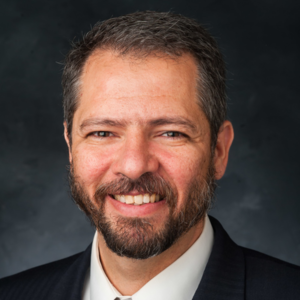
Luciano de Castro, the center’s interim director, made numerous allegations in the center’s first Legislature-required annual report, submitted Oct 12 to the governor, General Assembly and Board of Regents. De Castro had been a candidate for the permanent director but said in the report he would no longer want the job permanently even if he was still being considered for it.
In the report, he states the center is on the path to becoming a “lost opportunity” for true reform, with its opponents stymying its independence in day-to-day operations and exerting a level of control he believed wasn’t lawful.
“University of Iowa administrators have used their influence over the Board of Regents to hinder the Center’s operations at nearly every stage of its development,” de Castro wrote as his central finding in the report.
Established in a law signed by Iowa Gov. Kim Reynolds in June 2025, the center has put on discussions and guest speaker events throughout the previous and this academic year, offered two courses this past spring, introduced an organizational plan and is about to select a new permanent director.
It has also recently lost nearly half of its advisory council membership, and all activities beyond the guest speaker series and director search have been paused as the 2028 requirement to offer general education courses creeps closer. A three-person board of regents committee led by Regent Christine Hensley now oversees the center, with Hensley having approval authority over travel and certain expense decisions.
De Castro in the report called House File 2800, which sets the civic education requirements, the center’s “greatest opportunity,” but one he believes won’t be realized since “the required courses will be shaped by a director operating under close control by a Board that has consistently followed the University administration’s preferences.”
Hensley, in a statement sent via email by Iowa Board of Regents Senior Communications Director Josh Lehman, said the board has received the report and is reviewing it. The University of Iowa when asked for comment directed inquiries to the board of regents.
The board will meet Oct. 20 to interview three center director finalists and select a new director, with one finalist having dropped out for personal reasons, Lehman said in the email. De Castro himself applied for the director position, but the advisory council’s executive committee didn’t move his application ahead, he stated in the report. His tenure as interim director will end Oct. 22, according to a letter from the board.
“The Board of Regents wants the Center to be successful, and we will be interviewing finalists tomorrow for the director’s position,” Hensley said in her statement Monday. “We will continue to provide support to the Center to help meet its goals of providing scholarship on the intellectual foundation of free societies, as well as the principles, ideals and institutions of the American constitutional order, and the foundations of responsible leadership and informed citizenship.”
De Castro alleges unlawful actions
Multiple actions taken by the board of regents office “in coordination with University administrators” were described by de Castro in the report as “illegal, or at least contrary to the spirit of the law that created the Center.” Those include delaying hiring, campus invites and report releases, adding director search requirements and a timeline and interfering with the center’s efforts to be an independent academic entity.
De Castro said in the report many of these details have already been shared with state officials during a meeting in April.
Board Executive Director Mark Braun tried to have de Castro postpone a visit by now-former advisory council member Richard Lowery in fall 2025 to the point where de Castro paid for the visit with his own money, according to the report. This led de Castro to believe that UI Executive Vice President and Provost Kevin Kregel, who contacted Braun about the visit, was “attempting to undermine the center” since other expenses were approved without issue.
House File 437, which establishes the center, states the director “shall have the authority to invite guest speakers to the university on behalf of the center.”
The law also states that the director “shall have the sole and exclusive authority to manage the recruitment and hiring process,” but de Castro said in the report he was barred by Braun and through Kregel from hiring temporary faculty in October 2025, which led to restrictions on how courses could be developed since the center had no instructors and de Castro was beholden to his faculty responsibilities in the university’s business college.
Establishment of bylaws was left in the law to the center with required approval from the board, a process which took place in October and November 2025. De Castro said in the report he wrangled with board staff over inclusion of certain provisions.
De Castro wrote that he didn’t want a provision granting authority for approval of expenditures to the executive director of the board of regents. While it didn’t end up in the bylaws, he said in the report nothing was added giving that authority to the center director instead and Braun still handled expense approvals.
Other actions de Castro listed as potentially violating the law include the board of regents setting finalist requirements and a search timeline for the center director selection. He also objected to the center’s advisory council debating director applicants in closed session. No votes were taken on finalists in open session, he said in the report, and while de Castro made no requests to have his application discussed in closed session, the comparison between him and other candidates did not take place in an open meeting.
The center, through the law, was to be established at the UI as an “independent academic center,” which de Castro said in the report Kregel pushed back against. The report included a March 17 email from Kregel to center Administrative Services Manager Collin Sawyer about exploring the process for the center to become authorized to offer courses independently. Kregel said in the email because the center is a board of regents entity, “it cannot function as an academic unit within the University of Iowa” and recommended working with Braun on course offerings.
“The Provost’s email therefore effectively denies the Center the ability to fulfill its lawful obligation,” the report stated.
Proposal to reorganize
In April 2026, de Castro reported he submitted a proposal for reorganization to board of regents members that would put the center “on par with the University College and University Libraries,” with memorandums of understanding to let the center offer its own courses instead of ones temporarily through the University College or under the university’s control and to have the center receive administrative services.
“The proposal was not taken up; the framework later adopted by the Board was developed by the Board Office and the University without the Center’s participation,” de Castro wrote.
He said in the report that Hensley told him in August that Braun had sent out a draft plan for reorganizing the center, but de Castro wouldn’t get to see it until it she finalized it with Cramer, Regent Steve Lacy and Braun.
There were many instances where de Castro said he was left out of conversations about the center he felt he should be included in because of his position, including pay changes for staff, updates on questions he had for the university and board and center framework planning.
Despite sending messages to Hensley and Board President Robert Cramer about Braun leaving de Castro out of emails and discussions about things he had a direct hand in, de Castro said in the report things didn’t change.
The organizational plan, which received board approval at its September meeting, places Hensley, the board Center for Intellectual Freedom committee chair, in “an executive role” for the center through her required approval of expenditures and director travel, a position de Castro questioned in the report given her governing role on the board of regents.
“In particular, rather than vesting expenditure and travel approval in the Chair of the CIF Committee, the Center should be permitted to hire its own personnel to review its expenditures, an arrangement equivalent, in function, to the chief financial officer of a university,” the report stated.
Recommendations
De Castro offered recommendations in the report for the center to reach “true reform” despite the obstacles and challenges it has faced, including suspending the permanent director search and picking a different interim director. He proposed having the General Assembly decide the center’s future and develop an independent academic council of academics who “have no stake in the administration of Iowa’s public universities” to advise the board of regents.
He also included information on his approach to the director role, mistakes he made during his tenure and lessons he learned. De Castro described the center’s status as “a defeat,” as the legislation seems to not matter much when “the university bureaucracy retains effective control over every decision.”
“The experience of the past year does not show that such centers are unnecessary or that they cannot succeed. It shows that they require far more resolve than was anticipated, from the legislators, regents, and civic patrons who support them, to persist in the face of opposition from university administrators and faculty,” de Castro wrote. “Where that resolve exists, as other states have shown, such centers can flourish. Where it does not, they become a pretense. The choice now before Iowa’s leaders is which of these the Center for Intellectual Freedom will be.”
Des Moines, IA