Disease outbreak leads officials to curtail some deer hunting in southern North Dakota
Oct 19, 2026 | 3:03 pm ET
Description
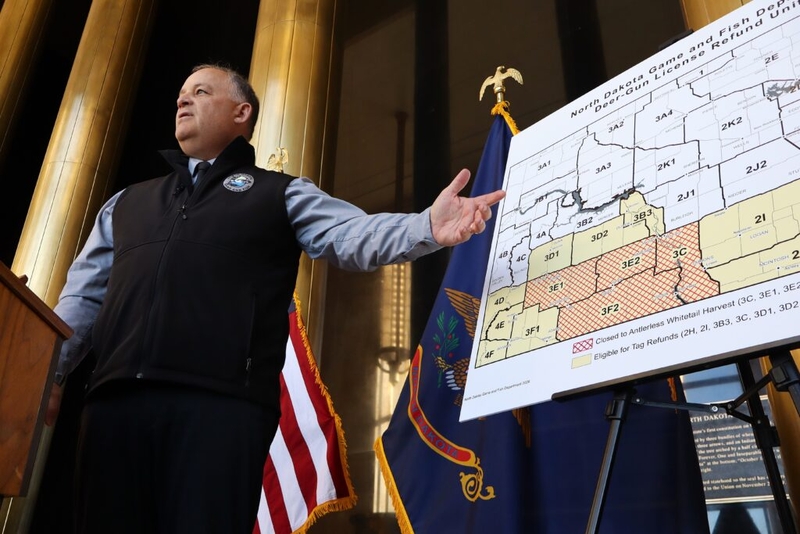
North Dakota Game and Fish Department Director Jeb Williams gestures during a press conference on Oct. 19, 2026.
(Photo by Jack Dura/North Dakota Monitor)
Gov. Kelly Armstrong on Monday announced the state is shutting down white-tailed doe hunting this fall in parts of southern North Dakota due to an ongoing disease outbreak, weeks before the state’s popular deer gun season opens.
Armstrong said the “conservative harvest strategy” is meant to help the deer population bounce back from epizootic hemorrhagic disease, or EHD, which has hit white-tails particularly hard in recent years.
As a result, about 350 previously issued licenses for antlerless white-tailed deer in Units 3C, 3E1, 3E2 and 3F2 are no longer valid. Those hunters will be refunded their $35 license fee and deer lottery bonus points, Armstrong said.
“This is about the most targeted overreaction we could come up with, and I mean that seriously,” the governor told reporters at a Capitol press conference, joined by state Game and Fish Department Director Jeb Williams.
The four units span an area from Interstate 94 to the South Dakota border, from roughly Belfield to Linton. The prohibition affects youth, muzzleloader, deer gun, deer bow and gratis licenses. Some of those tags are statewide, so those hunters are able to go to other places.
“You don’t need nearly as many white-tail bucks as you do does in order to make sure that you have good fawning next year, so we’re trying to protect the long-term viability, and this is the best of the worst-case options we have available to us,” Armstrong said.
Hunters with tags for white-tail bucks in the four units are still able to go out and hunt for those deer.
Other hunters with white-tail licenses in those four units and nine surrounding ones have the option to turn in their tags before the Nov. 6 opener for a refund and restored points, he said. A hunter’s points go toward improving their chances in the annual deer license lottery.
Deer numbers were already low to start the year, now hit with the EHD outbreak, Williams said. EHD was first detected in North Dakota in the early 1960s. The last major outbreak was in 2021.
EHD is a fast-acting viral disease transmitted to deer by tiny insects called midges, Williams said. Hemorrhaging and an extreme fever precede death in as little as 36 hours, he said.
Since early August, Game and Fish has taken about 170 reports of dead deer from landowners and hunters across the affected area, with around 400 dead deer, William said. There are more deaths across the landscape that go unreported, he added. Armstrong said his family has found 21 dead deer on their farm south of Richardton.
Williams said, “We think that this is a pretty reasonable approach to try to preserve some of the numbers that we have in those particular areas.”
Temperatures in the low to mid-20s Fahrenheit for multiple consecutive days reduce the insect activity, Williams said. But the affected area hasn’t had a hard freeze, and none is in the forecast for the next week, Armstrong said.
“Something really drastically terrible” would have to happen before officials would expand the prohibited area, Armstrong said.
“If we start changing the map three days before the season, that’s patently unfair to anybody who’s taking their kid out or going out with their buddies to do this,” the governor said.
Game and Fish allocated 39,100 deer licenses earlier this year, the fewest in more than 50 years, as deer try to recover from disease, weather and habitat impacts, the department said.
North Dakota’s deer gun season is from Nov. 6-22.
Neighboring South Dakota has taken similar steps, such as removing licenses in outbreak areas, limiting archery and muzzleloader licenses to bucks only and allowing hunters in the Missouri River corridor to return their licenses for a refund.
Reach North Dakota Monitor reporter Jack Dura at [email protected].
Bismarck, ND