Myth busting, values voting, Maine messaging
Oct 19, 2026 | 6:45 am ET
Description
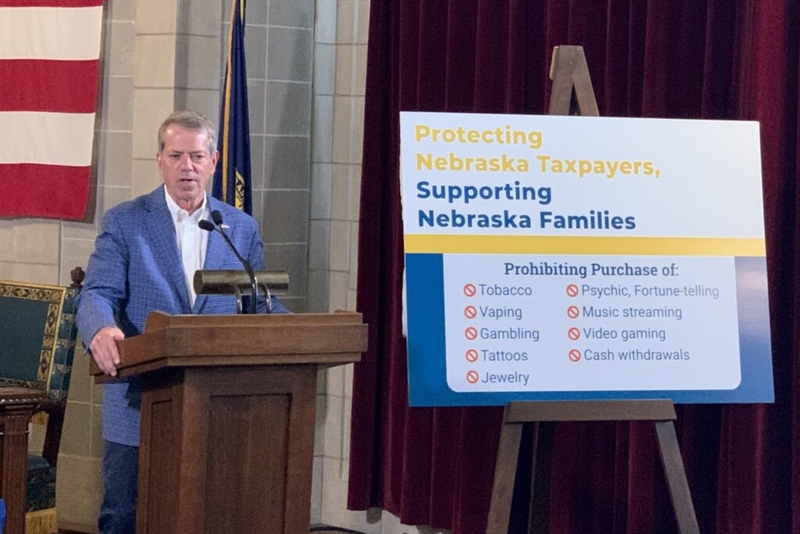
Nebraska Gov. Jim Pillen leads a news conference announcing he will seek changes to how Nebraska oversees the federal Temporary Assistance for Needy Families program for low-income families on Friday, Oct. 9, 2026, in the Nebraska State Capitol. (Photo courtesy of Gov. Jim Pillen's office)
Three thoughts …
Whether Nebraska wants to be like Florida is an open question. I’m a hard pass, but when the feds OK’d a plan to put the kibosh on certain kinds of spending for Nebraskans receiving Temporary Assistance for Needy Families’ Aid to Dependent Children funds, we became the second state they approved. Florida was the first.
The over 2,800 Nebraska households that get the $4,700 monthly TANF benefit — numbers courtesy of DHHS — will now be unable to spend any of it on items such as porn, pot or the ponies. Of course, nobody offered any evidence that they already did.
Those getting the monthly TANF stipend now have a longer list of no-nos including smoking products, intoxicants, entertainment, tattoos or piercings, spa treatments, psychics, anything to do with gambling including lottery tickets, video games, pornography, jewelry or, my favorite, political contributions.
The rationale makes some sense. SNAP beneficiaries already have limits on what they can purchase, although a recent court ruling in Nebraska allowed them to continue to buy candy, soft drinks and energy drinks with SNAP funds.
The underlying argument the government has been making the last couple of years is that we are awash in “waste, fraud and abuse” of public funds. Indeed, the misadventure we know as DOGE (Department of Government Efficiency) promised taxpayer savings of $2 trillion but delivered only about $175 billion, a number some believe is even overinflated. On the way, DOGE did away with USAID, reducing the nation’s standing in the world, and fired 284,000 federal employees.
Still “waste, fraud and abuse” remains a rallying cry for the administration and its supporters, some of whom have offices in the Capitol but live in Nebraska ZIP codes. While no one wants tax dollars wasted, obtained fraudulently or abused by recipients, according to economists from the American Enterprise Institute to the feds’ own Government Accounting Office, most of the money lost is not through individual fraud but rather through clerical or administrative errors. For example, according to the U.S. Department of Agriculture, the fraud rate for SNAP is less than 1.5% and its overall payment rate error is less than 7%.
Keeping such numbers in perspective belies this myth: That low-income Americans, 70% of whom work full-time jobs — some for companies worth billions — yet still need help feeding their families, are somehow the problem in the “waste, fraud and abuse” calculus.
***
We don’t hear much about values voters anymore, although my guess is they still are out there, voting their values. A Values Voter Summit used to be held each fall, the last of which was hosted by the Family Research Council in 2020. I never understood the concept. Don’t we all vote our values? Even if a candidate gets my vote because I like his hair or she wears my favorite color, my vote indicates what I value, however shallow.
I thought about values voting as I tried to wrap my mind around another school shooting, this one in Bend, Oregon, during the same week that a plan to livestream the firing-squad execution of a mass murderer was nixed.
Four people were murdered in the Bend shooting, three students and a teacher. Two others were wounded. The 16-year-old identified as the shooter was killed by a bystander.
Much has been written about what has become our apparent indifference toward gun violence and school shootings. The evidence of such insouciance? No real progress has been made toward any solutions, and gun violence remains the leading cause of death for children in America.
And while I’m pleased that the secretary of defense’s plan to turn an execution into a public spectacle was canceled, the thinking behind it remains part of our cultural bloodstream.
All of which makes a voter wonder just what it is we do value?
***
Nebraskans and Mainers share at least one political characteristic in that we both decide our Electoral College votes by congressional district rather than winner-take-all. Perhaps we’ve found another.
A recent debate in the Pine Tree State between GOP incumbent Sen. Susan Collins and her opponent, Democrat Troy Jackson, was held before a live audience at Husson University in Bangor. Near the end of the occasionally testy debate, an audience member started shouting at Collins about data centers ruining their state.
Collins quickly tried to portray the heckler as a Jackson supporter, a charge to which Jackson replied, “Oh, just shut up!”
For those of us in the Cornhusker State (and surely the other 49) weary of a parade of incessant and mostly insipid political ads airing on television, arriving in our inboxes, appearing on our caller IDs and showing up in our text messages, we couldn’t have said it better ourselves.
Lincoln, NE