A bluer NC could be in the offing
Oct 20, 2026 | 6:00 am ET
Description
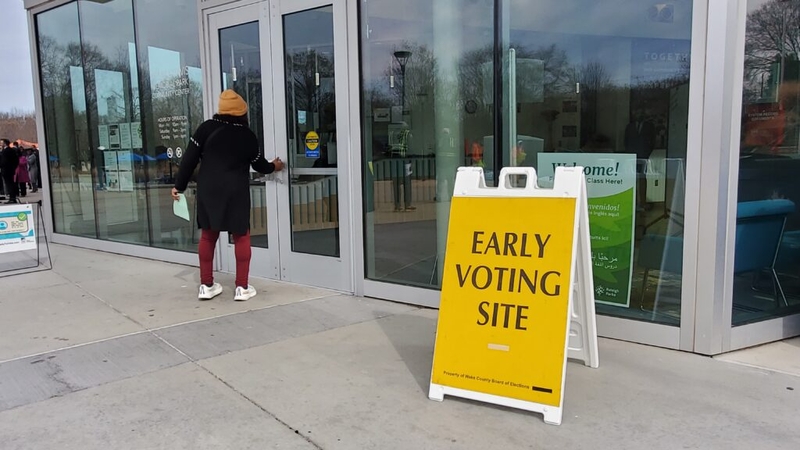
Early in-person voting runs Oct. 15-31, 2026 in North Carolina. (Photo: Clayton Henkel/NC Newsline)
The association of modern American Republicans with the color red and Democrats with the color blue has always left me a tad perplexed and amused. For those of us old enough to remember significant chunks of the 20th Century, red was always the color of world communism and the far left.
In the 1920s and 1950s, the term “red scare” was applied to the anti-communist paranoia that gripped the U.S. in the periods after both World Wars I and II. After communists prevailed in the Chinese civil war that ended in 1949, their country was commonly referred to in the western press as “Red China.” And during the Vietnam War, it was common for U.S. newspapers to feature weekly casualty counts (figures that we later learned had frequently been doctored by American officials) that specified the number of U.S. service personnel killed or wounded juxtaposed with the numbers of “reds” who had met a similar fate.
Meanwhile, blue, while not always understood to be associated with particular causes or political persuasions in the U.S., is in Great Britain, the color – or “colour” as Brits would say – of the monarchy. Even today, many an English football (soccer) team sports a blue “kit” as a sign of this historical connection.
Today in the U.S., however, as with so many aspects of our culture, the nation’s political hue associations have been altered by a force that long ago surpassed the influence of communists and monarchists in the national and global political dialogue – the all-powerful electronic media.
For years, television networks and other news outlets colored their U.S. maps during national elections blue and red to show which way states had voted. It wasn’t until the never-ending 2000 presidential election between George W. Bush and Al Gore, however, that, for no particular reason that anyone can pinpoint or recall, Bush states got painted red and Gore’s blue. And since then, the associations have stuck.
Today, Democrats raise millions of dollars for their candidates through websites like “Act Blue,” while Republican President Donald Trump is known for sporting trademark red ties and palling around with former longtime communist and current Russian dictator Vladimir Putin.
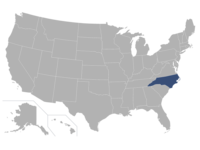
Of course, the transient nature of these color associations coincides well with the fact that few parts of the U.S. political quilt seem to be permanently stitched in place. Many states that once reliably voted one way or the other have done a 180 in recent decades. Meanwhile, battleground states like North Carolina that swing both ways in their partisan preferences are commonly referred to as “purple.”
And with the 2026 election now upon us and in full swing, it appears increasingly possible that North Carolina will take on an even bluer tint in the coming weeks. Boosted by Trump’s plummeting approval numbers in the polls – a trend that most observers attribute to the war against Iran, its impact on the U.S. economy and the general chaos in Washington – Democrats appear well-positioned to win races up and down the ballot.
Among the contests generating the most optimism for Democrats:
- The race to succeed retiring Republican U.S. Senator Thom Tillis – Barring some kind of remarkable last-minute comeback, GOP nominee Michael Whatley appears likely to lose to Democratic former Gov. Roy Cooper by a significant margin. At last check, national Republicans had all but written off the race.
- The state Supreme Court contest between incumbent Anita Earls and GOP state lawmaker Sarah Stevens. If Earls prevails as many expect, Democrats would be poised to take back control of the seven-member high court in 2028 when three GOP-held seats will be on the ballot – something that would bode well for lawsuits seeking to revisit the state’s egregiously gerrymandered congressional and legislative maps.
- The 11th District U.S. House race – After having elected three successive Republicans ultimately tarred by scandal (Mark Meadows, Madison Cawthorn and Chuck Edwards) voters in the state’s far west could elect a folksy and centrist farmer, Democrat Jamie Ager, over GOP state lawmaker Jennifer Balkcom. Despite the district being badly gerrymandered to favor Republican candidates, most analysts rate the race as a tossup.
- The partisan makeup of the General Assembly – While it would take a true political tidal wave for Democrats to win control of the state legislature after 16 years of Republican dominance and district map gerrymandering – the GOP currently controls the Senate 30-20 and the House 71-47 with two unaffiliated reps – the chances for narrowing the margins and thereby forcing more genuine negotiations with Gov. Josh Stein by ending the prospect of partisan veto overrides seem high.
Very little is certain in modern politics. With billionaire plutocrats capable of flooding races with vast sums of dark money, rogue actors spreading lies on social media, and even the nation’s chief executive issuing repeated and false claims about the validity of our elections, last-minute “October surprises” (and even November and December surprises) remain a possibility. For now, however, with the 2026 election already underway and early voting numbers up over the last midterms in 2022, the chances for North Carolina emerging with a slightly bluer shade of purple look to be high.
Raleigh, NC