Who funded Nebraska Working People, America First parties? Law doesn’t require disclosure.
Oct 19, 2026 | 6:45 am ET
Description
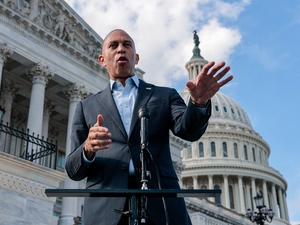
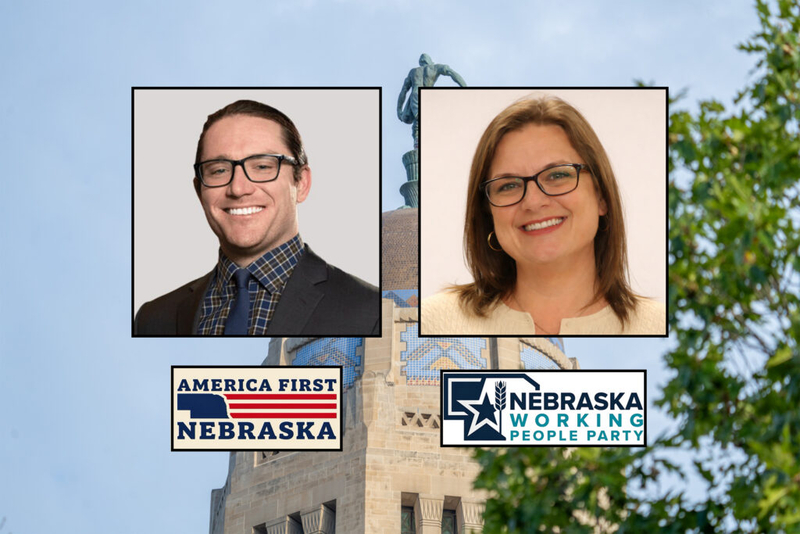
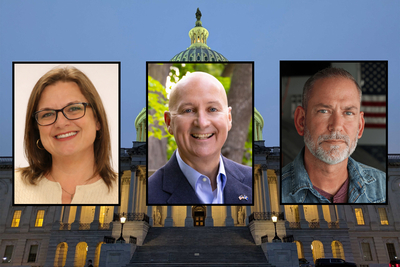
John Cartier of Lincoln, left, and Robin Richards of Ralston respectively led creation of the America First Party and Nebraska Working People Party and served as the inaugural chairs of the parties. Richards is also the 2026 U.S. Senate nominee for her party. (Photos courtesy of John Cartier, Robin Richards and the respective political parties | Nebraska Capitol photo by Zach Wendling/Nebraska Examiner)
LINCOLN — Candidates and ballot-measure campaigns petitioning to appear on Nebraska’s ballot must disclose how much is spent on signature gathering.
But Nebraska law doesn’t require new political parties to disclose their finances until they are qualified to have candidates on the ballot.
For 2026, that leaves a gap of at least two months of reporting for the new Nebraska Working People Party and America First Party that likely will never be disclosed for signature gathering or litigation, unless party officials voluntarily disclose the information.
The Working People Party said it won’t, and one party official cited the lack of transparency in his resignation. By an Oct. 5 reporting deadline, neither party had filed a state disclosure report.
“This cycle has shown us that absolutely this is an area where money is going to be spent to impact politics in meaningful ways that Nebraskans want to know about, but they can’t right now. They can’t do anything,” Gavin Geis, executive director of Common Cause Nebraska, told the Nebraska Examiner.
‘Law doesn’t really contemplate this’
Geis said he’s fielded questions “again and again” about who funded the creation of the two new state political parties this summer.

“I have to tell them time and again, ‘I’m sorry, but the law doesn’t really contemplate this,’” Geis said.
Laws regulating campaign finance are different for the Nebraska Accountability and Disclosure Commission, for the state, and the Federal Election Commission, for federal candidates.
In Nebraska, the reporting threshold is $5,000 raised or spent toward the goal of being elected and/or supporting or opposing ballot questions.
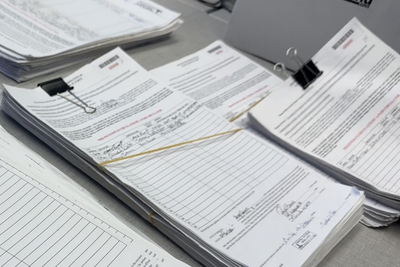
An Examiner review of petitions for the two new political parties showed most of the thousands of signatures, if not all, came from paid circulators.
Some circulators were from Nebraska, but a few dozen hailed from out of state, including Arizona, California, Florida, Georgia, Kentucky, Maryland, Michigan, Mississippi, Missouri, Montana, Nevada, New York, North Carolina, Ohio, Oklahoma, Oregon, Tennessee and Texas.
Geis said he can understand why this issue wasn’t pondered sooner. The tactic of forming new political parties as a strategy could be new, he said, and it remains to be seen whether the tactic is successful this November or whether it will be repeated in Nebraska or elsewhere.
“You can’t really wave it aside and say, ‘Oh, it doesn’t have any impact.’ It clearly does,” Geis said. “People are clearly watching and curious and want to know more.”
Parties certified Aug. 26
The NADC, the state agency overseeing campaign finance for Nebraska candidates and issues, confirmed in a July 21 email that under state law, a political party is only considered a “committee” for campaign finance disclosure purposes once it qualifies for the ballot.
County election officials validated nearly 18,000 signatures across the two campaigns. The two measures both needed about 2,200 signatures apiece across each of Nebraska’s three congressional districts to qualify for the ballot.
The Nebraska Republican Party and Nebraska Democratic Party each sued to block the new parties after signature gathering. The NEGOP and NDP argued the newcomers could sow confusion. The Nebraska Supreme Court ultimately upheld the new parties in an Aug. 26 ruling.
Outgoing Secretary of State Bob Evnen certified the parties that afternoon, which became the starting point for money raised (including leftover money) or spent toward the $5,000 limit.
The first reporting deadline for the 2026 general election was Oct. 5, covering June 16-Sept. 29 for candidates and political parties.
But by then, neither of the new parties reported raising or spending more than $5,000.
By Sept. 1, eight candidates petitioned to appear on the ballot for the new parties, three for the Nebraska Working People and five for America First. State law only required valid signatures from at least 25 new party members to appear on the ballot for each office.
Should the law be changed?
Of more than a dozen state senators the Examiner spoke to over the past three months about the disclosure requirements, all said they were unaware the parties would not be required to disclose finances from the signature-gathering or initial litigation period.
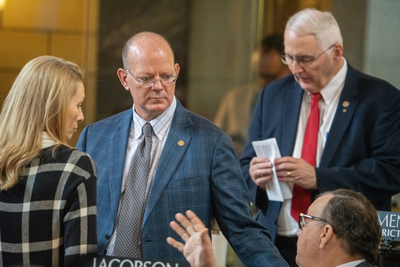
State Sen. Paul Strommen of Sidney, one of many lawmakers who have scrutinized petition campaign finance, said he was concerned about various types of “dark money” in Nebraska. He said the issue for political parties, among others, should be looked at in 2027.
Evnen, a member of the NADC by virtue of his office, said the parties will need to honor the $5,000 threshold. Asked if he would support disclosure changes, Evnen said on Sept. 3: “Haven’t considered it, but I would.”
State Sen. Machaela Cavanaugh of Omaha, who will be term-limited next January, said this is clearly a “blind spot” that should be rectified.
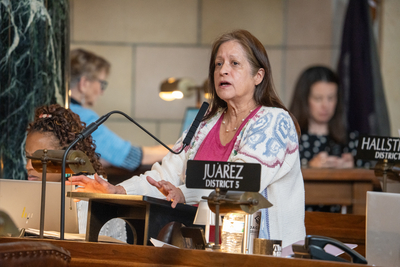
State Sen. Margo Juarez of Omaha said she was surprised and that the law needed to change. State Sen. Tony Sorrentino of Elkhorn said in the 11 seconds or so he considered the matter after being informed by the Examiner, it seemed inequitable. He wondered whether the matter had ever been brought up in the Legislature.
Marijuana supporters twice petitioned to create a new party, first in 2016 — the Nebraska Marijuana Party — and again in 2020 after the first effort fell short. In early 2021, the Legal Marijuana NOW Party joined Republicans, Democrats and Libertarians as a valid state party.
However, unlike before, the Nebraska Working People and America First parties appeared this summer without a prior push. This year also features the tense race for U.S. Senate featuring Democrats pledging to back registered nonpartisan Dan Osborn for U.S. Senate against U.S. Sen. Pete Ricketts, a Republican, and going as far to clear their ballot line to help Osborn.
Ricketts and Osborn also face candidates for the Legal Marijuana NOW (whose candidate dropped out in August), Nebraska Working People and America First parties.
‘Vitriol, harassment and political retaliation’
The NADC confirmed nothing prevents the America First or Nebraska Working People parties from voluntarily disclosing their finances.
However, in August, Robin Richards, the chair of the Nebraska Working People Party, who would later become the party’s U.S. Senate nominee, said that wouldn’t happen.
Richards, who ran a write-in campaign for Legislative District 12 in the spring, described her party as being “made possible by a broad base of supporters who believe Nebraskans deserve a meaningful alternative to the two established parties.”
“Because of the level of vitriol, harassment and political retaliation surrounding this effort, all of those supporters have asked to remain anonymous, and we intend to honor their request,” she said in an Aug. 21 email.
“We will comply fully with every disclosure requirement under Nebraska law,” Richards continued. “At the same time, we will not voluntarily expose private citizens to harassment simply because they chose to support the creation of a new political party. The focus should remain on the thousands of Nebraskans who signed our petitions and the reasons they believe our current political system is no longer working for them.”
The Nebraska Democratic Party, in a July 19 email to party members, ran the subject line: “Betrayal by fellow DEM w/ MAGA backing could cost us the Senate.” The email described Richards as “disgruntled” after she lost her legislative race and endorsed incumbent Republican state Sen. Merv Riepe over the runner-up Democrat, Christy Knorr. Richards came runner-up for the same seat in 2022, losing to Riepe by 524 votes. The party added: “There is no doubt this is the work of shadowy MAGA operatives, using a turncoat Democrat as the poster child.”
Party officers resign
The Nebraska Working People Party’s initial treasurer, Vince Rukstalis, resigned just three days after the party qualified for the ballot. The vice chair, Joe Hunter, also resigned. Hunter, a former Democrat, is running for Papillion mayor. Rukstalis is a registered Republican.
Rukstalis, in a resignation email to Richards, which he posted online, said he fully supports the party’s basic premise. However, he said he never imagined the party would run a federal-level candidate, or that Richards herself would be a nominee. He said the “distraction” from Hunter and his campaign was too much and that he was “taking all the hits while no one else is.”
“Furthermore, I cannot in good conscience continue in any executive capacity while still having zero information or understanding about full visibility and transparency into the funding source after repeatedly having asked about this critical piece of information,” Rukstalis wrote.
“In conclusion, you now have a certified party to run, and most likely a Senate race. Your benefactors, whoever they are, will expect you to fully engage to meet their expectations. Clearly, this was all well-planned in advance, executed very precisely and seemingly at Joe’s expense.”
‘Basic paperwork’
NEGOP Chair Mary Jane Truemper criticized the America First Party in an Oct. 7 statement for supposedly not raising $5,000 by Sept. 29 and for its gubernatorial nominee, former state Sen. Brett Lindstrom of Omaha, missing a reporting deadline by three days.
“If they can’t handle basic paperwork or raise a dime, they have no business asking Nebraskans to hand them the keys to our state,” Truemper said in the statement. “Voters will see this sham of a party for what it is and choose common sense in November.”
John Cartier, the chair of the America First Party, declined multiple requests for comments to the Examiner but fired back at Truemper within hours of the party’s post.
He questioned how much money the GOP had spent to keep his party off the ballot and argued that if the America First Party was “so irrelevant, why did they fight so hard to keep Nebraskans from having the option to vote for us?”
Cartier, a former Democrat who also helped the Legal Marijuana NOW Party, including being treasurer for that party’s 2026 Senate nominee, has tried to attract wayward Republicans to his party. He also blasted Nebraska Gov. Jim Pillen, U.S. Sen. Pete Ricketts and other Republicans for what Cartier said were governance actions that defied “common sense,” as Truemper put it.
“If you’re asking for receipts, there’s a pretty big mess sitting right in front of you,” Cartier wrote. “See you in November!”
‘A very poor choice’
Cavanaugh and Juarez, both Democrats, said they were dismayed that neither new party would voluntarily disclose its information, even if not required.
“They’re newly established parties — already they want to start off not being transparent? Why? Why is that a good first step?” Juarez said. “I think it’s a very poor choice.”
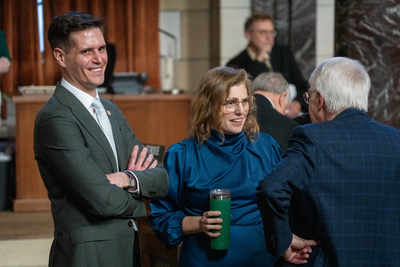
Cavanaugh has publicly questioned the rumor mill, including Nebraska Democratic Party Chair Jane Kleeb and others directly who asserted, without evidence, that Ricketts was behind Richards’ new party. “For whatever reason,” Cavanaugh said, her asking questions seemed to have “ignited theories” that she was considering joining either party or being one of their candidates. Both of those points, she said, aren’t true.
“I was saying I’d like to see the evidence that Pete Ricketts is behind it, because it just seemed like a fabrication based on no evidence,” Cavanaugh said.
‘Nobody has concrete evidence’
Geis said disclosure has the added benefit of preventing some of the “wild speculation” around the new parties, instead firmly answering whether an effort is more grassroots or revealing whether major donors or operatives are at play.
“Either way, I think transparency would allow voters to stop assuming the worst and know the truth of who is looking to influence our elections,” Geis said.
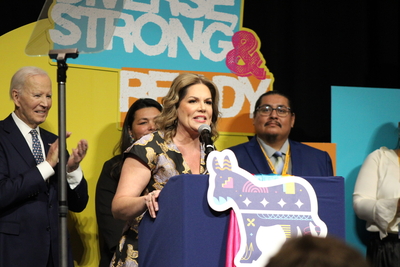
Kleeb, speaking with the Examiner on Aug. 21, repeatedly pointed fingers at allies close to Ricketts or Richards as behind the signature gathering.
Asked what evidence she had regarding Ricketts’ involvement, Kleeb responded: “Nobody has concrete evidence, because there’s no campaign disclosures.”
Kleeb went on to say that it’s a “very small political world.”
“It’s a very disgusting, shady business, and it’s shameful that they don’t have to disclose this information,” Kleeb said.
‘Stop blaming everyone else’
Jessica Flanagain, a partner at Axiom Strategies and key Ricketts ally whom Kleeb accused of being involved, denied involvement and said Kleeb was at the center of “all the new-party, no-party nonsense.”
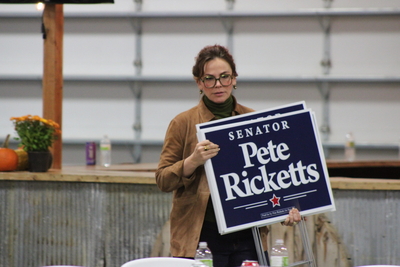
“First, she manipulated the Democrat primary to help Dan Osborn. Then one of her own failed Democrat candidates launched the Working People’s Party. Then a professional activist the Democrats once endorsed answered with a desperate America First Party,” Flanagain said in an Aug. 21 text.
“This will haunt the Democrat Party for years,” she continued. “Jane needs to stop blaming everyone else and get her own house in order.”
Truemper similarly denied the Republican Party’s involvement in the petition effort. The campaigns for Osborn and Ricketts have also repeatedly denied involvement.
Getting the ‘full picture’
Geis said that, in talking with his counterparts in other states, he learned this “gap” is not unique to Nebraska. At the same time, he said, political party formation as a strategy hasn’t been as “aggressive” elsewhere.
“We may be experiencing something novel, which explains the lack of regulation,” Geis said in a follow-up email.
The 2026 election has already been a confusing cycle, Geis added, and he said voters should have as much information as they can to help them make informed decisions, including requiring more of actors who, at times, hope to sow more confusion.
“I don’t know if that is both of these parties’ goal, but I think the end result is the same, that Nebraskans don’t really understand what’s going on or how they get the information to get a better picture,” Geis said. “It should fall to the state, at the end of the day, to make sure that they (Nebraskans) can get that full picture.”
Lincoln, NE