What do we need after Nov. 3? Political imagination.
Oct 19, 2026 | 5:59 am ET
Description
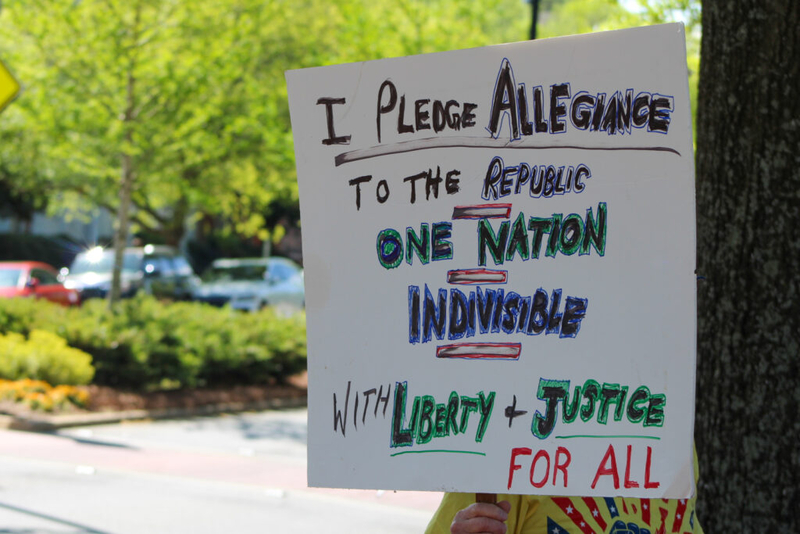
A protestor holding a sign with the Pledge of Allegiance at the Auburn No Kings protest on March 28, 2026, on Toomer's Corner, in Auburn, Alabama. (Anna Barrett/Alabama Reflector)
I try to avoid political predictions. But it’s safe to say that whatever happens on Nov. 3, most of us will end up disappointed.
Certainly, if our preferred candidates don’t win. But even if they prevail, the embers of excitement will cool. And by the summer, whatever our leaders have done or failed to do, we’ll be awaiting or dreading the next election.
It’s a pattern in American politics. Our patience for new politicians and regimes lasts about six to seven months. In Alabama, where we return most incumbents to a state government many of us claim to hate, we’re often disillusioned as soon as the results come in.
For better or worse, this makes it difficult to build lasting, productive coalitions. That’s fine if Reps. Lex Luthor and The Joker are trying to get fellow lawmakers to vote for the Blow Up Gotham Act of 2026. But it means more civic-minded officials lack the space and the will to implement effective public policies.
Why do we keep repeating this cycle?
In Alabama, there are a few answers. Our state constitution is anti-democratic and centralizes power in Montgomery. Meaningful political competition is the exception, not the rule. Party primaries are more likely to determine leadership than general elections. Voters conclude and are sometimes encouraged to believe that their vote is meaningless. Voter participation plunges, and few Alabamians feel invested in their leaders. We’ve been taught to expect little from a government that protects power above everything else.
Let me propose another reason for this disillusionment. It helps me think about why even governments with large mandates end up faltering.
If you’re a late Gen Xer like me, you’ve lived your life under a political consensus: Major problems must be addressed by the private sector, not the public one. In this view, a government cannot deliver the answers. It can only help the free market find them.
You may reject this idea and for good reason. If you need a doctor in the United States, you know the private sector has turned this essential service into a baffling ordeal of codes, claims and hidden charges. Countries with greater public investment in healthcare tend to have better outcomes (and spend less).
But this business-first, government-bad attitude is the baseline in American politics. It frames political discussions and sets boundaries on the debate. Politicians across the political spectrum have to work within these limits, even if they reject the premise. And politicians generally give voters a sense of what’s possible.
So our political imagination has rotted. Alabama has serious problems with rural healthcare, maternal healthcare, poverty and gun violence. Yet the only public policy that seems to command broad agreement is “economic development,” which all too often means throwing tens of millions or hundreds of millions of dollars at a business that will employ tens or hundreds of people. That’s nice. But it’s not a solution. It’s a localized painkiller.
There are other examples. Don’t expect adequate money for public schools; send your kid to a private one. We’ve got workforce participation issues in Alabama due in part to a lack of transportation, but don’t tell us to invest in public transit; buy a car.
We turn away from governments with some degree of accountability and toward a small clergy of entrepreneurs with none. They tell us they commune with the fickle divinity of the free market and receive answers that, like the Delphic oracle, may or may not answer the questions.
So we expect less of our elected leaders. Politicians become little more than helpmeets for the priests of commerce. And they tend to shrink from bold solutions, if they have any in the first place. There might be some marginal changes. A tax incentive here; a rewritten law there.
But a systematic approach? We rarely see that. We have been told for so long that the private sector is superior that we get leaders who believe that, too. Who have no sense of the potential of the public sector. And who end up delivering inadequate answers.
So we lose heart and begin thinking about the next election. But we are trapped in this post-Keynesian consensus that no longer works. Healthcare, housing and education: We need something more than prayers to the great god of private enterprise to solve them.
We need bigger ideas. But more importantly, we need a new political mindset. One that sees government as an active and creative space where popular will and new ideas can make something other than public assistance for stockholders.
In short, we need political leadership that understands citizens have as much of a stake in public affairs as any Big Mule. That takes its responsibilities seriously. That takes responsibility and doesn’t shuffle off public concerns to private enterprise.
An administration that engages the public like this is likely to hold onto its mandate for a longer time. Because it will hold onto the public longer. And maybe address the things we care about.
Montgomery