No-nonsense Ken Block ran for governor twice and lost. Will his 3rd time charm RI voters?
Oct 19, 2026 | 5:15 am ET
Description
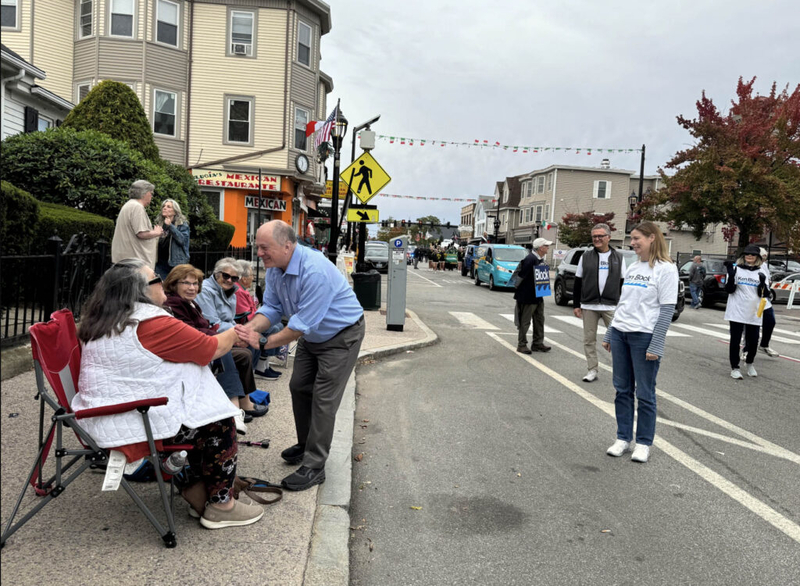
Independent gubernatorial candidate Ken Block shakes hands with spectators on Atwells Avenue in Providence during the annual Federal Hill Columbus Day Parade on Sunday, Oct. 11, 2026. (Courtesy of Block campaign)
Ken Block’s campaign calculus rests squarely on the numbers.
Battling against entrenched party politics as an independent candidate for governor with only modest name recognition and even less campaign cash, he looks to polling as proof he can beat Democratic rival Helena Buonanno Foulkes.
“Her favorability, beyond anything else, where her numbers are, is the reason I sleep well at night,” the 60-year-old software engineer said.
He need only look to two recent polls, from WPRI-TV 12 and the University of New Hampshire, each showing Block was the only gubernatorial candidate who more voters liked than disliked. The most recent, from WPRI on Oct. 13, put Block’s net favorability rating at 27. Foulkes had a net favorability rating of minus 1, while GOP nominee Aaron Guckian stood at minus 20.
The same survey put Foulkes 9 points ahead of Block among likely voters — significant progress given the 27-point lead she held over him in an August survey.
But nearly 1 in 10 voters still don’t know enough about him to form an opinion, compared with just 2% who said the same for Foulkes.
That’s even though his name has lingered on the fringes of local political talk for the last 12 years, ever since his second gubernatorial campaign ended in a bruising defeat against Allan Fung in the 2014 Republican primary.
Even after Block became a leading voice in the chorus of criticisms against Gov. Dan McKee after the abrupt 2024 closure of the Washington Bridge. He paid for two billboards over the replacement highway in 2024.
“If they had done their job, you would be home already,” read one.
Block insists he never contemplated a comeback until friends asked him if he might run again over dinner in March.
“I think he sees a time right now where he can really make a difference,” Jen Block, his wife of 26 years, said in a recent interview. “Who am I to hold him back?”
Her husband’s ambitions carried him through a 2008 federal lawsuit and subsequent statewide signature collection campaign to start the Moderate Party, debuting as the party’s first gubernatorial candidate in 2010. Three years later, he was the public face of the successful movement to get rid of the master lever that allowed for straight-party voting in Rhode Island.
In 2020,the Trump campaign hired his firm to audit the 2020 elections for alleged voter fraud. He found none, documenting the evidence in a 2024 book, “Disproven.”
Few challenges compared, however, to running for office.
“What surprised me the most, was how much it reached into the deepest parts of my brain and engaged me in a way few activities I have done in my life have,” he said.
Answers for unsettled voters but no tax returns
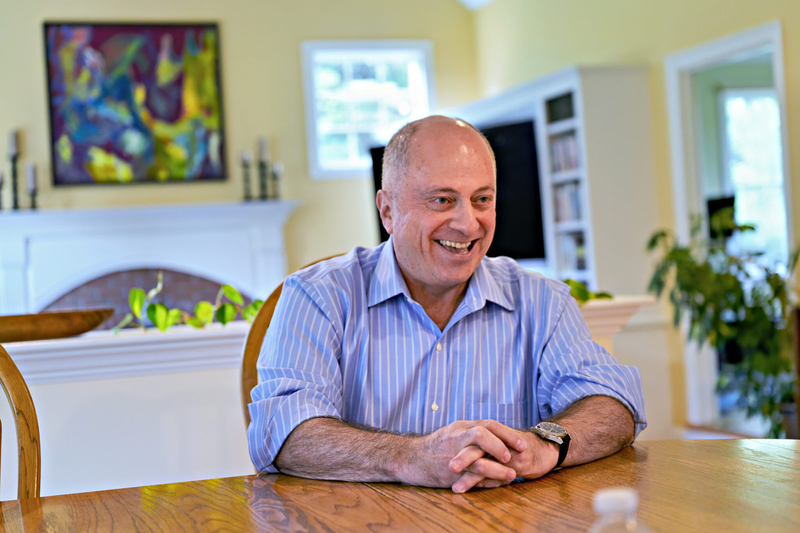
Over the hum of landscapers outside his Barrington home one recent morning — Block said he normally mows his lawn but doesn’t have time this year — the software engineer lays out his strategy.
“People are unsettled politically, and they’re looking for different answers,” Block, 61, said. “My job is to capitalize on that, and show voters across the spectrum that I have the answers they’re looking for.”
The Providence Journal described him as “wide-eyed and wonkish” during his first campaign in 2010. Now Block has the confidence and charisma of a seasoned politician, despite never having held or won elected office.
His beliefs haven’t changed from his last two campaigns. But he’s learned the art of delivery. Short face-to-camera video clips on his campaign website — a series titled “Ken I Be Honest?” — explain his positions on education, energy costs, and partisan politics.
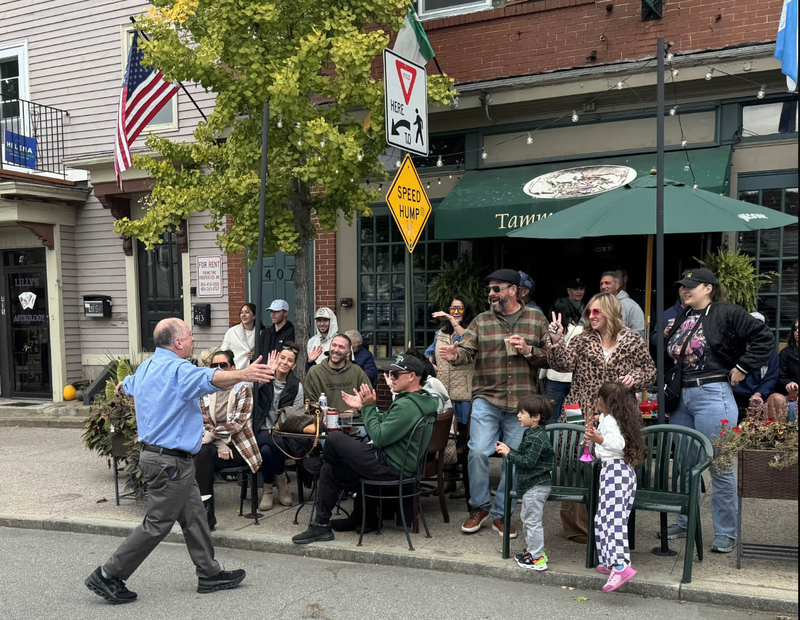
He still doesn’t love walking into a restaurant, interrupting people’s meals to introduce himself, but he can get over the discomfort, shaking hands, kissing babies and waving in parades. The campaign has him on the go all the time.
His afternoon schedule includes a phone interview with Reuters, a presentation to Rhode Island College student reporters and a “meet and greet” at a supporter’s home in Greenville.
“He is more understanding of how difficult day-to-day life is probably than ever before,” said Matt Schwiech, Block’s campaign manager, who also worked on his 2014 campaign. “That’s because he’s really out talking to voters, listening to their concerns.”
People are unsettled politically, and they’re looking for different answers. My job is to capitalize on that, and show voters across the spectrum that I have the answers they’re looking for.
Block has a lot of ideas to ease the affordability crunch: getting rid of car inspections (and the $55 biannual cost), making state public transit free for a year and tackling “hidden” taxes on energy and cell phone bills.
He grew up in Connecticut in a household where both his parents worked, “scrimping and saving” in his words, to pay for college for him and his two siblings. His dad was a college professor and his mom an occupational therapist and nurse.
Block graduated from Dartmouth College in New Hampshire with a computer science degree and student loan debt, which he paid off within four years of graduating thanks to his early career as a consultant for Brightstar Lottery — then GTech — in Providence.
“My ‘nice car’ is a 6-year-old Kia,” Block said.
The president of Simpatico Software Systems, which he founded in 2001, Block and his six-person team have consulted for international companies, defense contractors and government agencies, including the states of Texas and Rhode Island. He declined to share details of current customers, citing confidentiality.
Block also refused to provide a copy of his tax returns.
Since launching his 2026 campaign, he has put more than $200,000 of his own money into his account, with more than $1.2 million in personal loans dating back to his first run in 2010, according to public campaign finance reports. He has just over $236,000 cash on hand as of Oct. 5.
His four-bedroom, 2.5-bath farmhouse in Barrington — one of the state’s wealthiest communities — was valued at nearly $1.9 million in fiscal 2026. The undeveloped land cost $275,000 when he and his wife bought it in 2004, according to property records.
Both his children graduated from The Wheeler School in Providence, where Jen Block provides academic support to middle school students. Annual tuition currently costs $54,000 for students in grades 9 to 12. Max Pearlstein, a school spokesperson, confirmed via email that employees’ children qualify for tuition discounts, but did not say how much is discounted.
Buses, housing and the bridge
Block has ridden a Rhode Island Public Transit Authority bus just once — so long ago he can’t remember the exact when. But he can’t forget the agonizingly slow 90-minute commute from his home to his Warwick office.
“Never again,” he vowed.
Low ridership is a pain point for the perpetually cash-strapped public bus agency. Block’s solution after talking to riders, RIPTA employees and transit advocates: make it fare-free for a year, increasing ridership and then make the popular routes more frequent while getting rid of the hardly used ones.
His no-nonsense approach focuses on maximum efficiency and results, with pain points identified from personal experience.
He finds the state tax payment portal impossible to navigate. He pays his accountant to submit the quarterly corporate payments for him.
He was so frustrated with the required monthly paper filings for the state sales tax license on his book he stopped selling it at book fairs and speaking gigs, referring enthused readers to other retailers.
Rather than spending half a million dollars per unit to spur affordable housing development — the present cost of state housing development according to calculations from the Rhode Island Public Expenditure Council — Block thinks the state should focus on identifying, acquiring and redeveloping open or unused space, with buy-in from municipalities. There’s no cost estimate for his plan, which Foulkes and Guckian have both criticized for lack of detail.
Time on the state’s lawsuit against 11 contractors accused of negligence in repair or inspection of Washington Bridge is probably better spent on reshaping the management and practices within the state transportation department, he concluded. And the nearly $1 million cost to restart the state truck trolling program?
“Not happening” if he’s elected.
His tax and business ideas don’t sound too far off from what Republican Guckian has pitched, though Block insists the two couldn’t be more different.
Block loves the details, the numbers and the reports. He could talk for hours about the ways to fix the state’s troubled payroll system.
“This is where I eat and live,” he said.
A promise to hold weekly pressers
Convincing a Democratic supermajority in the Rhode Island General Assembly to allocate money to clean house and eliminate the people in charge of the payroll debacle — on his to-do list for the first 100 days in office — won’t be so easy, he acknowledged.
Block said he would air disputes with the legislature via a weekly press conference.
“The way I’ve gotten things done that the General Assembly doesn’t want to have done, and I’ve done that a few times now, it’s through effective use of the bully pulpit,” Block said.
Beneath the strong-willed, persuasive personality is a gentler Block, one who takes his employees out for lunch, prefers to listen to jazz music while driving and lets his 7-year-old Goldendoodle, Tilly, in and out of his backyard a half-dozen times with endless patience during a 90-minute interview.
Politics wasn’t always his passion. He preferred computers, hooked since his uncle gifted him an Apple II in the 1980s, when Block was a high school student.
A saxophone player who toured briefly with a jazz band after college, Block was much more likely to wax poetic about music than policy or elections. Stephen Conlin, a close friend from college, recalled “epic” ping-pong battles with Block in the basement of their shared Boston rental.
“He’s a very competitive person, as am I,” Conlin said. “His accounting of the results always differed from mine.”
That same competitive spirit is why Block isn’t running as a third-party candidate this time.
“Because I want to win,” he said.
Rhode Island Current will have a profile of Democratic gubernatorial candidate Helena Buonanno Foulkes on Tuesday. Republican Aaron Guckian was unavailable for a sit-down interview despite multiple requests. The governor’s race has a total of five candidates. Also running are independents Jasjit “Jay” Gotra and C.D. Reynolds.
Providence, RI