Growth of data centers becomes a defining issue of the midterms, entangling some Georgia candidates
Oct 19, 2026 | 4:00 am ET
Description
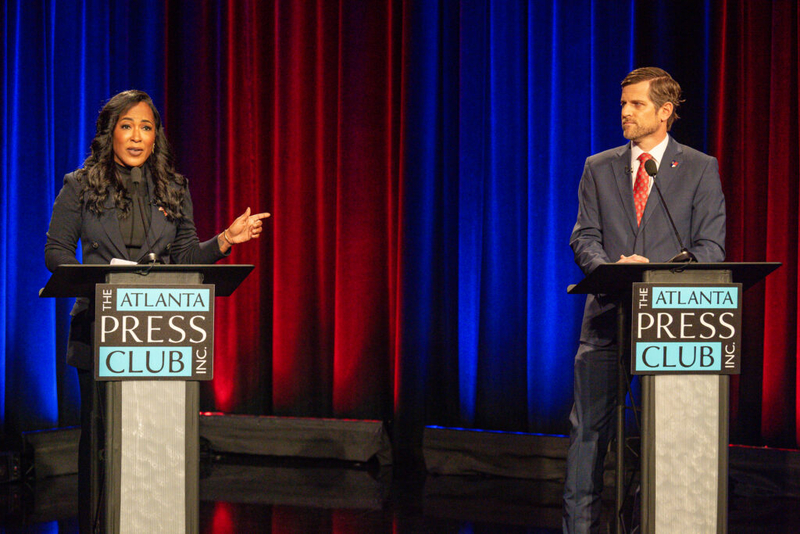
Candidates for Georgia Attorney General (left to right) Tanya Miller and Brian Strickland had a fiery exchange at the Atlanta Press Club general election debates on Oct. 12, 2026, when Miller pressed Strickland on a data center project proposed on his family farm land that he now says is “dead.” Pool photo via J Glenn Photography
Georgia candidates up and down the ballot are campaigning on an issue that has struck a nerve across the political spectrum: data centers.
A wave of data center projects across Georgia has been met with outrage in many communities in the last year or so, causing state lawmakers from both parties to push a flurry of legislative solutions during the 2026 legislative session. But in the end, none of the bills passed.
Since then, Georgia has become the leading state for data centers. Gov. Brian Kemp, a Republican who is term-limited and leaving office after this year, has welcomed the facilities, saying at a data center-related event in Washington this summer that “we cannot let China win this race, and that’s what some people want,” referencing the race between the U.S. and China to develop increasingly powerful artificial intelligence models.
The November election will decide to what extent Georgia embraces the energy-hungry facilities in the future, with voters choosing a new governor, the lawmakers who shape the state’s policies on data centers and other state leaders who play a role in carrying out those policies.
At the top of the ballot, Keisha Lance Bottoms, the Democratic nominee for governor, has criticized Republican nominee Rick Jackson, a wealthy healthcare executive, for his investment in a data center in Texas through a company Jackson was the head of until recently. Though his campaign has tried to distance itself from that development, in his campaign financial disclosure, Jackson is listed as the CEO and president of Datahub Developers, the company that is advancing the data center in Texas that the local community is fighting.
Bottoms and Jackson had a fiery exchange at a recent debate where they swapped accusations of being involved in advancing data centers.
“There is a community asking him to not build a data center, a massive data center in their community, and he is moving forward. So, if he is an investor in data centers, if he builds data centers, he cannot be trusted on this,” Bottoms said in the debate organized by Atlanta News First and Gray Media.
Jackson fired back, accusing Bottoms of approving three data centers during her time as mayor of Atlanta, but Bottoms said that she was “not sure what data centers he’s referencing,” saying there was only one at Georgia Tech that wasn’t one of the hyperscale data centers that cause concerns today.
Attorney general candidate says family has ‘moved on’ from data center project once planned for their farmland
At least one other candidate, Georgia state Sen. Brian Strickland, a McDonough Republican running for state attorney general, held a personal financial stake in a proposed data center as recently as the summer of 2025. But the proposal has since been shelved, according to public records and interviews.
The Georgia Recorder examined financial disclosure documents for all candidates running for statewide office in November. The Recorder also reviewed other public records and reached out to all of the candidates and their campaigns to ask whether the candidate has a direct financial stake in a data center.
In phone calls, text messages and emails with candidates and their campaign staff, all except those described in the story reported having no financial interest in data center projects.
Public records show that Strickland, a lawyer who represents a suburban district southeast of Atlanta, was involved in advancing a $1.2 billion data center on his family’s farmland in Henry County. On May 15, 2024, he authorized a real estate development firm focused on technology to pursue rezoning for the project.
Strickland’s personal financial disclosure statement shows that the state senator holds a greater-than-5% stake in Strickland Road Farms, which was a co-applicant in the rezoning application for the proposed 1.25 million-square-feet data center.
The project came close to being finalized mid-2025 – about the same time Strickland launched his bid for higher office – but Strickland told reporters last week that his family backed out over concerns about the noise that would come from the data center and now says the project is “dead.”
A public hearing before the Henry County Board of Commissioners was scheduled to consider rezoning part of the farmland on June 17, 2025, but Carlotta Harrell, the commission’s chair, said at the top of the meeting that the agenda item, along with other rezoning public hearings, “have all been removed at the request of the applicant and we will hear these items at a later time.”
County and local development officials confirmed the project is now inactive.
The Democratic nominee for attorney general, state Rep. Tanya Miller, pressed Strickland on the project at last week’s Atlanta Press Club debate.
“It wasn’t until days – and mind you, we’re talking days – after he announced his run for attorney general, did he remove the agenda item from the public hearing. He didn’t remove the data center application. He’s playing with words. He’s shape shifting,” Miller said to reporters after the debate.
Opponents of the data center project, like Connie Snow, a member of Conserve Henry County, a local advocacy group focused on zoning issues, say they’re worried the project will be revived after the November election.
“They’ve all told us that he’s withdrawn and all this other stuff, but I don’t think that it’s going to go away,” Snow said in an interview. “You have to also remember that all this happened coincidentally enough as it was getting close to election time.” Snow also participated in a press call organized by the Democratic Party of Georgia.
But Strickland said the decision to halt the project was not related to his decision to run for office and says the family now plans to add to an existing residence on the property and that his “parents decided to keep the entire farm intact.”
“The family has moved on and my dad is back working the land,” Strickland said in a text message.
Strickland says that the family listened to the community’s concerns about the project but that the family also ultimately did not want a data center next to them either.
“We said ‘no data center for us’ because the closest neighbor to the data center was actually my parents. They had their own concerns, and they said no to this,” he said at the debate.
The project also raised environmental concerns during a regional review process, with officials in the nearby city of Hampton saying potential hazardous material handled at the site could threaten the Towaliga River and Indian Creek watersheds and risk contaminating drinking water. The Atlanta Regional Commission concluded in their review that the data center project did not align with the commission’s planning policy for Atlanta’s developing suburbs and proposed ways the project could move forward by mitigating environmental impacts, such as using undeveloped areas around streams as a buffer, a plan to manage the proposed preservation areas and providing a fund “to support conservation land acquisition elsewhere in the County.”
In an earlier interview on Sept. 30, Strickland said that the proposal started when developers approached his father about using part of the family’s farmland for “some sort of commercial development.” Strickland said he became directly involved with the project to help with discussions and evaluate the contract since he is the only attorney in the family.
Strickland said that his father, once he learned more about the project, had concerns that noise from the data center could compromise their quality of life. Strickland’s father declined a request for an interview made through Strickland.
Strickland also said that the developers had purchased another parcel nearby that is not owned by his family, and he’s unsure about the status of that particular development. The land is owned by a Delaware-registered corporation called 0 Rocky Creek Road, LLC, and owned by Aaron Wolofsky, who also authorized the same real estate development firm to pursue rezoning for the land. Wolofsky is also the head of Red Wolf DCD Properties, the company that proposed developing on Strickland’s family farmland.
While Wolofsky did not return an email and phone messages seeking an update on the projects, Strickland provided a letter signed by Wolofsky that “Red Wolf has no relationship, by way of contract or otherwise, with Strickland Road Farms, LLC and there are no proposals to construct anything on any property owned by Strickland Road Farms, LLC.” There was no date on the letter, but its metadata shows that the document was created on Oct. 12 shortly before Strickland faced his Democratic opponent on the debate stage.
Georgia Recorder Deputy Editor Ross Williams and Reporter Maya Homan contributed to this report.
Atlanta, GA