Greg Abbott raked in $9 million from data center-related donors as he called for regulations
Oct 19, 2026 | 6:00 am ET
Description
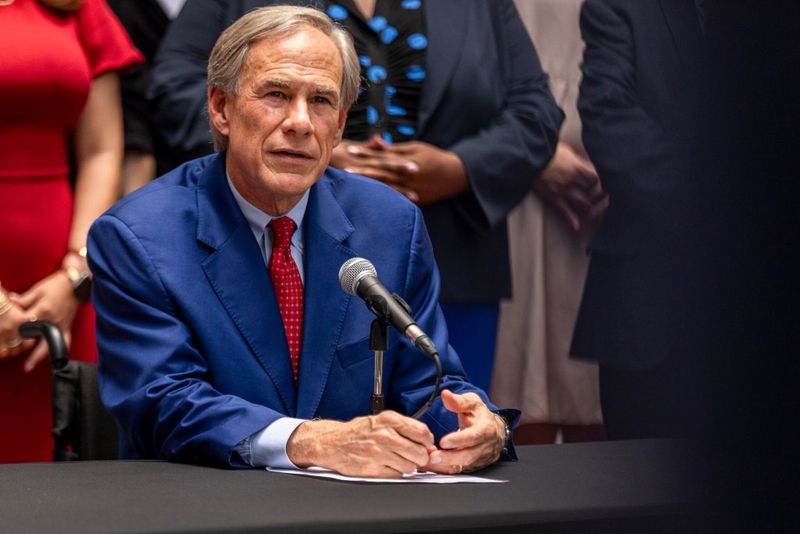
Gov. Greg Abbott answers questions from the media during the Texas Classrooms Commission press conference on the teacher-led initiative that is shaping the future of public education at the Governor’s mansion in Downtown Austin on Aug. 10, 2026. (Aiden Gonzalez/The Texas Tribune)
In June, as public opinion on data centers soured, Gov. Greg Abbott took his first big swing at reining in the industry, issuing a round of regulatory recommendations to the Legislature that included his call to end a major tax break for the facilities.
Donors with ties to the data center industry responded with cash. That same month, they gave Abbott’s campaign $1.5 million.
Two months later, the third-term Republican governor toughened his stance by pausing approvals for data centers seeking to connect to the state’s electrical grid, pending a statewide audit. That same month, he said in an interview with ABC that data centers “dug their own grave” and “got the backlash they deserve” for not gaining community buy-in at the outset of projects.
More money poured in.
After announcing the pause, Abbott went on to receive another $2.8 million from data center-related donors, his biggest monthly haul from the industry over the course of this election cycle, an analysis by The Texas Tribune found.
In total, Abbott has raised about $9 million from data center-related donors since July 2025, which accounts for about 13% of the donations he’s taken in during that time.
The Tribune vetted the affiliations of every donor who contributed at least $25,000 to Abbott or his Democratic opponent Gina Hinojosa since July 2025. More than half of Abbott’s data center haul, or $4.9 million, came from people or companies (and their corporate political action committees) that develop, own or operate data centers.
That group includes people like Rhett Bennett, the CEO of Black Mountain, a Fort Worth-based energy company building hyperscale data centers across Texas. Bennett and Black Mountain gave a combined $1 million to Abbott since last July. The group also includes people like Toby Neugebauer — the former CEO of Fermi America, the company behind the massive Project Matador data center campus in the Panhandle — who contributed $100,000 to Abbott.
The other $4.1 million in donations came from donors the Tribune found to have indirect data center links: people and companies that invest in or have financial ties to data centers, are associated with companies that primarily develop AI, or whose business models involve, at least in part, serving or helping build data centers.
That group includes people like Jeff Yass, a GOP megadonor best known for his interest in expanding school vouchers, but whose investment portfolio contains a number of companies that rely heavily on AI or data center technology. Yass’ investment firm Susquehanna International Group has stakes in Bytedance, the parent company of TikTok that also develops its own AI models; Broadcom, a company that supplies hardware and infrastructure to data centers; and Alphabet, Inc, the parent company of Google, which owns and operates data centers. This group also includes Edward Roski Jr., president of Majestic Realty Corp, a commercial real estate development company that counts data centers among its diverse list of tenants. They both gave Abbott $1 million.
Identifying data center donors is imperfect because many people with ties to the industry also have other business interests or political motivations. For example, Abbott’s largest data center-related donor was Airbnb co-founder Joe Gebbia, who contributed $1.5 million. Gebbia is a board member of Tesla, which owns and operates its own data centers. Abbott has also received major data center-linked donations from megadonors Elon Musk and Harlan Crow, who are both active in advancing conservative politics. Musk, the CEO of Tesla, which operates AI data centers, gave Abbott $500,000 and Crow, who has been an Abbott donor long before the recent data center buildout, gave $250,000. Crow is the chair of the board and former CEO of Crow Family Holdings, which announced in January it was developing a data center campus in central Dallas with CleanArc Data Centers.
“Mr. Crow has been a steadfast and long-standing supporter of Gov. Greg Abbott, dating back well over a decade and across several campaigns,” Crow’s office said to the Tribune.
The affiliations have nonetheless proven to be a liability for Abbott this election year. As the explosion in data center development in Texas fuels bipartisan discontent, candidates up and down the ballot, on both sides of the aisle, have worked to distance themselves from the industry while weaponizing donations from data centers against their opponents.
Staring down polling that has him neck-in-neck with Hinojosa, Abbott is for the first time fighting for his political life, trying to strike a balance between cracking down on the facilities while still holding onto his pro-business ethos.
“Governor Abbott has made his position on data centers clear. Data centers must pay their own way, protect Texas’ electric grid, bring their own water, and not to disturb the communities where they operate,” said Abbott campaign spokesman Eduardo Leal to the Tribune. “The Governor also directed state agencies to issue no data center related permits until ERCOT completes its review and he has also called for ending outdated taxpayer-funded incentives. Those are the standards Governor Abbott has laid out, and those remain his priorities.”
Leal also called the Tribune’s reporting a “disingenuous attempt to manufacture controversy out of information that is not new.”
Hinojosa, meanwhile, has made connecting Abbott to data centers a central part of her attack.
“Greg Abbott invited data centers into Texas with the richest tax breaks in the country, took millions of dollars in donations from the data center interests, and has spent months lying to Texans about his record to save his political career,” Hinojosa said. “Texans know I’ll fight for them – not the big corporations – and ensure they have a seat at the table to decide if and how data centers come into their communities.”
In a campaign ad, Hinojosa accuses Abbott of taking $20 million from “data center executives and companies.” Their list, obtained by the Tribune, includes companies that lease data center space, which is a looser threshold than the Tribune used because it includes many major companies that utilize technology, from Netflix to CVS. Hinojosa’s tally also includes energy companies that could supply power to data centers. The Tribune did not include those companies in its analysis.
According to the Tribune’s analysis, Hinojosa has received just one data center-related donation since July: $25,000 from Jon Freier, the chief operating officer of T-Mobile, which operates data centers in Europe and the U.S. It made up less than 1% of her total donations over that time.
Given the sway he is poised to have over the future regulatory environment in Texas, data centers are are expected to keep raining money on Abbott no matter what policy he pushes at this point, said Jim Henson, director of the Texas Politics Project at the University of Texas at Austin.
“The major players in the industry realized there will be something akin to a negotiated settlement on the relevant policies, and that the governor and his legislative allies will be negotiators of the terms of what emerges,” said Jim Henson, director of the Texas Politics Project. “Nobody wants to be left out of the discussions, and continuing to support the governor financially demonstrates the desire to be at the table.”
Down ballot
Further down the ballot, major data center-related donors spent most of their cash on Republican candidates.
After Abbott, Lt. Gov. Dan Patrick received the second most from data center-related donors of any statewide candidate at more than $1.6 million, according to the Tribune’s analysis. The majority of this came from donors with indirect ties to data centers.
Patrick’s campaign spokesperson Steve Aranyi disputed the Tribune’s characterization of donors as data center-related, saying it was akin to “counting every donor who has ever run a Google AI search on their iPhone.”
“The fact that few believe Ms. Goodwin is worthy of financial support or remotely qualified to hold the office is hardly grounds for criticism of Governor Patrick’s fundraising advantage,” Aranyi added.
Patrick, who is up for reelection for his role overseeing the Senate, could play a major role in what bills get passed in the Senate next year in a legislative session expected to focus heavily on data center regulation.
In March, Patrick directed committees that meet in the interim between legislative sessions to study data centers’ electricity demands and to make recommendations that strike a balance between economic development benefits and impacts on “landowners, private property rights, water infrastructure, and community integrity.” He also called for committee members to evaluate the costs of the sales tax exemption granted to data centers that Abbott later said should be abolished. He has since told the Tribune this month that he is supportive of getting rid of them as well.
In an interview with The Texas Scorecard, a conservative news outlet, at the end of September, Patrick said he supported the governor’s moratorium and planned to form a special committee on data centers.
“The data centers are like out of a cattle pen, you just open a gate and let them all run wild,” he told Scorecard. “So we’ve got to corral that in, and we’re going to corral the data centers in.”
Patrick’s Democratic opponent, state Rep. Vikki Goodwin, received no contributions from major data center donors identified in the Tribune’s analysis.
“The large dollar donors are looking for policy that will benefit them directly,” Goodwin said to the Tribune. “I’ve been proud to run a grassroots campaign supported by working Texans across the state.”
Comptroller Don Huffines, a Republican running to retain the seat this November, followed with about $1 million from data center-related donors, all with indirect links to data centers. Brint Ryan, the CEO of Ryan LLC, a tax and consulting firm that promotes its work helping data center developers get tax credits and abatements, gave Huffines $800,000. Ryan Texas PAC, a committee associated with Ryan LLC, contributed an additional $225,000.
Huffines’ campaign pushed back against the idea that Ryan’s donations were data center-related, noting that Ryan “has been a longtime prolific political donor long before the first data center was built in Texas” and that the centers are not a core part of his business.
“Hundreds of Texans with a wide variety of views on public policy have contributed to the Huffines campaign,” Huffines’ senior adviser Allen Blakemore said. “None of those contributions has any impact whatsoever on the decisions of the Comptroller’s office.”
The comptroller’s office reviews and approves sales tax exemptions for data centers that qualify.
Huffines was appointed by Abbott to serve after Acting Comptroller Kelly Hancock stepped down, but he is running for election to a full four-year term in November.
Huffines has been largely silent on the issue of data centers. Blakemore said Huffines supports the governor’s moratorium and his other priorities of protecting ratepayers, ensuring the use of efficient cooling systems and rescinding their sales tax exemptions. He also said Huffines’ believes local communities should “have a say in project siting decisions.”
Huffines’ Democratic opponent Sarah Eckhardt did not receive any donations from the data center-related donors the Tribune identified.
Blakemore added: “The fact that Ms. Eckhardt doesn’t have any notable donors is a result of her utter lack of standing as a credible candidate and her thin credentials to run an agency like the Comptroller’s office.”
A spokesperson for Eckhardt said “Huffines is clearly not interested in doing the public part of this job but instead serving the private interests who are paying his campaign for influence.”
House Speaker Dustin Burrows, R-Lubbock, received at least $377,500 from data center donors, the most of any legislative candidate. Musk comprised two-thirds of Burrows’ total, with $250,000. Other notable donors included Gideon Powell, the CEO of Cholla, Inc., an energy company that acquires land for data center development in Texas, and Neugebauer, the former CEO of Fermi America.
Like Patrick, Burrows would have major influence over what legislation related to data centers and AI advances in the lower chamber if he retains his leadership position. Burrows has said data centers are one of his legislative priorities for the 2027 session, with a focus on ways to streamline regulations and ensure data center development is water-efficient. Burrows’ office did not respond to a request for comment.
Among Texas Senate candidates, Sen. Charles Schwertner, chairman of the Senate Committee on Business and Commerce, received the most from data center-related donors at $52,000. He received money from Bennett, Crow, Ray Hunt, Powell, and the Caterpillar Inc. PAC. The Hunt and Crow families partnered to turn a Midwestern industrial facility into a data center. Caterpillar Inc. PAC is affiliated with Caterpillar, a company that provides power equipment to data centers. Schwertner did not respond to a request for comment.
Meta-backed PAC Forge the Future spent an additional $1.2 million in outside spending during primary season to back candidates for comptroller and in the Legislature through digital ads, phone calls and mailers. This included more than $495,000 toward supporting former comptroller candidate Kelly Hancock, who lost in the GOP primary.
This investigation was supported by a grant from the Tarbell Center for AI Journalism.
.methodology { display: block; border: 1px solid #f2f2f2; border-radius: 3px; margin: 2.5rem auto 0; padding: 1.25rem; } .methodology .wp-block-heading, .methodology .wp-block-paragraph, .methodology .wp-block-list li { font-family: “Open Sans”,Helvetica,Arial,sans-serif !important; } .methodology .wp-block-heading { text-align: left; font-size: .95rem !important; text-transform: uppercase; } .methodology .wp-block-paragraph, .methodology .wp-block-list li { font-size: .87rem; } .methodology .wp-block-paragraph, .methodology .wp-block-list { margin: 22px 0; } .methodology .wp-block-paragraph strong { margin-top: 32px; }
Methodology for our analysis
We identified data center donors by researching the affiliations of every donor who contributed at least $25,000 to Greg Abbott and Gina Hinojosa beginning July 1, 2025, which marks the first reporting period after the 2025 legislative session and the unofficial beginning of the midterm election cycle. We selected this dollar threshold to identify major donors, and because manually verifying each contribution was not feasible. As a result, some contributions from data center-related donors who gave smaller sums of money may be excluded. We used the governor’s race as our reference point to create a pool of donors because it draws the largest contributions in Texas politics, but for that reason, there may be other donations to candidates not captured in this analysis.
We categorized the Abbott/Hinojosa donors into two tiers. The first tier was donors with a direct data center connection, i.e. people or companies (and their corporate political action committees) that develop, own or operate data centers. Spouses of donors are included because they also are directly impacted financially. The second tier was donors with indirect connections, i.e. people and companies that invest in or have financial ties to data centers, are associated with companies that primarily develop AI, or whose business models involve, at least in part, serving or helping build data centers. To make those identifications, we used self-reported occupation and employer fields in campaign finance filings and reviewed publicly available company sites, SEC filings and news coverage.
We excluded donors who are solely in the energy industry, in abundance of caution, because their donations are so vast it would have dramatically inflated the findings. And because while the two industries are connected, their policy needs are not in perfect alignment. We also excluded companies that rent data center storage space because the category was overly broad.
Disclosure: Google and The University of Texas at Austin have been major financial supporters of The Texas Tribune. Airbnb and Meta have been financial supporters within the past five years. The Texas Tribune is a nonprofit, nonpartisan news organization that is funded in part by donations from members, foundations and corporate sponsors. Financial supporters play no role in our journalism. Find a complete list of them and more information about our financial and disclosure policies here.
Austin, TX