Justices uphold law allowing certain overseas voters to cast ballots for Nebraska elections
Oct 16, 2026 | 11:12 am ET
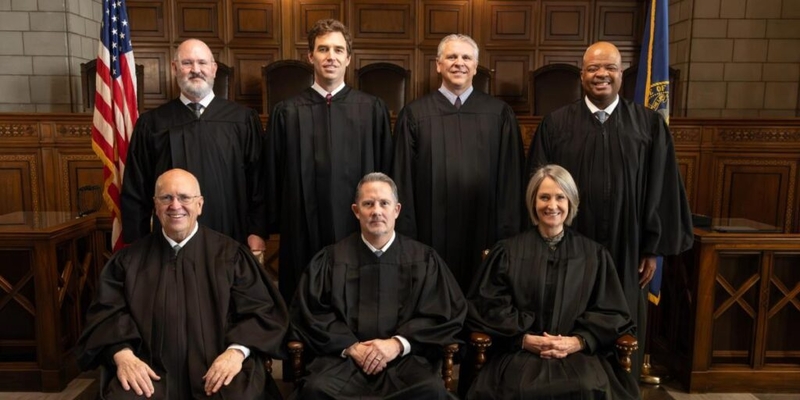
Description
Justices of the Nebraska Supreme Court (and when they were seated), front row from left: William Cassel (2012), Jeffrey Funke (2016, 2024 as chief justice) and Stephanie Stacy (2015). Back row, from left: Jason Bergevin (2025), Jonathan Papik (2018), John Freudenberg (2018) and Derek Vaughn (2026). (Courtesy of the Nebraska Judicial Branch)
LINCOLN — A Republican-led challenge to overturn a state voting law allowing certain overseas voters to vote in Nebraska is over after a Nebraska Supreme Court ruling Friday.
In an unsigned, 6-1 decision, the justices said challengers — the Republican National Committee and two Lancaster County voters, Jack Riggins and Pam Dingman — “failed to prove the statute is unconstitutional on its face.”
The RNC needed to prove that the statute had no constitutional applications. However, Nebraska Secretary of State Bob Evnen and Attorney General Mike Hilgers offered one: a voter born in South America to Saunders County missionaries who intended to return home.
“This and other courts have previously recognized that children acquire their parents’ domicile at birth and that such domicile ‘continues until a new one, a ‘domicile of choice,’ is acquired,” the Friday opinion states.
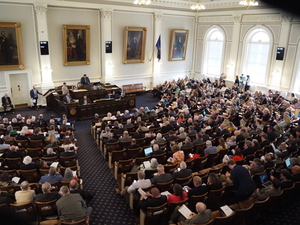
Justices consider appeal in challenge to Nebraska overseas voter law
The challenged 2005 law allows U.S. citizens who have never resided in Nebraska but who have a parent registered to vote in one Nebraska county to register in that county. It would be a felony to register or vote in multiple states or counties.
The RNC argues the law “dilutes the votes of lawful Republican voters” and violates Article VI, Section 1 of the Nebraska Constitution, which defines a qualified voter as a U.S. citizen who “has resided within the state and the county and voting precinct for the terms provided by law.”
In 1895, 20 years after the constitutional provision was adopted, the high court said “residence” and “domicile” were synonymous. On Friday, justices stuck with that interpretation and agreed that a child could adopt a parent’s “domicile” under certain circumstances.
Justice William Cassel dissented from the majority’s opinion because he said he would have dismissed the case outright. He disagreed with the majority’s ruling that Dingman had standing to sue as the elected Lancaster County engineer. She is running unopposed for reelection. A Lancaster County District Court judge and the other justices said the RNC and Riggins did not have standing.
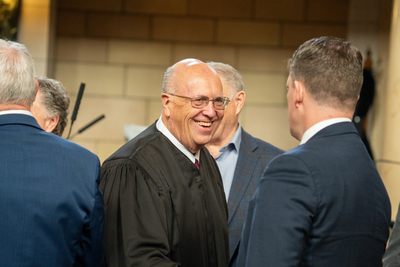
Cassel said that while a recent U.S. Supreme Court case could give Dingman standing, he agreed with the Hilgers’ office that the decision is “not binding” and refers to federal law.
Citing the small percentage of voters registered to vote under the challenged statute who cast a ballot compared to the number of voters in total, Cassel said they “establish that the claimed harm is neither actual, imminent nor palpable.”
For example, in the 2024 general election, 72 individuals registered under the challenged law voted, among 965,236 total voters, or 0.007%.
As of July, 116 overseas Nebraska voters were registered under the targeted statute, six of whom voted in the May 12 primary, according to data from Evnen’s office. That includes one voter in Lancaster County. In total, 30 of the 116 voters are registered in Lancaster County.
“The purported harm resembles a droplet in a deluge. I acknowledge that under other circumstances, standing might exist. But not here,” Cassel said. “I would dismiss the appeal, and, therefore, I respectfully dissent.”
The general election is Nov. 3.
Lincoln, NE