Spanberger’s energy plan dazzles – and disappoints
Oct 16, 2026 | 5:15 am ET
Description
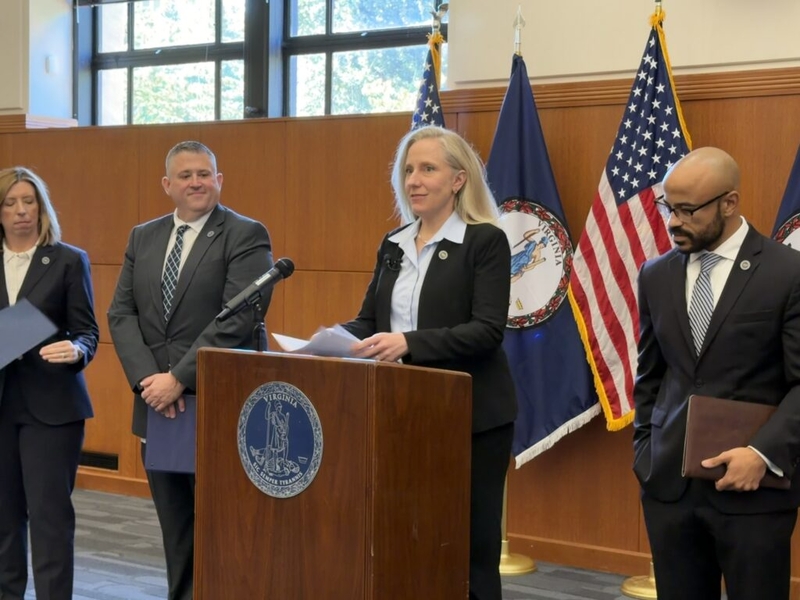
Gov. Abigail Spanberger unveils her administration's energy plan on Oct. 1, 2026 in Richmond. The plan models how the state can meet rising energy demands and achieve clean its energy goals. (Photo by Shannon Heckt/Virginia Mercury)
Virginia Gov. Abigail Spanberger’s energy plan, released October 1, is a marvel of earnestness and hard work. Anyone plowing through its 180 pages of text and appendices can’t help but be impressed with the level of detail and the thoroughness of its coverage.
The Department of Energy even acquired the same modeling software used by Dominion Energy and ran its own scenarios. And unlike Dominion, the administration took the goals of the Virginia Clean Economy Act seriously.
Spanberger’s energy plan keys in on clean energy to meet growing demand and VCEA goals
It’s an impressive effort, and the result surely has to be considered the new gold standard for Virginia energy plans, which have seldom even met statutory requirements. Take a bow, Virginia Energy staff and chief Energy Officer Josephus Allmond; you deserve it.
And yet.
If the plan’s central purpose is to demonstrate that Virginia doesn’t need to tamp down the growth of data centers to preserve energy affordability for residents and achieve the decarbonization goals of the VCEA, it fails.
The plan acknowledges that “rapid data center load growth is driving grid infrastructure constraints and higher costs.” Yet that unconstrained load growth is subjected to scrutiny only as to the accuracy of the forecasts, not to consider throttling back the growth.
Indeed, the plan hypothesizes that data centers will spend more on power than utilities will spend on infrastructure, an assertion the governor repeated last week at the Virginia Clean Energy Summit in Richmond.
From this calculation flowed her equally questionable argument that a future with more data centers will mean lower costs – the reverse of what the plan admits is happening now.
Providing enough clean energy cheaply to meet this load is a really hard circle to square, though the plan describes a few pathways heading in the right direction.
It identifies a lengthy list of ways to eliminate energy waste and smooth demand spikes, many of which have already been set in motion with 2026 legislation. (There is certainly room for improvement; the web site WalletHub just ranked Virginia 35th out of 48 states on energy efficiency.)
The plan also makes a strong case for energy storage and distributed generation as a way to harness private investment and make the grid more efficient, secure and resilient.
It recognizes the huge potential for solar on public buildings, currently held hostage to the interconnection barriers Dominion Energy erected. It also calls out Dominion for the high price tag on its clean energy projects and proposes a state-led renewables marketplace to bring the power of competition to bear on purchasing. And it suggests interesting interim solutions like fuel cells that could replace dirty diesel generators at data centers.
Certainly, it could go further. The governor could, for example, throw her weight behind a stronger residential building code and creation of an independent energy utility like Vermont’s to consolidate programs and maximize energy savings for residents.
She could also heed the calls of lawmakers and residents who want a moratorium on data center development.
The problem remains that all the efficiency, distributed generation and grid management in the world can’t get us out of the hole that data center demand is digging for us. We’re going to need a lot more generation, and if we also need it to be cheap and clean, we need a lot more utility-scale solar.
That brings me to my criticism of the energy modeling done by Virginia Energy’s staff, apart from its failure to include a scenario that limits data center growth. It imposes a cap on the amount of solar energy that the model was allowed to choose to achieve least-cost pathways for meeting demand. Without this artificial cap, it’s safe to say, the model would have selected a lot more cheap-and-easy solar paired with storage.
Doing so would have undercut a claim we are already hearing from Republicans, that if we would just leave climate and health costs out of the equation — and ignore turbine shortages, pipeline constraints, and fuel price volatility — building more fossil gas plants would come out as the cheapest option. A picture of what solar could do if we let it would rebut that argument.
That the model instead imposed a cap reveals Spanberger’s own ambivalence about utility solar. The administration takes it as a given that the current resistance to utility solar in many rural counties will persist even in the face of the declining farm income that makes solar one of the few lifelines available to struggling landowners. The plan mentions agrivoltaics approvingly but misses its transformational potential.
The plan could have proposed education and incentives to bring solar and agriculture together for the mutual benefit of both. Instead, it treats utility-scale solar as a regrettable necessity we should minimize. It’s an odd capitulation to solar NIMBYs from a governor who barely acknowledges the far greater public hostility to data centers.
Limiting utility-scale solar hamstrings the modeling effort. Even the addition of a lot more offshore wind, which is assumed to happen once President Donald Trump exits the stage, leaves us short of what’s needed to meet a massive increase in data center load.
Unwilling to check the growth of data centers, committed to defending the VCEA and wary of expanding energy imports, Spanberger isn’t left with a lot of great options. So, like so many governors before her, she puts her faith in nuclear.
Apparently, the best thing about the new small modular nuclear reactors (SMRs) under development today is that they are still a long way from commercial viability. That excuses leaders from having to immediately grapple with the realities of cost, siting, safety, security and waste. People can just imagine SMRs will be the perfect power source.
I am reminded of friends who joke that their retirement plan is winning the lottery. Fortunately, my friends know not to bank on it.
Spanberger proposes to bank on it, and to pass the cost of the lottery tickets on to the public. The energy plan has numerous suggestions for ways Virginia can help develop nuclear energy, all to be paid for by Virginia residents.
The worst proposal involves revising our renewable portfolio standard to make new nuclear an eligible technology. It’s yet another blow to solar, which Virginia has already made more expensive to develop in a way no other state has done (looking at you, House Bill 206).
The plan’s enthusiasm for nuclear even extends to conventional large light-water reactors. Recall that Dominion pulled the plug on its proposal for a third, 1500-MW light-water reactor at North Anna in 2017, when the total cost to ratepayers had hit $19 billion (about $26 billion in today’s dollars). There is a reason nuclear companies want their projects subsidized, and a reason the rest of us should be wary of being the ones doing it.
Really, when you consider it, wouldn’t it be better just to slow the growth of data centers?
Richmond, VA