Could data center opposition boost Democrats in Indiana House races?
Oct 16, 2026 | 5:00 am ET
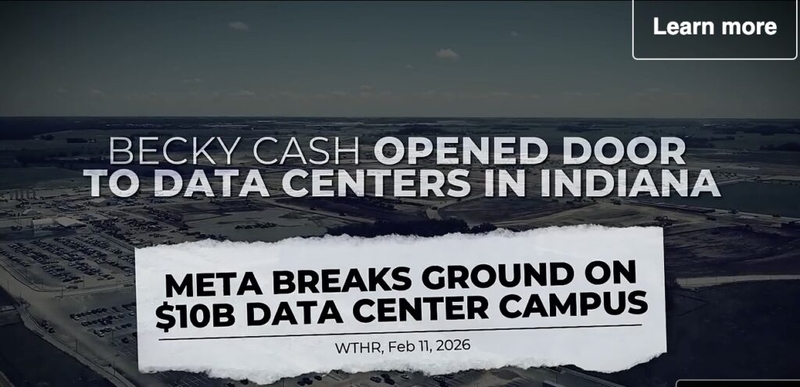
Description
A campaign advertisement from Democrat Tiffany Stoner attacking Republican Rep. Becky Cash over data centers. (Screenshot)
Democrats are looking to ride a wave of widespread opposition to big data center projects across the state as they aim to pick up seats in the Indiana House.
Data center worries are a prominent part of attacks against Republicans on affordability issues in several races targeted by Democrats this fall in their bid to break the two-thirds supermajority House Republicans have held since the 2012 elections.
Mail pieces and online advertisements from Democratic candidates use similar phrases, claiming Republicans “sold us out to data centers” and “gave data centers hundreds of millions.” The Democrats say they will “end data center deals we pay for.”
Republicans argue Democrats are distorting legislative votes and that local governments have the final say over allowing data center construction.
The GOP enters this year’s elections with a 70-30 House majority. But if the data center argument resonates with voters, Democrats could pick up at least the four House seats to break the two-thirds supermajority that allows Republicans to take action without Democrats even being present.
Democrats have “same messaging in every district”
Democratic candidates are pushing the data center issue in a cluster of Republican-held districts across the northern Indianapolis suburbs — near where Meta is building a $10 billion data center campus in the LEAP District outside Lebanon.
“I am not against data centers. I am against giving them a free ride,” Democratic candidate Tiffany Stoner told the Indiana Capital Chronicle. “I think this got rolling faster than probably some of the local officials really were able to even handle.”
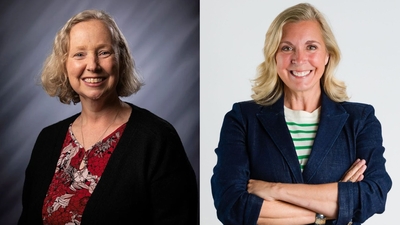
Stoner is in a rematch against two-term Rep. Becky Cash, R-Zionsville, of what was the tightest Indiana House race in 2024. Cash won by 64 votes out of more than 37,000 cast.
Cash counters that she voted against several of the bills criticized by Democrats as pro-data center and that she wasn’t even in the Legislature when the exemption from the state’s 7% sales tax on center equipment was enacted in 2019.
“The eighth postcard talking about this just hit the mailboxes, and every single postcard says the same thing, like, literally says the same thing,” Cash said in an interview. “The Democrats are very, very focused, and I’m learning that they have the same messaging in every district. They just slightly change the words.”
The data center issue looms as Republicans work to keep control of north suburban Indianapolis seats that have been increasingly contested over recent elections, including Rep. Danny Lopez, R-Carmel, facing Democrat Lindsay Gramlich; Rep. Hunter Smith, R-Zionsville, against Democrat Racheal Bleicher; and Rep. Chris Jeter, R-Fishers, who’s challenged by Democrat Stephanie Jo Yocum.
House utilities committee leader facing heat
Utility rate hikes and the impact of data centers is front and center in the race between 10-term Rep. Ed Soliday, R-Valparaiso, and Democrat Ryan Kominakis in northwestern Indiana.
Soliday, who is chair of the House utilities committee, was already facing heat over electric bill increases before an August storm caused tens of thousands of power outages among Northern Indiana Public Service Co. customers.
Kominakis is blunt in blaming Soliday for higher utility bills and for sponsoring the data center sales tax exemption legislation in 2019.
“He’s the most powerful man in the state, really, as far as making laws around the utilities,” Kominakis said. “He’s quite literally authored himself, wrote every law, that is, in my opinion, screwing over regular people on the day to day.”
Republican Gov. Mike Braun has remained an advocate of data center projects even as officials in many cities and counties have imposed moratoriums on such proposals.
A Free Press Indiana poll taken this month found 69% of likely voters surveyed opposed to new data center construction, with only 18% in favor. Similar opposition is being seen across the country.
Soliday has defended the state’s data center policies, saying the Legislature has responded to concerns about their impact on electricity rates and water usage. He argues that some opponents are stoking fears for political gains.
“The state provided an opportunity for locals by being competitive with other states,” Soliday said in an interview. “It’s a local decision, but that decision should be based upon the facts, and that really boils down to two areas: Is it aesthetically acceptable to our community, and is it economically beneficial? But we are going through a hysteria right now, where at public hearings there is a lot of screaming.”
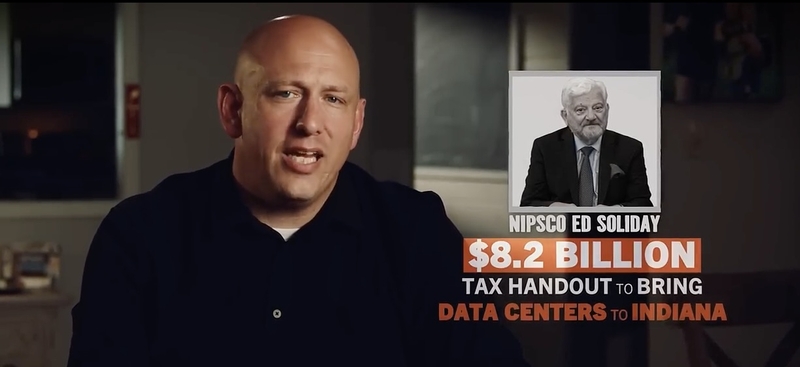
Kominakis points to news reports of data center companies benefiting from more than $655 million in exemptions from state sales and other taxes.
“That number is only going to grow,” he said. “Just imagine what we could do with that kind of money to help regular people.”
Soliday said a singular political focus on utility rates ignores the complexity involved in ensuring reliable electricity sources and a resilient power grid.
“They’ve got a horse and they’re going to ride it,” Soliday said. “Even though there is no (talk about) ‘What are you going to do differently, and what are the unintended consequences, and how are you going to get it done?’”
Democrats hoping for momentum swing
Democrats have fallen short the past six election cycles in their goal of breaking the House supermajority held by Republicans.
They maintain they see greater voter enthusiasm this year for their candidates. Democrats have candidates on the ballot for 97 of the 100 Indiana House seats, which they say is the most since at least 2000.
Republicans, meanwhile, left 20 current Democratic legislators without a GOP challenger. That includes 10 districts in Indianapolis and five in Lake County.
Stoner, one of the Democratic challengers, said she feels support swinging her party’s way more than when she was campaigning in 2024.
“I do anticipate we will have some real surprises across Indiana,” Stoner said. “I think given the mood and the energy and just given where people are in comparison to two years ago, I think people feel, perhaps, duped.”
Indianapolis, IN