Predicting or gambling? New markets invade all areas of society
Oct 16, 2026 | 5:00 am ET
Description
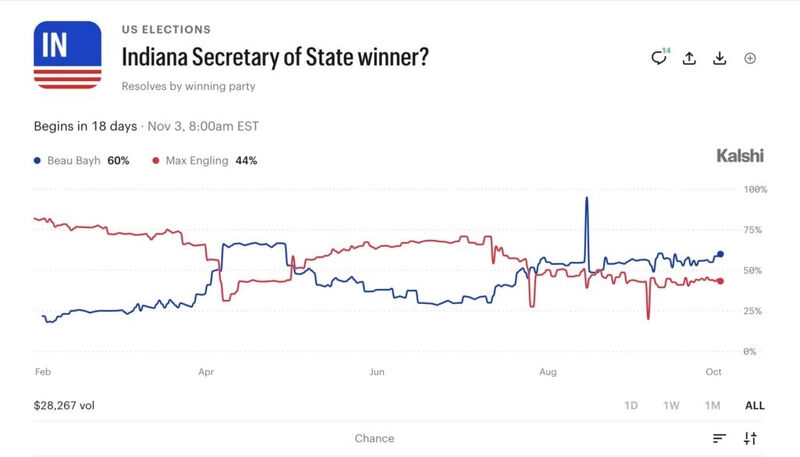
The Kalshi odds as of Thursday on who will win the Indiana secretary of state’s office. (Screenshot)
Prediction markets are bending the common definition of gambling — and states across the nation are pushing back.
Kalshi is the first federally regulated financial exchange in the United States dedicated to trading on the outcomes of future events. It handled billions in weekly contract volume. And it’s battling in court with 21 states.
Whether Indiana will join its name to that list could be a topic in the 2027 legislative session.
But it’s not just Kalshi. They are simply the best known. A handful of other prediction markets, such as Polymarket, are “trading” on election results, the weather, sports and even the next winner of “Dancing with the Stars.”
Here’s how it works – individuals buy “yes” or “no” contract shares on whether an event will happen. Each event has a clearly stated source on how to determine the winner. For instance, on a weather trade – yes, people trade on whether it will rain – the source might be the National Weather Service’s airport sensor in a major city.
Or, in the case of a political race, the source might be a state election division site.
Prediction markets spend millions to influence state, federal governments
For instance, on Thursday Kalshi had the Indiana secretary of state race listed in favor of Democrat Beau Bayh at 60%. Republican Max Engling is at 44%. They have swapped leads over the past months and the odds are constantly shifting as people buy contracts.
The Libertarian and Lincoln Party candidates aren’t included.
So if you buy a “yes” contract at 60 cents for Bayh and he later wins you collect $1. You can also buy “no” contracts.
I know that doesn’t equal 100%. The bigger the gap between the “yes” and “no” means the market is less confident in the price, according to several explanatory sites. In a market with lots of action, the two sides should be pretty close to 100% total.
The trades are treated like a commodity on the stock market. Warnings against insider trading are all over the sites.
One way the markets are different than straight gambling is you can sell your shares before a future event is officially decided.
For instance, if you bought for Bayh early — maybe when he was at 40 cents — you can try to sell your contracts to other users now at the higher price and pocket the small win before the election is over. But someone has to be willing to buy.
The volume of trading in the secretary of state race stood Thursday at $28,267, which is considered to be a solid market.
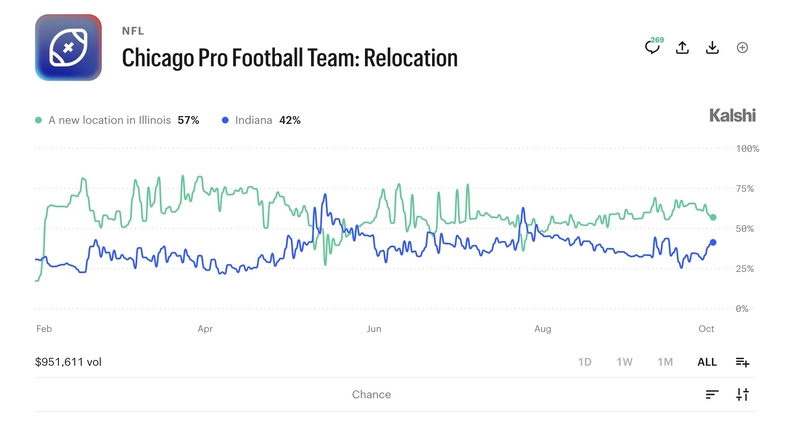
Another interesting Indiana-related event on Kalshi right now is where the Chicago Bears will relocate. That volume has topped $950,00.
The “odds” on Thursday were 57% in favor of a new location in Illinois with Indiana at 42%. Another 3% is on no relocation. The Illinois line has been winning most of this year with small spikes for Indiana.
The federal government contends it has sole authority to regulate these markets and that is handled through the Commodities Futures Trading Commission. But many states want to have their own say on the issue, including consumer protections.
The sports market is causing much of the concern. After all, sports gambling sites like DraftKings and others are paying state gaming taxes on the bets — something Kalshi and other prediction markets don’t have to do.
A few states have specifically banned the sports trades. At least one state, Arizona, has filed criminal charges against Kalshi.
Others are very concerned about how the issue might impact the results of an election.
Last week, 40 state attorneys general banded together to file an amicus brief urging the U.S. Supreme Court to hear New Jersey’s petition on whether federal law regulating commodity trading superseded the state’s gambling laws.
The Trump administration has sided with the prediction markets.
Indiana Attorney General Todd Rokita did not sign on, though. His office provided this statement on the issue:
“The issues on all sides of this situation are well-covered by the parties in this case, including some other states. We have heard little from anyone in Indiana state government advocating to us one way or the other for the issues this case presents. SCOTUS will be deciding this case soon enough, and Indiana will take action from there.”
Some people are now looking to these contract markets instead of polling to gauge the views of the electorate.
Money changing hands over the outcome of elections is corrosive to democracy and amounts to an attempt to bypass existing bans on election betting, civic organizations and some public officials say. Twenty-three states completely ban election betting, according to data from the National Conference of State Legislatures analyzed by the Pew Research Center.
I think it’s important to have some state involvement on this important issue, so I am hopeful the Supreme Court ultimately takes up the case and gives states some basic authority. From there, it would be up to state lawmakers to provide reasonable guardrails and a taxing structure.
Indianapolis, IN