Mainers are tired of dark money and the rigged horse race
Oct 16, 2026 | 4:41 am ET
Description
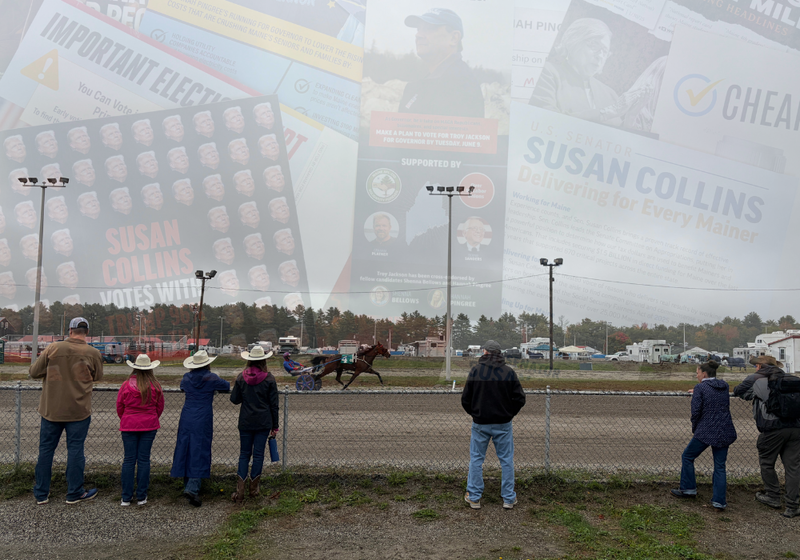
Harness racing at the Cumberland County Fair on Sept. 29, 2026. (Photos and image by Lauren McCauley/ Maine Morning Star)
Allegations that U.S. Sen. Susan Collins was being investigated by the FBI for a potential connection to a pay-for-play scheme until President Donald Trump purged the bureau’s anti-corruption unit, to some observers, seemed like a political bombshell destined to crater the senator’s re-election efforts. But based on conversations with several Maine voters, the ProPublica investigation barely made a ripple.
“I think all politicians are corrupt,” said South Portland resident Denny Conley. “I hate to be so negative, but it starts right at the top, the top if you know what I mean.”
Conley was among dozens of Cumberland County fairgoers watching harness racing on a rainy September afternoon. The dreariness punctuated by moments of excitement. But when it came to conversations about the upcoming election, it was clear the audience had soured on that horse race.
Seated on folding chairs in the shelter of the grandstand, Scarborough residents Rhonda and Jim, who declined to give their last name because of family connections to politics, said there’s been “such a barrage” of political advertising and accusations thrown around that the allegations of corruption were “just one more thing.”
It was a bleak assessment of the state of U.S. politics, but when you are on the receiving end of more than $110 million in political spending, that’s where you land.
Mainers had tried to put a stop to the influence of dark money, those donors who do not have to reveal themselves. In 2024, more than 70% of voters passed a law to put a limit on contributions to political action committees that independently spend money to try to support or defeat candidates, which has since been tied up in court.
Now, the race between Collins and Democratic nominee Troy Jackson, one of a handful that could determine whether Democrats are able to shift the balance of power in Congress, is the third most expensive of all midterm elections, falling only behind Senate races in Ohio and Texas — whose populations and media markets dwarf the Pine Tree State’s.
What this means for Maine’s 1.4 million residents is months of mailers and back-to-back ads on seemingly every channel and streaming platform. Some of these are positive, highlighting various accomplishments and promises, while most are bashing their opponents and paid for by outside groups with ambiguous names, sourcing and donors.
‘Not a pretty thing to watch’
Collins has denied wrongdoing and repeatedly disputed reporting by ProPublica that the FBI was looking into her staff’s communications with top donor Martin Kao, the former CEO of defense contractor Navatek, who pleaded guilty in 2022 to illegal campaign contributions involving a pro-Collins super PAC.
Last week, her campaign staff held a press call pushing back on the allegations, during which campaign manager Steve Abbott responded to a question about how, under current campaign finance laws, corporations can anonymously donate unlimited funds to PACs as a reward for specific actions and how that may be perceived by voters.
“The system is not a pretty thing to watch,” Abbott said. Pointing to the hundreds of millions of dollars raised by Democratic U.S. Sen. Chuck Schumer’s Senate Majority PAC, he added, “We aren’t the only ones in this system.”
He’s right. Jackson’s first fundraising report for the Federal Election Commission was due yesterday, but we already know his campaign has been buoyed by several dark money groups, including Schumer’s PAC. Last week, Planned Parenthood’s political action group announced a $600,000 ad spend in support of the former Maine Senate president. That certainly doesn’t make it acceptable and it only underscores voters’ distrust of the political system and those in it.
Following the ProPublica story, HuffPo reported that PACs supporting Collins, who chairs the Senate Appropriations Committee, continue to accept millions in donations from “an intricate web of conservative dark money groups that appear to exist solely to hide the true identity of their donors.”
Each election cycle, the torrent of dark money flowing into Maine gets more and more unwieldy. And all these millions ultimately do is pay for more ads to drown out competitors, overwhelming voters so our leaders can continue to make decisions that donors hope will benefit them.
The measly laws meant to deter political dealing — whether illegal or not — are clearly not working.
Listen, people are worried about how they will heat their homes this winter while hundreds of millions of dollars are being spent on annoying, confusing advertisements. It’s unacceptable.
Democrats nationally are now tying anti-corruption messaging to their rhetoric on affordability and rising healthcare and energy costs. We’ve seen Jackson do this too.
But beyond messaging, anyone who is asking for voters’ support at the moment and is not promising to take actual action to address our absolutely corrupt campaign finance system is not worth the pile of cardstock mailers growing under my desk.
Augusta, ME