In final debate, Collins and Jackson share different outlooks on future of democracy
Oct 15, 2026 | 9:34 pm ET
Description
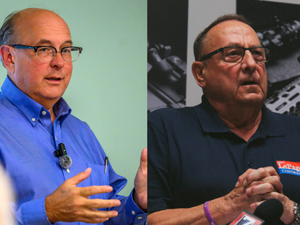
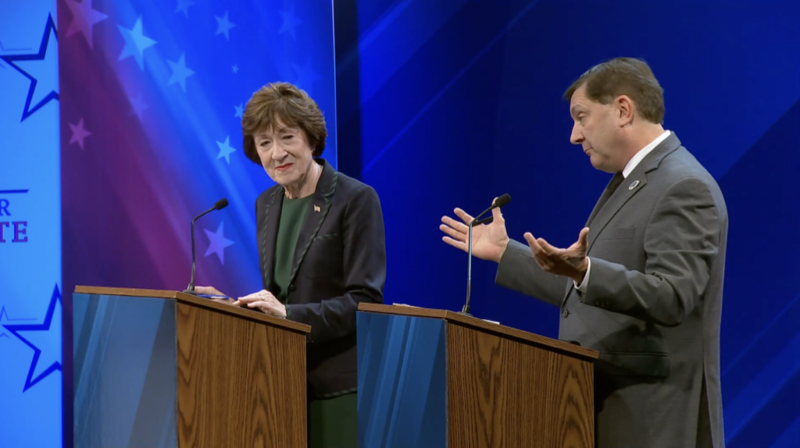
U.S. Sen. Susan Collins and her Democratic challenge, Troy Jackson, met in Bangor for their fourth and final debate on Oct. 15. (Screenshot courtesy of Maine Public/ News Center Maine)
Incumbent Republican U.S. Sen. Susan Collins and Democratic nominee Troy Jackson offered new insight on how they view the state of American democracy, gun rights, campaign finance and more during their final debate on Thursday.
The debate, hosted jointly by the Portland Press Herald, Maine Public and NEWSCENTER Maine at Gracie Theatre in Bangor, was the fourth in two weeks and the only that included questions submitted directly from voters, in addition to moderator questions.
While the debate had a live audience, attendees were invited by the campaigns, not members of the general public. The format of debates had been a point of disagreement, as Jackson’s campaign had requested town hall-style forums, where voters could ask questions on the spot.
Jackson continued to try to tie Collins to President Donald Trump on Thursday, while the five-term senator again pitched her seniority as most beneficial to Mainers, something that has been a thorough line in earlier debates and the campaign season.
Tensions were high both on and off stage Thursday. In addition to the candidates continuing to take jabs at one anothers’ records, fifteen minutes into the debate a member of the audience interrupted, yelling to Collins, “AI data centers are destroying our climate,” before being escorted out.
Collins turned the blame on Jackson, saying, “so this is obviously one of Troy’s supporters.” Jackson responded, “Oh shut up, I don’t even know that kid.” The audience member had a press badge on but it was unclear who he was.
Collins says democracy ‘will be just fine.’ Jackson disagrees.
One of the voter questions came from Bridget O’Brian of Harpswell, who asked what they thought of the state of democracy in America today.
Collins called the U.S. “the greatest nation on earth,” before saying presidents from both parties have tried to expand their power historically.
“I think that Congress does need to keep reasserting itself,” she said. “But I think our democracy will be just fine.”
Jackson responded that it would not be fine if the administration takes away people’s voting rights. Trump has attempted to restrict voting by mail, purge voter rolls and send sensitive personal information to the Department of Homeland Security, among other efforts.
The Democrat pinned the future of democracy on his party taking control of the U.S. House of Representatives and Senate to be able to hold Trump accountable.
“The Republicans have totally given up their willingness to do that,” he said.
Gun rights
Both candidates were asked if they would support an assault weapons ban, like the one that had been in place nationally from 1994 to 2004. These assault weapons have been used in many mass shootings, including the one in Lewiston in 2023.
Collins said she has voted to ban bump stocks and supports a “reasonable limit” on magazine capacity. She also pointed to her support of the 2022 Bipartisan Safer Communities Act.
Meanwhile, Jackson said outright he would support an assault weapons ban, though with the caveat that he wouldn’t take firearms from people who already own them. “I don’t see a good reason for assault weapons,” Jackson said. “You can’t use them for hunting or anything like that.”
The candidates were also asked if they would raise the age to buy a gun from 18 to 21.
Jackson said no. Collins said she’d be open to raising it, but didn’t specify an age.
Jackson’s views on gun rights have shifted. He initially voted against proposals to expand background checks and implement a 72-hour waiting period for firearm purchases, but after the Lewiston mass shooting, came out in favor of such proposals.
National debt
The national debt is roughly $40 trillion and Trump’s signature spending law, known as the “One Big Beautiful Bill,” adds another $4 trillion to that total. That debt impacts everyday Americans through higher borrowing costs, stagnant wages, and higher prices, according to the Government Accountability Office.
Collins said the government should focus on growing the economy and “not pursue policies as Troy would and as he has here in Maine that impose enormous tax burdens on the people of Maine.”
Jackson criticized tax cuts for wealthy people in the “One Big Beautiful Bill,” which Collins helped advance but ultimately voted against. He also pointed out that the national debt has grown nearly eight-fold during her tenure, which began in 1997. “And somehow it’s my fault?” Jackson said. “I mean, in Maine, we have a balanced budget. Has it grown? Yes, but it’s still balanced.”
Collins pointed to the state’s projected $1 billion structural gap saying, “That happened under Troy’s watch.” (Such gaps are not novel and revenue projections due in December could also alter the estimate.)
Jackson, who served as president of the Maine Senate from 2018 to 2024, responded, “I don’t think I’ve been in the Legislature for the last two, three years.” That response was met with laughs from the audience.
Campaign finances
During the third debate on Tuesday, Jackson said he would release his financial disclosure the next morning, which he did not do. Collins brought that up Thursday night.
Both Jackson and Collins submitted their reports to the Federal Elections Commission on Thursday, the deadline to do so. Overall, they show Jackson, who became his party’s nominee in late July, outraised Collins from July through September.
Jackson admitted to not meeting his self-imposed deadline. “We had over 200,000 people that gave to our campaign,” he said. “I had to make sure this report was done right. It was my first one. I had to make sure it was right because I don’t have Donald Trump getting me out of investigations like you do.”
He was referring to reporting from ProPublica last month that found the FBI had been looking into Collins’ alleged involvement in a pay-for-play scheme in recent years until Trump’s purge of the bureau ended the inquiry. Collins has denied any wrongdoing.
Jackson has pledged to refuse corporate PAC money. On Thursday, Collins painted the ads he has done with the Democratic Senatorial Campaign Committee as breaking that pledge.
“Those ads obviously are done without my approval,” Jackson said, later adding, “that would be illegal for me to make those decisions.”
But ads between a national party and candidate are legal. And over the summer, the U.S. Supreme Court removed limits on how much political parties can spend in coordination with candidates.
Both Jackson and Collins have ads with the DSCC and the National Republican Senatorial Committee, respectively.
Ad spending by outside groups for this race has reached $200 million, $75 million of which is from essentially untraceable sources, known as dark money. Both candidates were asked if they think it is important for the public to know who is trying to influence their vote.
Both said they did.
Collins pointed to her co-sponsorship of the Bipartisan Campaign Reform Act of 2002, which largely has not stood constitutional muster. She said she supports full disclosure of donors.
Jackson said he supports overturning the Supreme Court’s landmark Citizens United v. FEC decision in 2010, which allowed for unlimited election spending by corporations and labor unions. He also said he’d be open to exploring if Maine’s Clean Elections program could work on the national level.

Augusta, ME