Key takeaways from Maine’s fourth and final gubernatorial debate
Oct 14, 2026 | 11:15 pm ET
Description
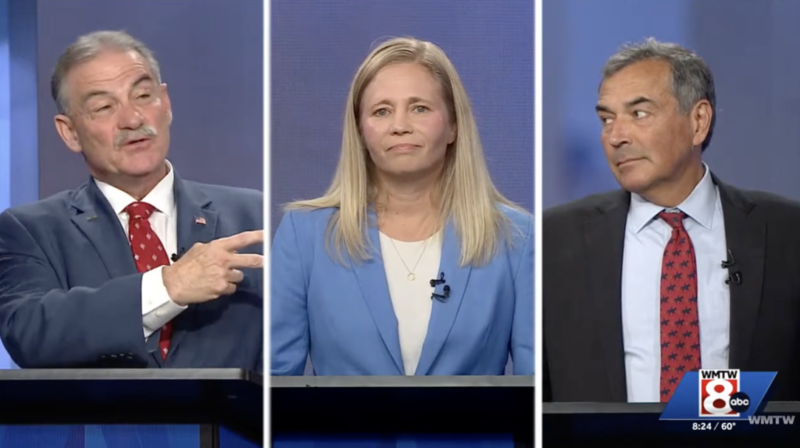
Maine's three candidates for governor, (left to right) Republican Bobby Charles, Democrat Hannah Pingree, and independent Rick Bennett, met on October. 14 for their fourth and final debate. (Screenshot courtesy of WMTW)
The three candidates running to be the next governor of Maine — Democrat Hannah Pingree, Republican Bobby Charles, and independent Rick Bennett — met for the fourth and final time on the debate stage Thursday evening.
In the hour-long debate, hosted by WMTW, the candidates touched upon familiar topics, including housing, education, immigration enforcement, healthcare, and the state budget.
The event also highlighted several key dynamics that have emerged in the race, with Charles frequently attacking Pingree, seen as the frontrunner, often repeating falsehoods about her record serving in the administration of Gov. Janet Mills and as former speaker of the Maine House of Representatives.
Charles also accused Pingree of corruption, saying without evidence that she used her position in the Mills administration to secure a loan from MaineHousing for a nonprofit now run by her husband, Jason Mann. According to the Bangor Daily News, North Haven Sustainable Housing received an $840,000 forgivable loan from MaineHousing for rental units. Pingree said she was not involved in the award.
At one point, he also said these facts “are on ProPublica,” an apparent reference to the investigative outlet’s recent report on allegations of corruption surrounding Republican U.S. Sen. Susan Collins — not Pingree.
Bennett, who left the Republican Party to run as an independent, used those moments of finger-pointing to highlight what he described as the toxicity of the two-party system. Meanwhile, Charles rebuffed accusations that he has moderated his positions since the GOP primary. Maine Democrats have accused him of trying to mislead voters, an allegation he disputes.
At one point, Pingree brought up an audio clip leaked to the Bangor Daily News in which Charles said he would ask Trump administration border czar Tom Homan to send U.S. Immigration and Customs Enforcement and U.S. marshals “to be at our voting booths.”
Charles denied that he said that. “I never invited them into the polls,” he said.
Here are some other take-aways from Thursday’s debate:
On affordability, who’s to blame?
A key issue across the state is the rising cost of living, something moderator Jon Chrisos touched on repeatedly. But the candidates’ responses showed that when it comes to the reasons behind the state’s current economic challenges, some are looking at Augusta while others have their eyes on Washington, D.C.
In response to a question about energy prices, Pingree noted that the rising cost of natural gas and storm recovery expenses “are the primary driver of Maine’s electricity rates,” and said she would rein in utility profits, invest in clean electricity and efficiency to help make energy more affordable. But she quickly pivoted to the war in Iran and the need to become less reliant on imported fossil fuels.
“I will just say that my opponent Bobby Charles has supported Donald Trump’s war in Iran, his tariffs that have raised energy prices,” Pingree said.
In response, Charles was quick to pin energy prices on Pingree, who served several years as director of Mills’ Office of Policy, Innovation and the Future focusing on climate, workforce development, housing, issues facing youth and older Maine people, the opioid crisis, and Maine’s long-term economic prosperity — not energy.
“Hannah Pingree was in charge with Janet Mills for the last six and a half years and beyond…She owns this issue,” Charles said. Pointing to rate increases in recent years, he added, “That is not Trump’s fault. Now, a reminder that Maine is spelled M-A-I-N-E, not T-R-U-M-P.”
Later, in response to a question about what the candidates would do to address the closure of healthcare facilities, Pingree repeated her support for a public insurance option, increasing investments in primary and maternity care, and making a plan to keep birthing clinics open. But then again she pivoted to Trump.
“I will say that Donald Trump’s Big Beautiful Bill is going to make it much much worse,” Pingree said. “Cuts to Medicaid, Medicare, cuts to our prescription drug programs. We’ve already lost (Affordable Care Act) coverage for thousands of Maine people, so the job is not going to be easy.”
Charles said the Mills administration expanded MaineCare but did not fund it, even though 90% of Medicaid expansion is paid for by the federal government. He said if elected he would raise the state’s reimbursement rate for healthcare providers and incentivize doctors to practice in areas of need.
Bennett said “both Hannah and Bobby are correct” that the healthcare system is “under assault by the Trump administration.They’ve also been under assault by inaction by the Mills administration.” He said the closure of 12 birth centers “were lost while (Pingree) was in office working with the governor on healthcare.”
Chrisos clarified that Pingree did not work for the state health department or on issues related to healthcare.
Not party people
Each candidate also made a point to distance themselves from the establishment parties, which polls have shown to be consistently underwater in terms of favorability.
Pointing to Washington Post reporting that after the GOP primary, Charles’ campaign website “removed references to MAGA for Bobby Charles and other Trump-related material,” Chrisos asked the Republican about his relationship to Trump and the MAGA movement.
“At the end of the day, there are things that Trump’s done right, and there are things that he’s done wrong,” Charles said.
Reiterating his opposition to tariffs and the war in Iran, he continued, “I’ve never met the guy. I have no pictures with him, but I’ll interact with him, and I’ll have a good relationship, because we need a relationship with the federal government that will help Mainers.”
When Vice President JD Vance came to Bangor in August, Charles did not attend, though Vance said he’d “been an amazing fighter for the state of Maine,” and would “make a more amazing governor.”
And despite Pingree’s high profile role in the Mills administration, she outlined the ways she disagreed with the governor, including Mills’ opposition to tribal sovereignty, the data center moratorium, the red flag law and some labor bills. She also said she would tackle challenges with healthcare and housing in a “much more accelerated way.”
“We don’t all agree in the Democratic Party, and I think that’s how it should be,” she said.
Bennett, who formerly chaired the Maine GOP and served for years as a Republican in the Maine Legislature, was put on the defensive when asked why he left the party. He said, “in recent years, I’ve come to the conclusion that the parties are actually a large part of the problem of our democracy.”
Describing partisan bickering as “toxic and off-putting,” he said, “The fight goes on and on and on, and people’s needs aren’t met. We need to get back to a politics of compromise and collaboration. The party candidates can’t do that.”
But Pingree pushed back. Acknowledging that Bennett was always “independent minded,” she said he’s a lifelong Republican who only left the party when he decided to run for governor, “because he knew he couldn’t beat Bobby Charles because the party has gone MAGA.”
“You could have left the Republican Party on Jan. 6,” she said.
Augusta, ME