Kansas Board of Regents adopts early warning rule for college athletics deals with private equity
Description
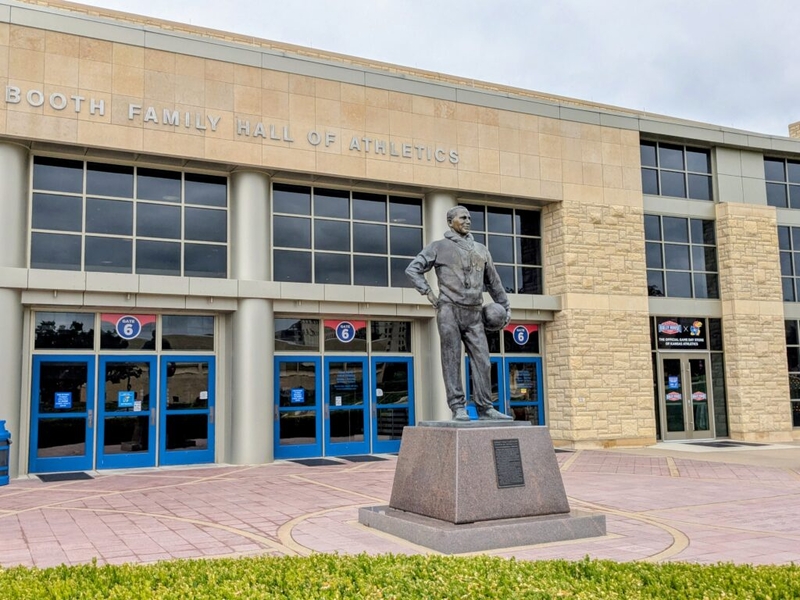
The Kansas Board of Regents adopts new policy guiding development of agreements between public university athletic departments and venture capital or private equity companies. Negotiations must be disclosed to Board of Regents leadership and the board will review deals prior to implementation. In this July 2025 image, a statute of University of Kansas coach Phog Allen stands outside Allen Fieldhouse. (Photo by Tim Carpenter/Kansas Reflector)
TOPEKA — The Kansas Board of Regents amended policy to require officials at the six state universities to notify the higher education board’s leadership of discussions about partnerships between intercollegiate athletic departments and private equity or venture capital firms.
Text in the policy regarding disclosure of “material discussions” likely to lead to proposed agreements was left intentionally vague, but the rule required university officials at some juncture to notify the Board of Regents’ CEO and the board’s chair. In addition, the policy says all contracts and agreements between a university athletic department or athletic-affiliated corporation and entities engaged in private equity or venture capital must be approved by the Board of Regents before implementation.
It’s unclear why the Board of Regents convened a special meeting Friday to unanimously approve the policy rather than wait until a regular meeting Wednesday in Wichita.
The Big 12 Conference’s university presidents and chancellors in April ratified a five-year financial arrangement with College Athletic Solutions, which is a partnership between RedBird Capital Partners and Weatherford Capital. RedBird Capital is a private equity firm with ownership ties to networks offering sports programming. The investment firm Weatherford Capital has a stake in IMG Academy, a $102,000 per year boarding school for athletes in Florida.
The agreement didn’t transfer university or Big 12 governance authority, ownership interests or revenue rights to College Athletic Solutions.
The Big 12 office received $12.5 million to promote commercial development. Each of the 16 conference universities were given the option of taking a $30 million line of credit. The interest rate on the cash would be near 10% and repaid through conference revenue sharing. The partnership with the Big 12 could eventually serve interests of all parties when the conference negotiated a new media rights contract in 2031.
Kansas State University and most other Big 12 schools said they wouldn’t accept the $30 million credit line. The University of Kansas said it hadn’t decided whether to take the offer.
An earlier draft of the policy was revised to declare the Board of Regents wasn’t assuming oversight of coaches’ contracts, sports conference agreements or name, image and likeness deals involving athletes.
“We want to make sure, of course, that we are supportive of the universities … as we look at the fact that we do have a lot of critical short-term sort of financial issues in terms of athletics,” said Alysia Johnston, chairwoman of the Board of Regents from Edna in southeast Kansas. “We want to make sure, of course, that does not jeopardize anything that we should do long term.”
She said the board would be able to go into executive session to avoid disclosure of proprietary information or trade secrets of companies seeking to do business with university sports programs. Final votes by the Board of Regents would be subject to the Kansas Open Meetings Act.
“We’re just trying to make sure that down the road … we don’t somehow do something that would remove control or be a detriment to the finances or to the sustainability of not only the athletics programs but the universities in general,” she said.
Regent Blake Benson of Pittsburg asked about clarifying for university officials what was meant by policy text that says notice to the Board of Regents must occur “before engaging in material discussions that are likely to lead to a proposed transaction, agreement or arrangement” between a university and outside investment business.
He appeared concerned use of the phrase “material discussions” in the policy might not be universally understood.
Board of Regents general counsel John Yeary said the disclosure requirement wouldn’t be triggered during an initial meeting between a university and a private equity company.
“I think the idea is … if there is interest after an initial meeting and it’s, ‘Let’s talk further,'” he said. “Maybe when it gets a little more serious and looks like something that might proceed.”
Peter Johnston, a Salina attorney serving on the Board of Regents, said there was benefit to not refining the reporting mandate.
“From my vantage point, the language is, I think, fine. There’s some benefit in the ambiguity,” he said. “I really value flexibility in this space way more than in other spaces. I think the institutions need to have a free hand to a great degree.”

Topeka, KS