Televising an execution wouldn’t be justice. It would be a snuff film dressed up as spectacle.
Oct 14, 2026 | 1:11 pm ET
Description
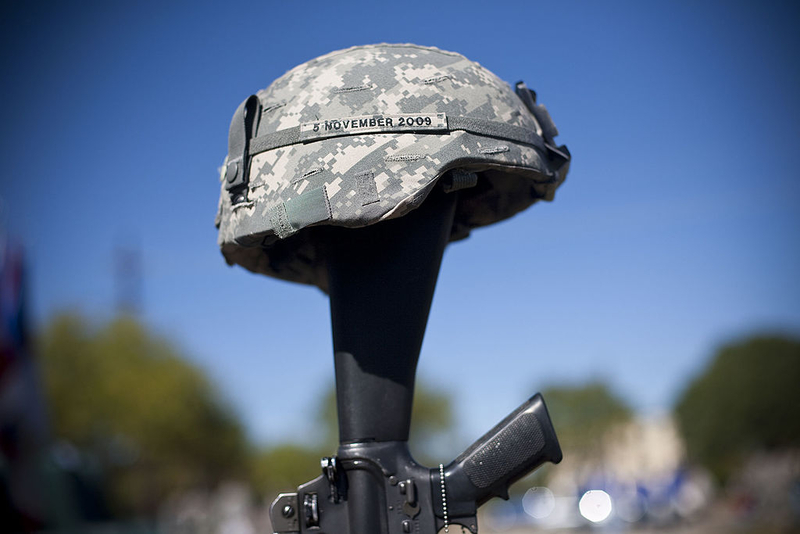
The soldiers memorial reads the date November 5, 2009 at a remembrance service recognizing the 13 victims killed in the Ft. Hood attacks on the one year anniversary in Killeen, Texas, on Nov. 5, 2010. Major Nidal Malik Hasan, an army psychiatrist, was later convicted killing 13 and wounding 30 during a shooting rampage in 2009. (Photo by Ben Sklar/Getty Images)
Executions are conducted like rituals, at least in Arizona.
The witnesses are ushered in as solemnly as at a funeral and seated as precisely as guests at a wedding: government officials, families of the victims, guests of the soon-to-be decedent, journalists.
A disembodied voice announces over a speaker that the execution has started. Viewed on a closed circuit TV, a team of men dressed uniformly in black escorts the prisoner into the chamber and straps him to a table. Another team, this time in white, swarms over him to set IV lines. A curtain opens dramatically, and there he is, blinking and gaping awkwardly at his audience. Or staring dumbly at the ceiling, lost in his last moments.
The warden reads the death warrant. The condemned person is asked for last words, but often declines, because what is there to say?
Silence. Everyone watches as the man’s eyes close, his chin drops, his chest slows, his breathing stops. A long moment passes, though it seems like hours.
Then, the voice on the speaker announces that the execution has been completed, and everyone is hustled out of the room. The journalists, and often the victims’ survivors, retreat to a conference room to stand before TV cameras. The ranking prosecutor gives a homily about closure and justice served to drive home how necessary this was.
Sometimes the victims rage. Sometimes they are reflective. The reporters tell everyone how peaceful it was — except on those occasions when it isn’t. The recent Tennessee failed execution, for example. Or the 2014 Arizona botch when a man gasped and choked for two hours before executioners finally finished him off with the fifteenth dose of what should have killed him in one. Or countless other examples.
Four prison administrations ago in Arizona, there was even a buffet with cold cuts afterward, as at a funeral, though no one seemed inclined to eat.
What is disturbing about execution by lethal injection is that, if done as planned, it looks like nothing. But a person has died in front of you, and that alone keeps you up at night.
The point of witnessing is not for the spectacle. It’s not for entertainment. It is to make a record, to assure that the procedure is carried out legally, fairly and humanely.
I have witnessed seven executions and covered at least as many more as a reporter in the press scrum. In 2007, the day after I witnessed my first, I got a call from a top Arizona law-enforcement official who had also witnessed and wanted to get something off his chest.
“They go to great lengths to make this look like it is not a violent act,” he said.
That is the purpose of the ritual.
Now, Secretary of Defense Pete Hegseth wants to livestream the execution by firing squad of former Army officer and psychologist Nidal Hasan, who, in 2009, murdered 13 service members and injured 32 others at Fort Hood, Texas, while shouting “God is Great” in Arabic.
It was a horrid crime, the kind that merits the death penalty in the military, in federal law and in the laws of those states that still keep capital punishment on the books. Hasan earned his death penalty. Hegseth thinks it is a teaching moment worthy of a ritual.
“We’ll make sure that people are able to watch it, that’s the public,” he told the media, “because people need to understand there’s serious consequences for these types of things.”
Hegseth fashions his oratory after evangelical preaching. He quotes Old Testament scripture. The religiosity is interspersed with rants about testosterone and transgenderism and “lethality,” an uncomfortable mishmash of sexuality and violence and religion.
“We will hunt you down without apology and without hesitation, and we will find you and we will kill you,” he intones in a recent TV ad.
Sigmund Freud theorized that sex and violence shared a part of the psyche he called the Id, which he described as operating completely on the desire for immediate gratification, regardless of logic or moral consequences.
What is the logic and morality of watching people die?
In a sense, we have already been watching public executions on our TVs and other screens: the shooting deaths of Alex Pretti and Renee Good by ICE agents, the missile attacks on alleged drug-runner boats in the Caribbean. We were scandalized by videos of the public murder of the activist Charlie Kirk.
Here is the proposed black-and-white dichotomy: shooting a conservative icon was truly horrifying. No one needed to see it. But watching the shooting of a Muslim terrorist will be judicious and satisfyingly debasing, and never mind the taint of Holy Crusade.
In medieval times, execution was political commentary, and cruelty was the point. Transgressors were dragged behind horses from town to town, they were drawn and quartered, their bodies left to rot, their heads impaled on stakes.
Execution by firing squad in those states that still practice it is marginally more violent than lethal injection. They strap the prisoner in a chair and dress him in dark colors that don’t show the blood. They put a black hood over his head. The guns may poke through a hole in the wall so that the gunmen can’t be identified. But there is the flash and bang, the jerking and slumping, aural and visual shock to let the witnesses know that someone is most definitively dead.
It’s not supposed to look peaceful.
No one has been executed by military firing squad since 1945; they made a controversial TV movie starring Martin Sheen about that execution. The fact that there hasn’t been one since speaks volumes.
But who is to say what a military firing squad will look like in 2026? If it happens at all — and I don’t believe it will — I’m certain it will be grandiosely styled to symbolize Hegseth’s theocratic vision of the kingdom and the power and the glory, amen.
But instead of some dramatic scene worthy of a movie, featuring a dangerous-looking villain, they will be executing a middle-aged man who uses a wheel chair. That sounds more like a cheap snuff film.
A human sacrifice. A ritual. But in the name of what god?

Phoenix, AZ