Charleston County school board member can stay in office after state probe, SC governor decides
Oct 14, 2026 | 12:24 pm ET
Description
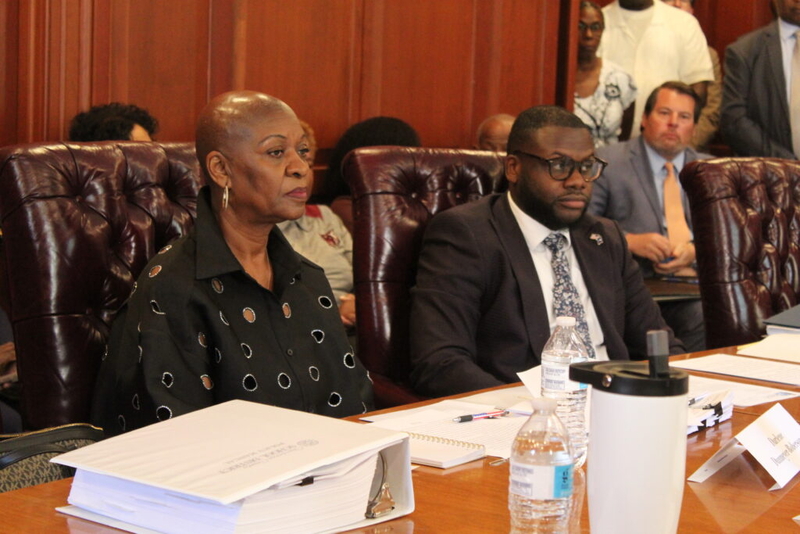
Darlene Dunmeyer-Roberson and her attorney, Rep. Kambrell Garvin, make a case during a hearing in Columbia, S.C., on Monday, Sept. 28, 2026. (Photo by Skylar Laird/SC Daily Gazette)
COLUMBIA — A Charleston County school board member can keep her seat, despite “unacceptable” behavior outlined in a state inspection, the governor said in a Wednesday letter.
The inspection found Darlene Dunmeyer-Roberson, who was first elected to the school board in 2022, leaked private information and helped arrange a deal for her former campaign manager, which she disputed during a hearing last month.
This was the first time a governor could decide whether to remove a school board member under a 2022 state law giving him that power.
The inspector general’s report’s findings “are deeply troubling,” Gov. Henry McMaster wrote the letter to Dunmeyer-Roberson.
“Some will find them outrageous,” he added.
But they didn’t rise to the level of removing Dunmeyer-Roberson from the board, he decided.
McMaster appointed a three-person panel composed of attorneys to evaluate the evidence against Dunmeyer-Roberson. They unanimously found Dunmeyer-Roberson inappropriately shared information covered under attorney-client privilege, according to the panel’s findings, also released Wednesday.
Dunmeyer-Roberson admitted to forwarding emails from district attorneys to local reporters. She believed the information was already public and didn’t read the fine text at the bottom of the emails noting they should remain private, she told the panel.
Dunmeyer-Roberson said in a statement she was grateful McMaster decided to keep her on the board but concerned “by certain conclusions and characterizations contained in his decision.”
“Although the question of my removal has been resolved, I believe it is equally important that the public have a full and accurate understanding of the record and the circumstances surrounding these allegations,” she said in the statement provided by her attorney, state Rep. Kambrell Garvin, D-Columbia.
Dunmeyer-Roberson and Garvin will evaluate the panel’s findings and the evidence from the hearing “to fully understand the findings and determine whether a further response is warranted,” the statement continued.
She said her “commitment to the children, families, and communities of Charleston County remains unchanged.”
In his letter, McMaster called the possibility of removing an elected official “a most significant action.”
“Judged alone, aside from unproved allegations — as they must be under obligations of due process and fairness — these facts do not justify the harsh penalty of removal,” McMaster wrote. “This is not a criminal case, yet a basic rule of criminal prosecution applies: the punishment must fit the crime.”
If McMaster removed Dunmeyer-Roberson, that would leave her constituents without their elected representative and keep her from serving through the end of her elected term, “both of which are rights protected by the Constitution of South Carolina and the Constitution of the United States,” he wrote.
Facing removal, SC school board member refutes accusations in first-of-its-kind hearing
The panelists unanimously agreed Dunmeyer-Roberson did nothing wrong in forwarding confidential emails to her personal email address, which she also used for her education consulting business when she had a contract with the district.
The attorneys didn’t have enough evidence to say Dunmeyer-Roberson helped her former campaign manager get a district contract or improperly shared information discussed in executive session.
That could be because Inspector General Brian Lamkin, who wrote the report detailing potential trouble in the district following his office’s investigation, doesn’t have the same tools as law enforcement officials, McMaster noted. He can’t get search warrants or have a grand jury help evaluate evidence, he wrote.
The inspector general’s report was sent to the State Law Enforcement Division as well as the Department of Revenue for further investigation. The hearing didn’t touch on questions raised in the report about whether Dunmeyer-Roberson lived in her district, which includes Edisto Island, Hollywood, Johns Island and Ravenel.
Nor did it address potential issues with her taxes.
Leaving Dunmeyer-Roberson on the board did not mean McMaster condoned her behavior, he wrote.
“My decision, however, is not an exoneration or excusal of your conduct,” McMaster wrote. “I find that your conduct while serving in this office has been unacceptable.”
Even though McMaster didn’t find enough evidence to remove Dunmeyer-Roberson from the board, he noted the investigation showed “unnecessary disruption” to the school board’s work.
“No board can function properly if its members violate attorney-client privilege and fail to respect the confidentiality of the Board’s sensitive deliberations, all as required by its own written policies and ethical considerations,” McMaster wrote. “There is no doubt that you committed misconduct in office by disclosing privileged information to non-school board members.”
Columbia