Rogers Behavioral Health charged with labor law violations for firing workers in union drive
Oct 14, 2026 | 4:30 am ET
Description
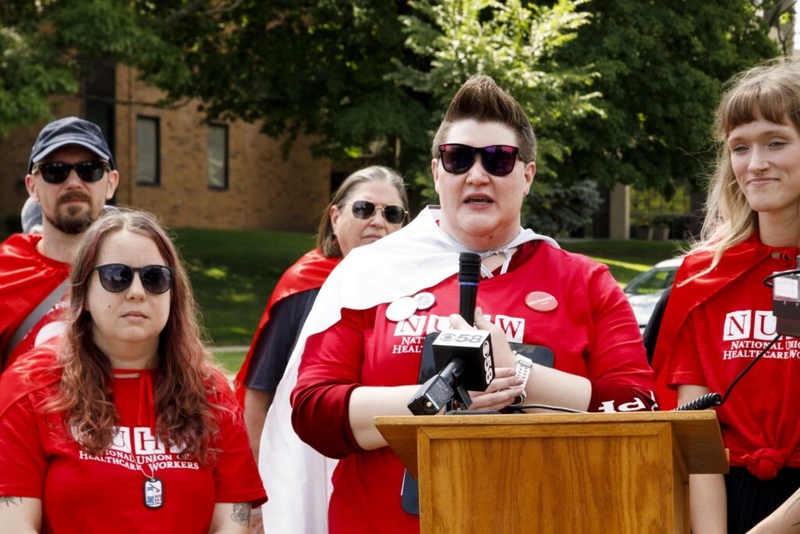
Kate Zolandz, a behavioral health therapist who was fired from Rogers Behavioral Health after actively supporting a union organizing drive, speaks at a rally in June in support of the union. Rogers has been charged with violating federal labor laws in a National Labor Relations Board complaint. (Facebook livestream screenshot)
Rogers Behavioral Health violated federal labor laws when it fired six employees amid a contentious union organizing campaign in Wisconsin, according to a National Labor Relations Board official in a new complaint against the healthcare provider.
Rogers officials also violated labor laws when they accused the employees of criminal conduct and threatened them with criminal charges, civil charges, litigation and professional misconduct complaints, the NLRB complaint charges.
Those actions took place starting two months before employees at Rogers’ clinic in West Allis voted to be represented by the National Union of Healthcare Workers, and continued on the day the vote was held and in the weeks that followed, according to the complaint.
Rogers executives fired the employees because they “supported and assisted the Union and engaged in concerted activities, and to discourage employees from engaging in these activities,” the complaint states.
The complaint, issued Oct. 8 by Minneapolis-based NLRB regional director Jennifer Hadsall, set a hearing on the allegations to start Dec. 14 before a labor relations board administrative law judge in Milwaukee.
In a statement issued Tuesday afternoon on behalf of Rogers by a staff communications, marketing and public relations specialist, the organization declined to comment on the allegations or “pending proceedings” because the case is “an active legal matter.”
The statement asserted that Rogers respects “all employees’ rights under the National Labor Relations Act” and conducted “all employment and labor practices” according to “applicable law and longstanding policies.”
Rogers Behavioral Health, based in Oconomowoc, operates a network of mental health hospitals, residential treatment clinics and outpatient clinics in 10 states.
Employees at three clinics in California and one in Pennsylvania organized with the National Union of Healthcare Workers starting a few years ago.
Spurred by policy changes that employees said led to increased client caseloads and reduced one-on-one care for clients, therapists and other behavioral health professionals at clinics in Madison and West Allis began organizing with the NUHW in 2025.
After a contentious organizing campaign that was met with strong opposition by Rogers management, on April 22 West Allis employees voted 53-4 and Madison employees voted 26-4 in favor of the union.
Rogers has declined to recognize the union at either clinic and has mounted an appeal to overturn the West Allis vote.
First firings after union drive goes public
Rogers fired three West Allis employees who were union supporters in February, shortly after they went public with a petition for union recognition.
According to the NLRB complaint, a Rogers manager directed the fired employees “not to discuss their terminations.”
At the same time, Rogers’ President and CEO, Cindy Meyer, directed employees in writing “to keep their terms and conditions of employment confidential,” the complaint states.
With those instructions as well as some broad Rogers policies directing employees to keep information confidential, Rogers officials were “interfering with, restraining, and coercing employees in the exercise of the rights” guaranteed under the National Labor Relations Act, the complaint states. The confidentiality policies, quoted in the complaint, are not limited to information about individual patients.
The union filed charges with the NLRB on behalf of the three employees fired in February. The charges enabled them to vote in the West Allis union representation election on April 22.
When they showed up at the clinic to vote, a fourth employee escorted them to the polling area where they cast their ballots, which were set aside as challenged under standard NLRB procedures. The employee then escorted them out of the clinic.
According to the complaint, Rogers suspended that employee the day of the vote and fired her five days later because she “assisted employees participating in the NLRB-conducted election” — and because she “supported and assisted the Union and engaged in concerted activities, and to discourage employees from engaging in these activities.”
That violated federal labor law by “discriminating against employees for their participation in a Board-conducted election,” the complaint states.
Matt Artz, a spokesperson for the NUHW, said Rogers tried to challenge her application for unemployment insurance but that the challenge was rejected.
Two other employees were also suspended on the day of the vote and fired five days later, the complaint charges — also because they supported the union and to discourage other employees.
Complaint charges attorney’s letter ‘coerced employees’
In the six firings, Rogers was “discriminating in regard to the hire or tenure or terms or conditions of employment of its employees, thereby discouraging membership in a labor organization” — also a labor law violation, according to the complaint.
The NLRB complaint also charges that an attorney representing Rogers wrote a memo to employees that “coerced employees” exercising their rights under federal labor law “by repeatedly characterizing protected employee activity as criminal activity, in violation of civil laws, and as professional misconduct; and threatened employees with criminal charges, civil charges, litigation, and misconduct complaints with their respective professional organizations for having engaged in protected activity.”
A Rogers vice president, Steven Hertig, sent a complaint against one of the fired employees, Kate Zolandz, to the state Department of Safety and Professional Services, which oversees professional licensing
The NLRB complaint doesn’t mention the license challenge, but the NUHW said in a press release Tuesday that in the filing with DSPS, the Rogers executive claimed that when Zolandz donned a cape during her lunch break on the day of the vote, “a patient became dysregulated.”
After reviewing the complaint, however, DSPS officials wrote back to an attorney representing Zolandz that the information in the licensing challenge “does not indicate a violation” of relevant state administrative codes or laws.
“We took a stand to improve care for our patients, and Rogers executives tried to ruin our careers,” said Zolandz in a NUHW press release Tuesday. “Rogers acted like it could do anything to us it wanted, so it’s great to see that the federal government is holding Rogers accountable to the law.”
Madison, WI