Cincinnati Public Schools has served hundreds with first-in-the-nation sleep lot for families
Description
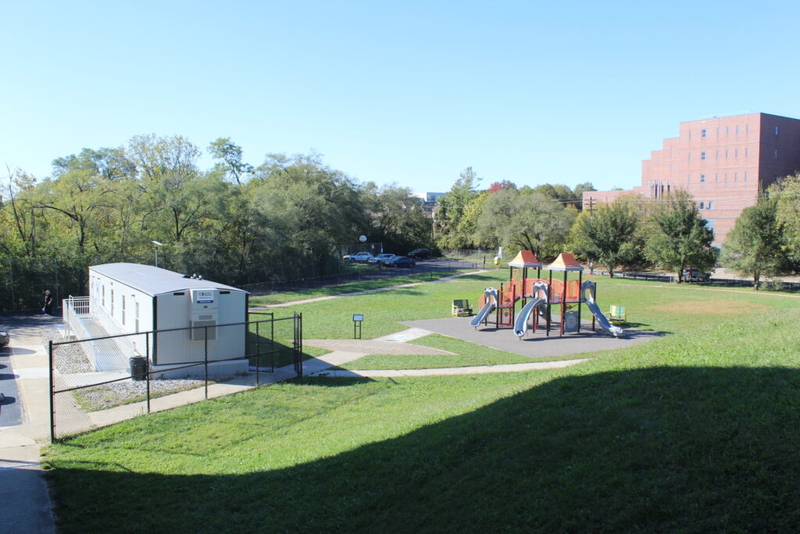
The modular unit and playground at Cincinnati’s Safe Sleep Lot at William Howard Taft Elementary School. (Photo by Megan Henry, Ohio Capital Journal).
Cincinnati Public Schools is the first school district in the nation to own and operate a parking lot where families experiencing homelessness can go to at night and sleep in their cars.
Cincinnati’s Safe Sleep Lot opened April 30 at William Howard Taft Elementary School and more than 300 people have slept in the lot so far, said Megan Rahill, shelter and housing specialist with Project Connect.
“A lot of times, when you’re sleeping in your car, it’s because you’ve exhausted all your social avenues of people you can stay with, and so they’re often feeling so isolated and like nobody cares anymore, and they’re on their own,” Rahill said.
“If they’ve already been sleeping in their car, it’s just on a dead-end street and it’s scary, so we’ve got a space you can come to where other people and other kids are there, there’s food and you don’t have to worry about where you’re going to the restroom.”
Project Connect is a program that provides support to students in the district experiencing homelessness under the federal McKinney-Vento Act that supports the enrollment and education of homeless students by making sure homeless youth have access to a public education.
Nearly 8% of Cincinnati Public School students — about 2,650 — experienced homelessness during the 2025-26 school year, according to data from the Ohio Department of Education and Workforce.
The number of students experiencing homelessness in the district has mostly been on the rise in the last five years — up from about 2,000 students experiencing homelessness during the 2021-22 school year, according to ODEW data.
The district also noticed a “pretty significant increase” of families experiencing homelessness sleeping in their cars, said Project Connect Manager Rebeka Beach.
Families sleeping in their cars often do not know where to safely park their car overnight. Sometimes, they would park somewhere and feel unsafe or the police would ask them to move, Rahill said.
“It was hard to have a consistent spot or they’re parked in the Kroger parking lot, but then you’re worried maybe someone I know will see me,” she said.
People staying in their cars often don’t have a place to go to the bathroom, shower, access water, or cook food.
“I had a parent tell me ‘We feel like we’re just like animals. We don’t have facilities that we can use. We’re trapped in this little vehicle,” Rahill said.
A street outreach worker from Greater Cincinnati Behavioral Health Services has to see someone sleeping in their car in order to have them verified to be put on a homeless shelter waiting list.
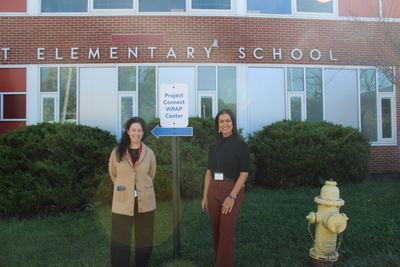
“We were hearing so often from parents that it was taking so long to get verified just to get on the waiting list for shelter because they moved so much throughout the night they couldn’t connect with the street outreach worker,” said Beach, who has been working for the district for nearly twenty years.
“In one week we had two parents who came in and said they had lost their employment because they’d fallen asleep just because they were up watching their children during the night and couldn’t sleep.”
That’s when the district started looking into some ideas to help families.
Project Connect discovered San Diego’s Safe Sleeping Program and Long Beach City College’s Safe Parking Program, so they went on a research trip to California.
“We decided we wanted to open our own safe sleep lot,” Beach said.
Once Project Connect had the idea for the Safe Sleep Lot, it took just under a year for the lot to open.
“One of the reasons that we created the lot was that that the process (to get verified) can be quite cumbersome for a family,” Rahill said.
“It’s so early in the morning that they’re coming. Oftentimes our families are going to work, they’re taking the kids to school, they’ve been ships passing in the night.”
When a family spends a night in the Safe Sleep Lot, they are automatically verified and added to a shelter waiting list.
“The Safe Sleep Lot serves as a bridge to shelter, so families sleep in the lot, they’re verified within 24 hours,” Beach said.
How the Safe Sleep Lot operates
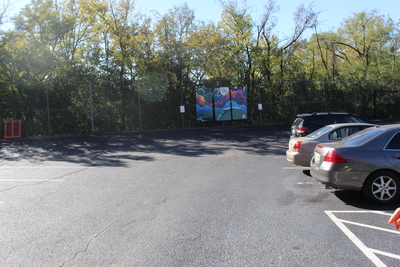
The Safe Sleep Lot has 12 spaces and is open daily from 9:30 p.m. to 6:30 a.m. There are typically between three to eight families that stay in the lot every night.
A family gets referred to the Safe Sleep Lot and then Project Connect does an intake appointment. Once they are accepted, families receive a bag with pillows, towels, blankets, and laundry pods. The kids also get to pick out a stuffed animal.
Each family that stays in the lot gets a parking pass with a unique code that security scans when they arrive for the night to help keep track of who is staying in the lot.
After a family spends a night in the Safe Sleep Lot, Rahill is able to get them on the shelter waiting list. She also gets the family a hotel stay.
Project Connect can put a family in a hotel for up to two weeks if they have CareSource as their health insurance provider. A family will still get a hotel stay if they don’t have CareSource, but instead it’s for four to six nights.
“We are quite transparent with them that it’s unlikely that the shelter placement will come through while you’re in the hotel,” Rahill said.
She encourages families to use that time in the hotel to try to find somewhere to stay.
“Most of the families are on that trajectory of Safe Sleep Lot, emergency hotel stay back to the Safe Sleep Lot on a waiting list,” Beach said.
There is no limit on how many nights a family can stay at the Safe Sleep Lot and the average wait time to get into a shelter typically ranges from one to two months, Beach said.
The Safe Sleep Lot has security, a library, wifi and a tutoring program will soon be available to families on Wednesday nights.
The Safe Sleep Lot is open March through November.
“We’re not really comfortable having people there when it’s really cold,” Rahill said.
Christ Church Cathedral will be able to host families during the winter months.
Project Connect built a modular unit through grant funds complete with a kitchen area, showers, bathrooms, and room for security. There are frozen meals, snacks, breakfast items, and hygiene items. A local nonprofit has also partnered with the Safe Sleep Lot to provide laundry services to families.
Project Connect is going to build a pergola so families can have a place to sit and stretch their legs.
The Safe Sleep Lot has led to more students being enrolled in school and some students are now enrolled at Taft Elementary School.
“We do have quite a few students who now go to (Taft Elementary) because we were able to use the address of the Safe Sleep Lot,” Rahill said. “They’re just taking their kids to school in the morning from the Safe Sleep Lot.”
“Once they get into shelter or to a more stable address, then the next step is we we set up transportation for them, so that they can stay at the same school. The closer we get to that really stable point, the attendance starts to rise.”
For students experiencing homelessness, Beach likened it to Maslow’s hierarchy of needs.
“If your basic needs are not being met, you’re not positioned to learn,” she said.
“Our goal is for families to be able to sustain jobs that provide for livable wages and be able to sustain housing and exit shelter.”
She hopes other school districts will be able to create their own version of the Safe Sleep Lot and was, at one point, receiving calls daily asking how the district made the lot.
“I really want to build a blueprint out of how we did it, so that it’s replicable,” Beach said.


Follow Ohio Capital Journal Reporter Megan Henry on X or on Bluesky.
Columbus, OH