Three weeks out, Foulkes is 9 points ahead of Block in WPRI poll
Oct 13, 2026 | 5:00 pm ET
Description
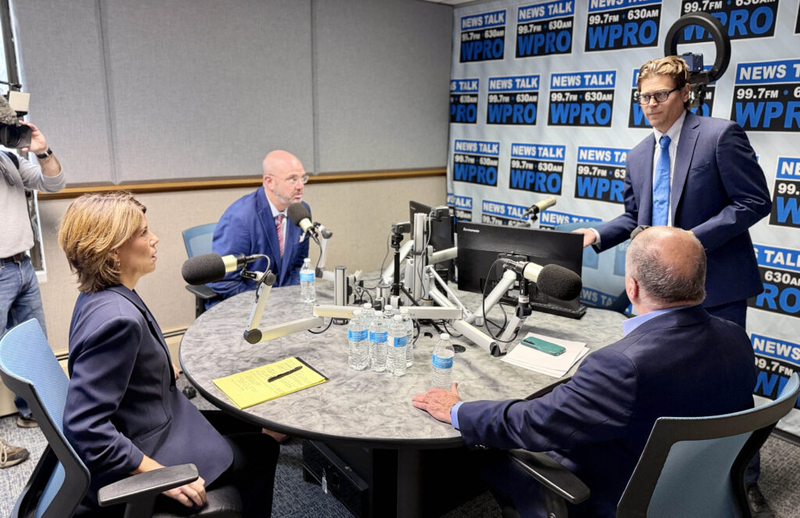
WPRO host Bill Bartholomew, standing, interacts with Rhode Island gubernatorial candidates Democrat Helena Buonanno Foulkes, seated far left, and Republican Aaron Guckian, second from left, and independent Ken Block, seen from the back at far right, on Tuesday, Oct. 13, 2026. (Photo courtesy of Cumulus Media)
Democrat Helena Buonanno Foulkes continues to lead the five-way race for governor, even as independent Ken Block has narrowed the gap, according to a WPRI-TV 12 poll published Tuesday.
The survey of 800 likely voters, conducted by Emerson College from Oct. 8 to 11, puts Foulkes 9 points ahead of Block — compared to the 27 points between the two candidates in a survey conducted in August. The margin of error is 3.5%.
While Foulkes still has the support of more than 4 in 10 likely general election voters — nearly identical to two months ago — Block has gained ground, with more than 1 in 3 voters backing him now, compared with 1 in 5 in August.
Meanwhile, the share of undecided voters shrank from 14% to 9%. Also on the decline: enthusiasm for Republican nominee Aaron Guckian.
Only 10% of survey participants said they supported Guckian, compared with 18% backing an unnamed GOP nominee in August before he won the Sept. 9 primary.
Could Block come from behind and win the election?
“Nothing is impossible,” said Joe Fleming, a political analyst for WPRI.
But Block will have to broaden his appeal beyond undecideds and conservatives to pull from Foulkes’ Democratic base. That could prove challenging, Fleming said.
All three candidates have traded barbs on debate stages and in political ads and mailers over their ideology. The Rhode Island Democratic Party spent $300,000 to send out mailers on Foulkes’ behalf, accusing Block of secretively being a Republican.
Block, who has run for governor twice before, once as a Moderate and then again as a Republican, came out with two new TV ads Monday leaning on his work fighting the political establishment, including disproving the Trump campaign’s allegations of voter fraud in the 2020 election.
But Block’s statement on reproductive rights during an Oct. 30 gubernatorial forum, pledging to sign any bills passed by the General Assembly, drew fierce rebukes from Foulkes and from all 68 Democratic state lawmakers.
Another potential turnoff for Democratic voters: Block’s opposition to the Affordable Care Act, a position he restated when asked during a WPRO debate Tuesday morning, citing the cost to small business owners.
Pocketbook problems top voter concerns
Health care access and costs remain a concern of voters, though the survey found taxes and spending were the top problem respondents want state officials to tackle.
Block’s pragmatic focus on improving government efficiency, drawing from his work as a software engineer helping other state governments and private companies improve operations and root out waste, appeals to voters, Fleming acknowledged.
“The pocketbook issues really stand out a lot,” Fleming said. “For Ken Block, I would stay on that message.”
Key to getting the message out is raising money. Block had $263,000 cash on hand as of Oct. 5, the highest of any candidate, though his balance includes a $190,000 personal loan.
Foulkes, having depleted her campaign account with more than $5 million spent in the primary, had nearly $215,000 cash on hand. But Democratic groups came through with financial support, including the state party covering the cost of anti-Block mailers, plus $500,000 from the Democratic Governors Association.
No independent expenditures for Block or Guckian had been reported to the Rhode Island Board of Elections as of Tuesday.
Guckian, who narrowly defeated Elaine Pelino in the Republican primary, continues to struggle with lack of name recognition and donations. He had just $7,000 cash on hand as of Oct. 5.
After Block released an internal poll last month showing he could defeat Foulkes in a two-way race, calls mounted for Guckian to drop out of the race. Guckian’s campaign rejected the pressure, in turn suggesting Block should be the one to drop out.
More than half of Republican voters surveyed by WPRI picked Block, compared with 3 in 10 who backed Guckian. Block also drew support from nearly half of the independent voters included in the poll, while one-third supported Foulkes.
Block was the only one of the three who more voters viewed favorably than unfavorably, with a plus 27 rating. Guckian’s net rating was minus 20, while Foulkes was essentially neutral at minus 1, a signal to Fleming that McKee’s attacks on Foulkes have stuck with voters.
“His negativity on her paid off in the primary,” Fleming said.
In a statement Tuesday, Block said he was “encouraged” by the poll, pledging to “work every waking moment for the people of Rhode Island.”
“Rhode Islanders are realizing that Helena represents the political status quo and I am the only candidate who can defeat her,” Block said. “Voters don’t want another member of the political establishment, backed by special interests and out-of-state money, to serve as our next Governor.”
Foulkes’ and Guckian’s campaigns did not immediately respond to requests for comment.
Debate, take 2
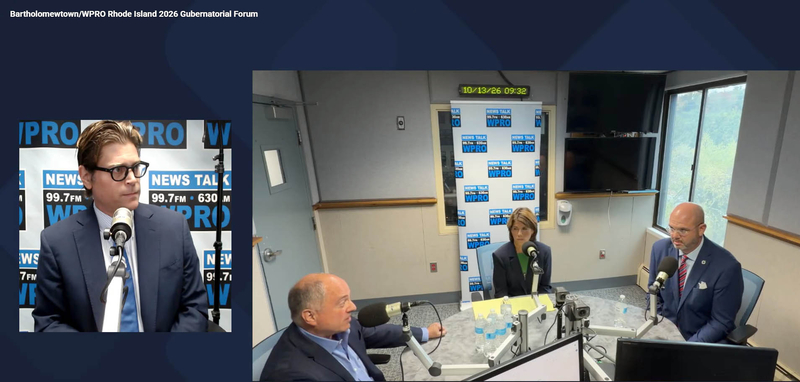
Block remained immune from scrutiny until the general election cycle, a point Guckian raised during the pre-taped debate at WPRO’s offices Tuesday morning.
“You cut the line,” Guckian said to Block, criticizing Block’s changing party identity while touting his own “right to be here” having survived a primary.
The hourlong event hosted by Bill Batholomew rehashed many of the same disagreements that unfolded seven days earlier in an Oct. 8 debate organized by NBC 10 and Coastal ABC.
On Tuesday, Guckian continued to attack Foulkes for her willingness to work with Democratic Providence mayoral nominee David Morales, a socialist.
“I have never seen someone who benefited from capitalism so much, and now she stands for socialism,” Guckian said, referencing Foulkes’ corporate career that includes 25 years at CVS Health.
Guckian, 50, of East Greenwich, most recently served as head of the Rhode Island Dental Association. A former aide to then-Gov. Don Carcieri, Guckian touted his ability to work with Republicans in Washington to yield funding for Rhode Island.
I have never seen someone who benefited from capitalism so much, and now she stands for socialism.
Foulkes, 62, of Providence, reprised similar criticisms of Block over the lack of detail in his housing and education policies, while Block denounced both his rivals.
“Aaron’s plan is to have the federal government swoop in to save the day, and Helena’s plans are heavy on empathy but light on fact-based solutions,” Block, 61, of Barrington, said in closing statements.
Much of the debate focused on housing — the second most-pressing issue among voters surveyed by WPRI and the top issue for registered Democrats.
Aaron’s plan is to have the federal government swoop in to save the day, and Helena’s plans are heavy on empathy but light on fact-based solutions.
Foulkes has proposed a public revolving fund to encourage private developers, using money from the state millionaire’s tax. Block emphasizes an individual approach tailored to each municipality, while Guckian suggested creating communities of modular homes specifically for veteran and frontline workers.
Criticizing her opponents, Foulkes said, “My takeaway from both of these folks is they don’t really think there’s a housing crisis.”
Foulkes was also vehement in her pledge to fight federal immigration authorities “with every bone in my body,” while Guckian warned that failure to cooperate with ICE and law enforcement would lead to increased crime.
“You defund police, and socialism is going to attract more and more bad actors and people who are not documented,” Guckian said.
Block did not wade into the immigration debate, focused on pragmatic solutions to cut red tape and improve government efficiency.
All three candidates said they would lean into Rhode Island’s blue economy to boost jobs and suggested higher reimbursement rates for government and commercial health care as a solution to the primary care doctor shortage.
None of them wanted to keep Rhode Island Commissioner of Elementary and Secondary Education Angélica Infante-Green in her cabinet position, and each stressed the need to overhaul management in the Rhode Island Department of Transportation.
While Foulkes’ housing plan leans on a tax on income over $1 million, Block and Guckian both opposed the tax, which took effect July 1 as part of the state’s fiscal 2027 budget.
My takeaway from both of these folks is they don’t really think there’s a housing crisis.
The three will meet for a third, and final debate, hosted by WPRI-TV at Rhode Island College, on Tuesday, Oct. 20.
The gubernatorial race also includes two other independent candidates, Jay Gotra and C.D. Reynolds, who have not qualified for any of the debates under station criteria.
LG race a ‘nail-biter’
In the lieutenant governor’s race, WPRI’s poll put Democratic incumbent Sabina Matos tied with Republican challenger John Loughlin. The findings echo results of a University of New Hampshire survey from Sept. 25, though more voters, 12%, were undecided in the WPRI poll.
Despite defeating four challengers in the Sept. 9 primary, Matos remains haunted by the signature fraud scandal from the 1st Congressional District Democratic primary in 2023, Fleming said. Matos finished a distant fourth in the race that elected now-U.S. Rep. Gabe Amo, and was never linked to the forgeries that led to criminal charges against two campaign workers.
Loughlin, a former state representative from Tiverton and former talk radio host, enjoys modest name recognition helping boost his campaign, Fleming said.
Neither candidate has significant campaign cash — Matos had $43,000 in the bank as of Oct. 5 while Loughlin had $22,800 — though Fleming speculated Matos may benefit from independent expenditures on her behalf, as she did in the primary.
“It’s going to be a nail-biter,” Fleming said of the lieutenant governor’s race.
WPRI is set to release a second round of poll results at 10 p.m., focused on Rhode Island’s congressional races and Trump’s approval rating. There will also be more results published Wednesday morning.
Early voting begins Oct. 14 ahead of the Nov. 3 general election.
This story will be updated.
- 5:53 pmUpdated to include a comment from Ken Block on the poll results.
Providence, RI