Clean Elections Commission to high court: Green Party candidates’ harm is self-inflicted
Oct 13, 2026 | 6:15 pm ET
Description
(Photo by Jim Small/Arizona Mirror)
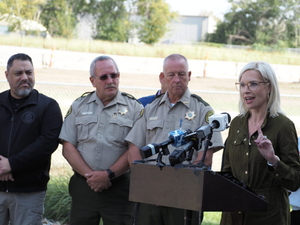
The director of the Clean Elections Commission told the Arizona Supreme Court that two Green Party candidates being investigated for campaign finance fraud are working to “recklessly vilify public servants” through their lawsuit against the commission.
“Snide soundbites, cloaked in hyperbolic opinion and lacking actual evidence, should not be strewn about recklessly,” Tom Collins, executive director of the Clean Elections Commission, said in response to the candidates’ petition to the Arizona Supreme Court. “Legal arguments do not require this approach to be persuasive or to make their point. This approach should be condemned.”
Last week, the state’s highest court agreed to consider the case after a trial court dismissed it and the Arizona Court of Appeals declined to hear it.
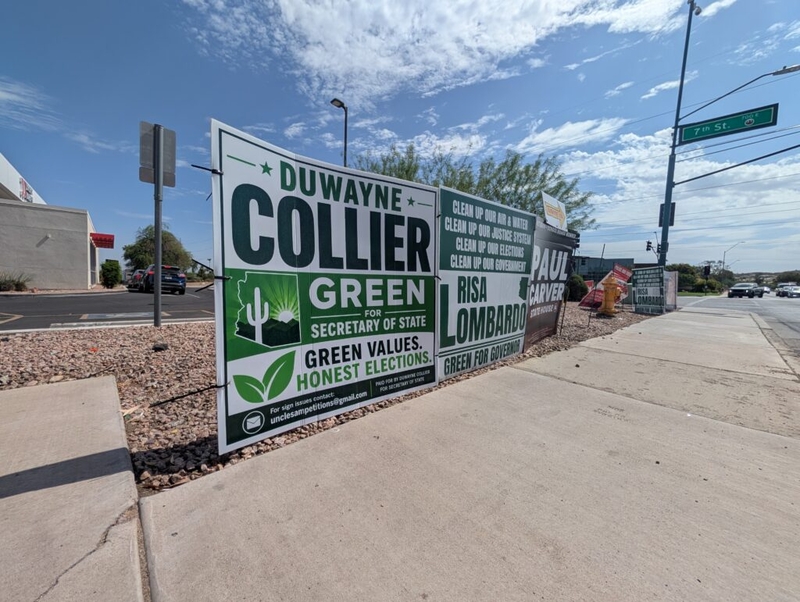
Through the lawsuit, Risa Lombardo and Duwayne Collier, the Green Party nominees for governor and secretary of state, are asking the courts to preemptively block the Citizens Clean Elections Commission from ordering them to repay millions in public campaign funds.
Lombardo, Collier and and Republican Scott Neely, who lost his primary for governor to Andy Biggs, are all under civil investigation by the Clean Elections Commission and criminal investigation by the Arizona Attorney General’s Office for accusations that they falsified documentation for enough $5 contributions from voters to qualify for a collective $4.7 million in public campaign funds.
In August, the Arizona Mirror exclusively reported that six people who were listed in campaign finance records as having made $5 contributions to all three candidates were adamant they didn’t give any money to the candidates. On the same day, Collins sent letters to the three candidates, informing them of the Clean Elections investigation into their campaign finances and warning them that they may be required to repay all or some of the money.
Two weeks later, Lombardo and Collier filed their lawsuit against the commission, asking a Maricopa County Superior Court judge to block the commission from forcing them to return the money.
Judge Melissa Iyer Julian dismissed the lawsuit, saying it was brought too early, before the commission’s investigation was complete and before its members made any repayment decisions.
In the lawsuit, Tim La Sota, an attorney for Lombardo and Collier and a former lawyer for the Arizona Republican Party, accused Collins of targeting them for political reasons in an effort to halt their campaigns, pointing to Collins’ description of them as “sham” candidates in his letters.
But that wasn’t his opinion — rather, he was quoting the Arizona Green Party, which initially described Lombardo and Collier as “sham” candidates. That’s because they had no connection to their registered party and numerous ties to the Republican Party.
In their petition to the Arizona Supreme Court, Lombardo and Collier wrote that Collins “told both Candidates that he would do everything he could to have the Clean Elections Commission order the Candidates repay every single penny that had been provided them when they qualified for funding.”
In his response to the high court, Collins said that was a lie, and the public record confirms it.
“There is no evidence anywhere such a thing was ever said,” Craig Morgan, an attorney for Collins, wrote. “His letters certainly say no such thing. It is an unsupported misstatement intended only to impugn the Director’s honesty and integrity and inflame the reader — which is not only this Court, but includes the public.”
Both Collins and the Clean Elections Commission asked the high court to decline to hear the case, to affirm the lower court ruling that the lawsuit had been filed prematurely or to find that the court has no authority to interfere with the commission’s investigation.
In the lawsuit, La Sota argued that the Clean Elections Commission was attempting to overstep its legal authority by “decertifying” the candidates from receiving Clean Elections funding for their campaigns. Only the secretary of state, with the help of the county recorders, can certify that the candidates collected enough $5 contributions to receive public funding, he wrote.
“Petitioners’ theory rests on the fact that the Secretary certifies candidates, and from that premise, Petitioners extrapolate that the Commission cannot investigate misconduct related to certification,” Morgan wrote. “That oversimplified logical leap has no foundation in the (Clean Elections) Act.”
The secretary of state doesn’t have power to enforce the Clean Elections Act, he wrote, but only to certify or reject candidates who apply for public funding. Instead, the power to enforce any part of the voter-approved Clean Elections Act lies with the Clean Elections Commission, Collins and the commission told the court.
“If the Court were to accept Petitioners’ argument, then candidates who are certified through fraud or misconduct would face no repercussions and could unlawfully procure millions of dollars in public funds,” Morgan wrote. “To read the Act that way nullifies the Commission’s authority and allows theft of public money without recourse.”
La Sota told the courts in previous filings that criminal court was the place to deal with allegations of fraud instead of civil enforcement by the commission.
In his response to La Sota’s arguments to the Arizona Supreme Court, Collins explained how difficult it is for candidates to collect enough $5 contributions to qualify for public funding, which contributed to his suspicions about the three candidates under investigation.
“As simple as the process is, qualifying is a heavy lift,” Collins said in his response.
To qualify, gubernatorial candidates must collect 4,000 qualifying contributions and secretary of state candidates must collect 2,500. The last time a candidate for governor qualified was 2014, when two experienced Republican candidates — Ken Bennett, who was secretary of state at the time, and Andrew Thomas, a former Maricopa County Attorney — both qualified.
Lombardo and Collier, meanwhile, both qualified without the support of their party and without the use of Equal, the state’s online contribution system. The Green Party candidates and Neely reported that they collected all of their contributions in cash between October 2024 and March 2025, but never deposited any cash into their accounts until May, on the same days they applied for public campaign funding.
“The Director identified substantial irregularities in the Petitioners’ campaigns that warrant investigation — including suspicious patterns of qualifying contributions, unexplained lump-sum deposits, and inadequate sub-vendor reporting,” Morgan wrote to the Arizona Supreme Court.
The candidates accused Collins of successfully bullying them into stopping their campaigns and said that the court should step in because, once the election is over, they will have suffered irreparable harm, having lost out on crucial campaign time.
“The ‘harm’ Petitioners allege is self-imposed caution, not compelled by an official agency directive,” Morgan wrote. “They remain free, as they always have, to proceed lawfully under the Act. If Petitioners did nothing wrong, then they have nothing to lose through continued spending.”
Even as La Sota told the courts that the investigation into the campaigns was moving too slowly ahead of the upcoming election and had forced the candidates to stop their campaigns, he refused to comply with subpoenas from the Clean Elections Commission, further drawing out the investigation.
La Sota described the subpoenas as “overly burdensome and harassing” and said that his clients would not comply — and that, if they did comply, they wouldn’t be able to supply any additional campaign finance documents to the commission until after the Nov. 3 election.
“Petitioners chose to take public money, chose to subject themselves to the Act and related regulations, and are presumed to have known the law permits an investigation during the election cycle if any provision of the Act is violated,” Morgan wrote. “Petitioners cannot now, knowing all this, eschew the administrative process as inconvenient in order to avoid the very scrutiny upon which their receipt of public funds is conditioned.”
The Arizona Supreme Court is set to discuss the lawsuit on Oct. 14.
Phoenix, AZ