George Ayoub: Letting them read ‘The Vanities of October’
Oct 12, 2026 | 6:45 am ET
Description
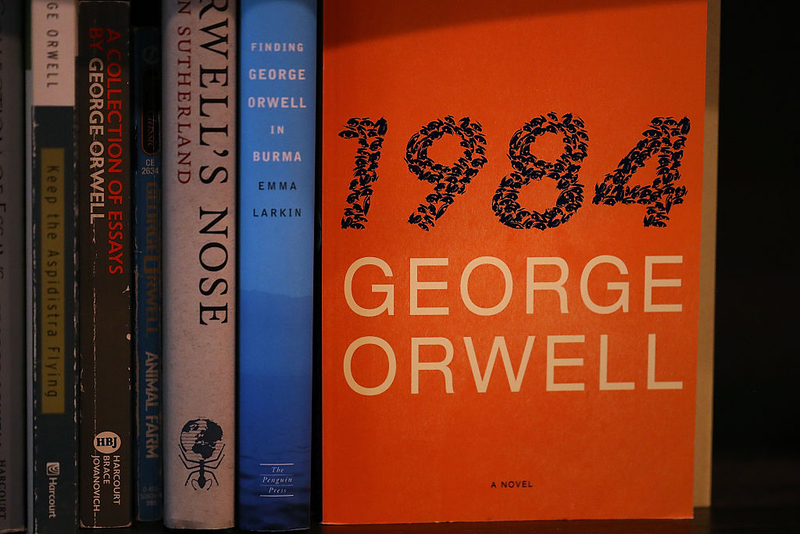
George Orwell's novel "1984" is displayed at The Last Bookstore on Jan. 25, 2017, in Los Angeles. (Justin Sullivan/Getty Images)
Lost in the din of a presidential visit to Nebraska, the ongoing glut of political campaign ads, a slew of prediction market come-ons and the sports world’s busiest month was Banned Books Week, which readers from bibliophiles to the casual celebrate annually.
While I do not play the prediction markets but am an avid sports fan and a voter, it was the president’s stopover that caught my attention. For the wrong reason. That’s because he suggested — to cheers — that the price to pay for our current war was letting Iran “take out” Los Angeles and San Diego. Aides and apologists later argued that the broadside was misinterpreted.
Like millions of others, I’m a hard pass of such backwalking because for some of us, the insult was not only disgusting, it was personal. He said it in my hometown, Grand Island. I lived in Los Angeles for 10 years and still have scores of friends there. San Diego is home to members of my extended family, some of whom served our country in the military.
Let’s move on to another effluvium: book banning, which remains a thing … and getting worse. According to literacy advocate, PEN America, nearly 12,000 books were banned in American schools during the last school year. Over 7,000 of those were unique titles. That’s nearly twice the number of bans from the previous school year.
We’re doing quite well in Nebraska. PEN lists Nebraska as one of 28 states with no book bans last school year. A new law, LB 390, which we discussed in the space last spring, should further keep the banners at bay, heading off all but the most overt attempts to limit titles for students. It requires schools to have a catalog of books that is easily accessible for parents (which school libraries already had) and a system for parents to be notified when their child checks out a book.
One improvement to LB 390 would have required those requesting a book be banned from a school library or a classroom to prove they have read the book and understand it. Perhaps we could also add the same codicil for anyone who has gone as far as attempting to remove titles from public libraries.
Meanwhile, events took place in Nebraska bookstores and libraries and on college campuses to celebrate Banned Books Week, a time when we champion the freedom to read what you want. Some of the festivities included public readings of notably banned books, which could have included Toni Morrison’s “Beloved,” Roald Dahl’s “Matilda” and any of J.K. Rowling’s Harry Potter books, what with the witchcraft, the Ministry of Magic and that whole Horcrux thing.
Some banning comes from deep left field. Consider those who want to put the kibosh on “The Wonderful World of Oz” (gender roles and “godless” values), “Charlotte’s Web” (talking critters apparently a no-no) and “Hansel and Gretel” (more witchcraft). Even Dr. Seuss’ “The Lorax” was pulled in a California town because some there believe the story to be anti-logging.
Throw in the significant jump in challenges across the country and celebrating Banned Books Week carried even more weight this year. Plus, while book banning remains a scourge in a society that once valued enlightenment, scholarship and plain old smarts — even the kind you get from books — the practice is part of an inexplicable but growing disdain for education.
When that happens, we pull books from school classrooms, thereby stifling curiosity. We mitigate the horrors of slavery by conditioning schools’ curricula in what can only be called a rewriting of history. We question science and the scientific methods leading to dangerous policies and deregulation concerning vaccinations, product efficacy and food safety. The consequences? Measles has returned to the public square and the worst cyclospora food poisoning event in history occurred. Nearly 13,000 people in 21 states were affected including 570 hospitalizations, and 2 deaths.
Perhaps some day a history book will be published about this time (working title “The Vanities of October”), detailing a nasty, expensive election season filled with lies, innuendoes and threats to two great American cities; how Americans bet on everything down to which color of Gatorade bath would be poured on the winning Super Bowl coach; or the lengths consumers went to make ends meet during what was the period’s “Affordability Crisis.”
Such a volume would be critical reading for students to learn how, at a certain point in our history, we chose our leaders, talked about and treated our neighbors with whom we disagreed, entertained ourselves and with what regard we held education.
Of course, we’d have to let them read it first.
Lincoln, NE