Oklahoma judges are behaving badly with no real consequences. Why are they getting away with it?
Oct 12, 2026 | 6:29 am ET
Description
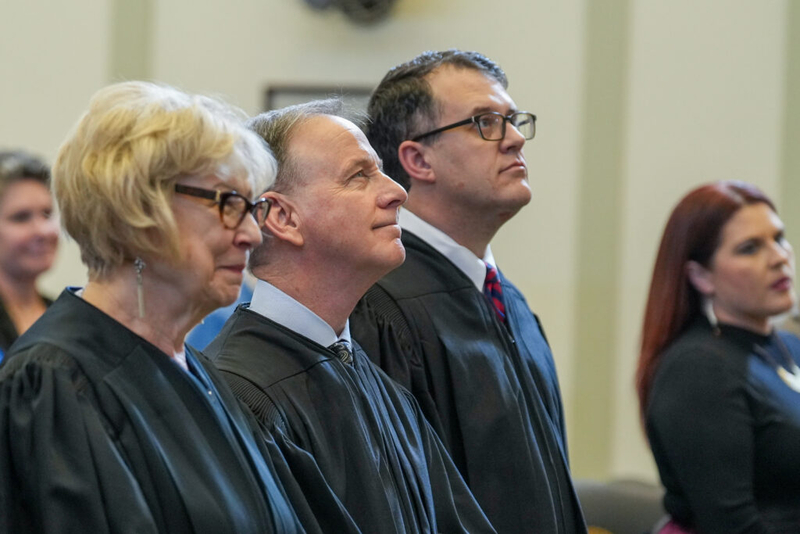
From left, Oklahoma Supreme Court justices Noma Gurich, M. John Kane IV and Travis Jett stand for the governor's State of the State Address on Feb. 2, 2026, at the state Capitol in Oklahoma City (Photo by Kyle Phillips/For Oklahoma Voice)
Imagine being a defendant in a courtroom when suddenly the judge exits the bench, fists raised as if wanting to fight you.
Or you have the misfortune to appear before that judge who also apparently ignores sentencing guidelines and has yelled at a public defender.
Or you’re in a courtroom with a judge, who has demonstrated substantiated biases toward some attorneys and a “poor demeanor” toward lawyers and courthouse employees, yet justifies the bad behavior because they’re not a “morning person.”
Or you’re involved in a paternity case where the judge apparently used artificial intelligence to generate a court order that contained two made up court cases. And, that same judge has faced allegations of possibly eavesdropping on jury deliberations, according to The Oklahoman.
These have all rocked Oklahoma’s judiciary since 2025, yet the Oklahoma Supreme Court, which is one of the bodies tasked with policing judges, has allowed these officials to continue presiding.
In two of those cases, the Supreme Court chose to publicly reprimand the judges with the equivalent of a slap on the wrist. They don’t appear to have acted on the allegations facing the third judge yet.
As an outsider this judicial conduct is egregious, and allowing these folks to remain on the bench risks undermining Oklahomans’ faith in our entire judiciary system.
It also risks tarnishing the reputation of the many judges who are doing it right, following the laws that our Legislature has put into place, even if they don’t like them, and treating all people that appear before them with respect and dignity.
The lack of substantive action against these three judges also raises some very serious questions:
- What sort of conduct does it take for a judge to recommend removing another judge?
- Is our system that relies on judges to police each other working?
- And what sort of message does it send about how we want our courts to function if our top judges, who have initially been selected by our governors to serve on the Supreme Court, continue to excuse this type of behavior?
Something feels wrong with our discipline system, but I’m not quite sure why.
Oklahoma has a state agency tasked with investigating judicial complaints. The Council on Judicial Complaints is designed to function separately from the judicial branch, but when needed sends its findings to the Oklahoma Supreme Court’s chief justice. The Council can recommend action, but does not have the authority to enforce it.
In the case of Tulsa County Judge Sharon Holmes the Council recommended her removal after substantiating accusations that she had improper communications with jurors and a defendant, ignored sentencing guidelines, yelled at a public defender and even “left the bench and approached an agitated defendant with her fists raised as if she was going to fight him.”
The Oklahoma Supreme Court decided that Holmes should only receive a reprimand for conduct that they themselves called “indefensible.” They said it reflected a lack of judgment, but while serious, did not represent an excessive use of judicial authority.
The Oklahoma Supreme Court did acknowledge that some of Holmes’ conduct “created the appearance of impropriety, undermining the public’s confidence in the independence, integrity and impartiality of the judiciary.”
You know what really “undermines the integrity and impartiality of the judiciary”? A high court that inexplicably refuses to follow the recommendations of an independent investigatory state agency to can a judge.
And because they didn’t, Holmes will serve another judicial term after she ran for reelection unopposed. The court didn’t issue its reprimand until September, after the primary election cycle was complete.
In August 2025, Special Judge Emily Mueller also received a reprimand by the Oklahoma Supreme Court after substantiated accusations of “poor demeanor toward certain attorneys and courthouse staff and bias against certain attorneys.” She was also accused of having discussed issues without another party’s attorney being present, which the high court found violates the Judicial Code of Conduct.
Chief Justice Dustin P. Rowe wrote that Mueller, whose judicial district encompasses Pottawatomie and Lincoln counties, “admitted that her attitude has fallen short in interactions with attorneys and even her co-workers, but ultimately attributed her poor interactions to not being a ‘morning person.’”
Lots of us are not a “morning person,” but we drink our caffeinated beverages and push through. If we acted like that, we’d be fired.
Mueller’s conduct “reflects a serious departure from the standards required of a judicial officer and erodes the public’s confidence in the Judiciary,” Rowe wrote.
He hit the nail on the head, yet the court didn’t recommend her removal.
And then there’s Stephens County Associate District Judge Lawrence Wheeler, who is accused of using AI to prepare a court order that cited two imaginary cases, and who also has faced accusations that he “eavesdropped on jury deliberations,” according to The Oklahoman.
The Oklahoma State Bureau of Investigation was called in to investigate by the Oklahoma Council on Judicial Complaints.
The Attorney General’s Office declined to file criminal charges, but told The Oklahoman that the Oklahoma Supreme Court and the Court on the Judiciary hold ultimate power over Wheeler’s future on the bench.
That’s because we’ve empowered the Oklahoma Court on the Judiciary to remove judges from their positions. This body, whose current membership is not clearly listed anywhere I can easily find, is composed of 18 judges: nine that serve in an appellate role, and nine that oversee trials. Surprisingly, no citizens are permitted to serve on this policing body.
The Oklahoman reported the last time a judge has been removed by the body was 2020.
Removing judges should only be a last resort, but if we’ve got ones who are behaving badly on the bench, even if it’s not criminal, someone needs to be holding them accountable.
And if the Oklahoma Supreme Court isn’t willing to do that or refer cases to this Court on the Judiciary, are these justices willing to do one the hard parts of their job? And should we feel confident in retaining them when their retention is next on the ballot?
I don’t know. I do know that Oklahoma courtrooms are supposed to be dignified places where justice is blind and AI isn’t presiding.
And if our judges can’t find the willpower to hold each other accountable, particularly when an independent board recommends removal, then maybe it’s time for Oklahoma lawmakers to take a closer look at creating a system that will.
Oklahoma City, OK