North Carolina Muslims have spent decades building political power. What has it produced?
Oct 12, 2026 | 6:00 am ET
Description
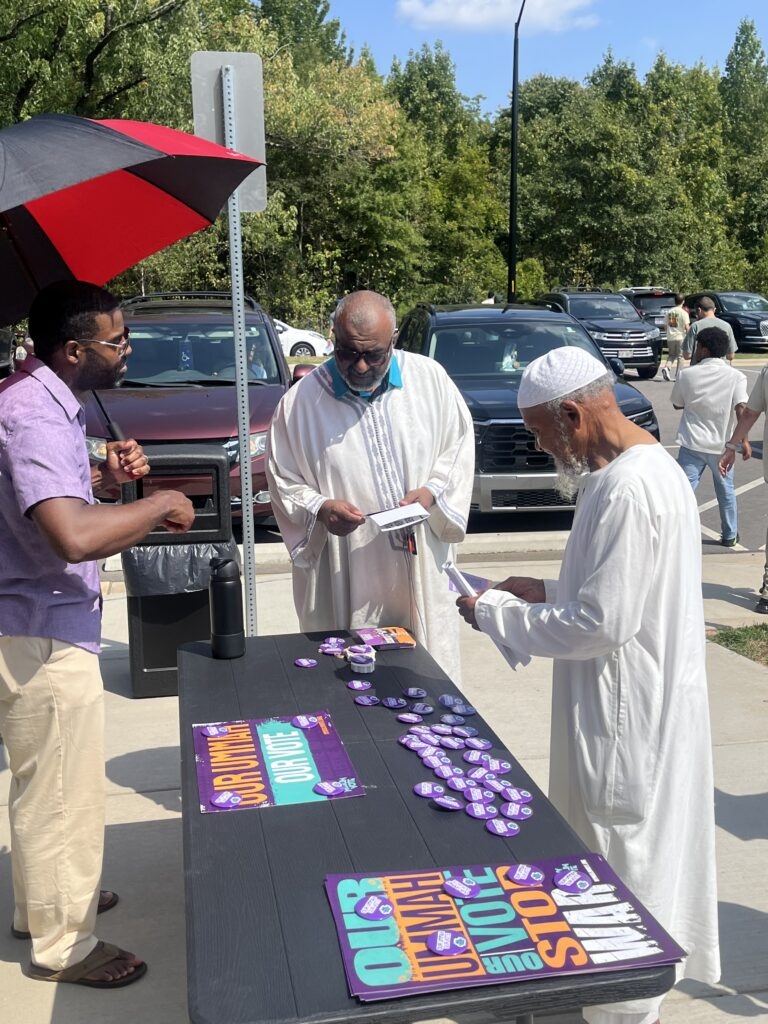
Nigel Edwards speaks with attendees at a voter registration table after Friday prayers at a Durham mosque.
(Photo: Ahmed Jallow/NC Newsline)
On a blistering Friday morning at a Durham mosque, Nigel Edwards sets up a table with voter registration materials that include buttons, signs, posters and flyers.
“Are you registered to vote?” he asks those filing past as sweat drips down his chin. Some are already registered, others are noncitizens, and a few say voting doesn’t matter.
“We want candidates to motivate us to vote, but unless we show up as a community, those candidates will never appear in the first place,” said Edwards, an immigration attorney and president of the North Carolina-based Muslim American Public Affairs Council.
In recent years, Muslim organizers in North Carolina have been working to build a political infrastructure to register voters, engage candidates and give the state’s growing Muslim population a more organized voice in government.
Several of those organizations now meet monthly to discuss their current initiatives and how they can support one another.
“We meet once a month, and we say who’s doing what, what’s their initiatives right now, and how can we assist each other on those initiatives,” said Al Rieder, regional community engagement manager for the Council on American-Islamic Relations.
CAIR, a Muslim civil rights and advocacy group, expanded into North Carolina in 2023 to serve the state’s growing Muslim population. North Carolina now has 130,000 Muslim residents, the 11th-largest population in the country.
Building political power
When Muslim Women For was founded in 2016, Lela Ali was a college student trying to figure out how to build safety and political power in her community.
Three young Muslims had been killed in Chapel Hill the year before, as the country headed into a presidential campaign marked by anti-Muslim rhetoric. The violence, Ali said, felt painfully close to home.
“It was a moment where we were very shook to our core that this sort of violence would just hit our community and our backyard in this way,” said Ali.
Ali and the other founders wanted to build something in response. But she said young Muslims had a few places to organize outside traditional religious institutions.
“There was very little organizing happening,” said Lela Ali, a co-founder of the group. “There were very little spaces that created that sense of a political home for young people, especially young Muslims.”
A decade later, Muslim organizers have built some of the infrastructure Ali said was missing. The Charlotte Muslim Caucus maps early voting sites near mosques, organizes “Prayers to the Polls” events, and interviews candidates before deciding whether to endorse them, said Nasif Majeed, the group’s president and co-founder.
“We wanted to give our masjids a way to engage the community in civic politics and grassroots engagement,” Majeed said. The organization was founded in 2023.
Last year, the group endorsed newcomer JD Mazuera Arias, who defeated incumbent Marjorie Molina by 34 votes to win a seat on the Charlotte City Council.
“The Muslim caucus endorsement is meaningful because it does reflect a community that is increasingly organized and engaged in our local democracy,” said Mazuera Arias.
The relationship has continued beyond the election, Mazuera Arias said. Since taking office, he has consulted the caucus on issues affecting Muslim residents and businesses, including restrictions involving halal food trucks.
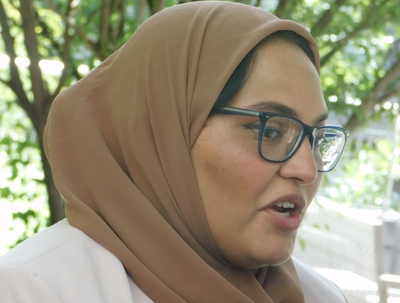
That kind of organizing was harder to find when Nida Allam first ran for office in Durham in 2019.
“It was very eye-opening,” Allam said. “Even in the most progressive county of North Carolina, like the bluest county, I was faced with a lot of Islamophobia and xenophobia that I didn’t expect.”
The experience led Allam to look for another elected Muslim woman in North Carolina who could advise her on dealing with the hostility she faced. She found none.
In 2020, Allam became the first Muslim woman elected to office in North Carolina. Since then, she said, groups like Muslim Women For have developed resources that did not exist when she first ran.
“Now they have established themselves, and they have paid canvassers, they have paid phone bankers, folks that they can send to the polls to do voter protection, and that didn’t exist when I first ran,” Allam said.
Muslim political organizing in North Carolina has been around for decades.
North Carolina Muslim groups push voter registration ahead of November election
At 14, Fleming El-Amin went with a barber to hear a Nation of Islam preacher speak about Black history and pride. It was his first visit to a Nation of Islam temple and the beginning of a decades-long connection to Muslim civic and political organizing.
He later served as president of the American Coalition for Good Government, founded in Charlotte in 1997 to encourage Muslims to engage in politics and run for office. He also served on the Forsyth County Board of Commissioners from 2016 to 2022.
“When I first got involved, it was almost like a new thing, a new idea of religion,” said El-Amin, who is now 74. Muslims, he said, were “not very much engaged in community prayers outside of their own mission. But over time, you know, the community has grown substantially.”
That growth has changed how Muslim organizers interact with elected officials, El-Amin said. He pointed to his work with former state Senator Larry Shaw to establish the right for Muslim elected officials in North Carolina to take their oaths of office on the Quran. He also pointed to the governor’s Ramadan dinners, which began in 2018, as an example of how the relationship between Muslim leaders and state government has changed.
“It was unimaginable 30 years ago that the governor of North Carolina would invite us to the mansion to have a dinner sponsored by him, for the most part, for all the Muslim leaders in the state of North Carolina,” he said. “That’s been a good example of how the community’s progressed over the years.”
How much influence?
The growth of that infrastructure does not necessarily mean Muslim organizers have developed a consistent political force across the state.
Chris Cooper, a political scientist at Western Carolina University, said he looks for three things when assessing whether a community has developed meaningful political capacity: size, organization and stability.
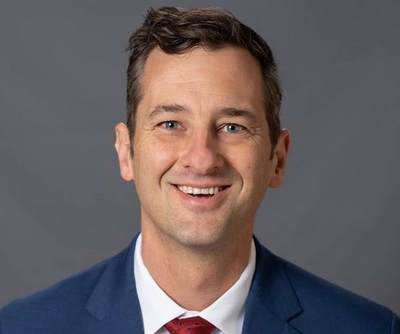
Size matters because “politics is ultimately a game of numbers,” Cooper said. But having people with similar interests is different from having an organization capable of mobilizing them. Stability, he said, means being able to remain part of the political conversation election after election.
By those measures, Cooper sees Muslim political organizing taking hold in parts of North Carolina, but not statewide yet.
“I think there are pockets of that, some localized pockets, which is a good thing for influence,” Cooper said, “but it doesn’t appear to be repeated consistently across the state.”
Cooper said he also could not identify a single statewide Muslim organization comparable to groups such as the AARP or NRA. Building that kind of influence takes time, he said.
“I think that’s what the Muslim community should be aspiring to: the ability to play the long game,” Cooper said.
Edwards has seen that evolution from inside MAPAC.
He was initially only loosely involved with the organization after being introduced to it through someone who rented office space where he worked. His involvement grew around an effort to reopen the mosque at Shaw University.
MAPAC formed after the Sept. 11 attacks, when organizers saw a need for greater political engagement amid backlash against Muslims. Edwards said the organization was built around establishing relationships with elected officials before the community needs their help.
Those relationships have sometimes paid off, he said. Edwards pointed to the effort to reopen the mosque at Shaw University, where MAPAC members used their relationships with Raleigh City Council members to bring attention to the issue while the university was pursuing a rezoning.
But Edwards said the harder challenge is getting people to participate consistently.
MAPAC has held candidate forums, produced voter guides and registered voters, but turnout at some events remains low, he said, and politicians do not always respond to invitations.
“It’s hard to tell people to show up when the candidates don’t come,” Edwards said. “So it’s a chicken-and-egg problem.”
Raleigh, NC