In north Alabama congressional race, a Democrat pitches affordability and political reform
Oct 12, 2026 | 6:01 am ET
Description
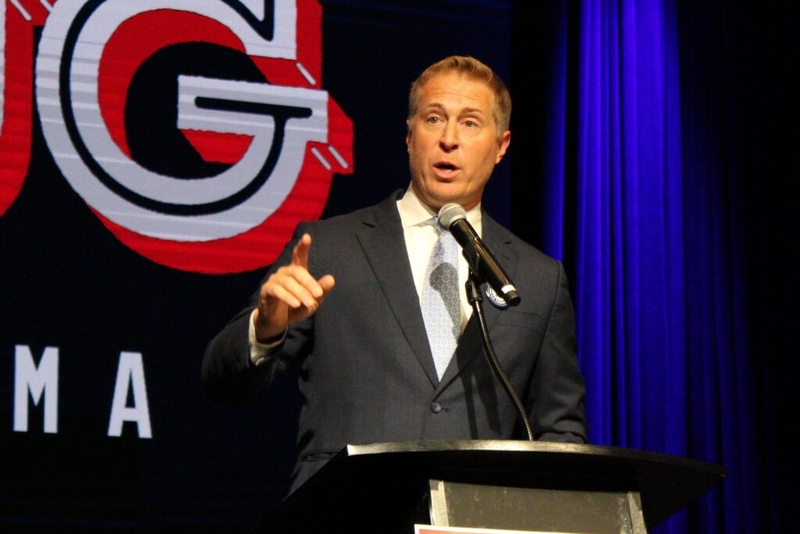
Andrew Sneed, the Democratic nominee for Alabama's 5th Congressional District, introduces Democratic gubernatorial nominee Doug Jones at a rally at Mars Music Hall in Huntsville, Alabama on Oct. 11, 2026. (Ben Sessoms for Alabama Reflector)
Throughout all of the 20th Century, Alabama’s 5th Congressional District, anchored in north Alabama, was represented by a Democrat. But in 2010, after the two parties had evolved and ideologically solidified into what they are today, voters sent Republican Mo Brooks to Congress, upending that longstanding electoral stasis.
For nearly two decades now, the Republican Party has dominated the region. Brooks held the seat for 12 years, and incumbent Republican Rep. Dale Strong, R-Madison, has been in office since 2023 — with both winning with 60% or more of the vote each election cycle. In 2020 and 2024, Brooks and Strong won uncontested.
Enter Andrew Sneed, a Huntsville native whose professional career has taken him from the restaurant industry and the trades to starting his own contracting business in 2019. Now the Democratic candidate for the 5th Congressional District, an ostensibly deep red region, Sneed is daring to give politics a try.
Even with the seemingly long odds — the Cook Political Report rates the district solidly Republican — Sneed, 46, believes he has what it takes to pull off the upset, amid Donald Trump’s unpopularity and Republicans like Strong, according to Sneed, who are failing to hold the president accountable and deliver for ordinary people.
“We’re going to win because we’re actually addressing the needs and listening to folks. That’s exactly what he’s not doing,” Sneed said, referring to Strong. “I have 25 years in service. That’s all I’ve ever done. I’ve worked with my hands for 25 years — 10 years in restaurants, 15 years in the trades — as opposed to a career politician.”
When it comes to raising funds, Sneed has been competitive with Strong. While the incumbent retained an overall advantage in spending, fundraising and cash on hand through the end of June, according to filings with the Federal Election Commission, Sneed outraised Strong $162,000 to $125,600 between April and June. (Campaign finance reports for the race only run through June 30; filings covering July to September are due on Oct. 15.)
Strong, a Huntsville area native, did not agree to an interview, but in emailed responses to questions, the incumbent said he believes his record warrants another term in office.
“In the last year I have brought home millions of dollars for new roads, secured a new veteran’s clinic and funding for the first Veteran’s cemetery in our community,” Strong said in an email. “I am also proud of my record on new jobs by bringing the Space Command Headquarters to Alabama plus more funding for Redstone Arsenal missile and aviation programs and the Marshall Space Flight Center.”
Affordability, political reform
Since Trump has returned to office, the Democratic Party’s primary electoral strategy in special and off-year elections, especially with high gas prices due to the president’s war in Iran, has been to focus on making the economy more affordable for the average American.
Mirroring this approach, Sneed’s platform centers on reducing housing, healthcare and energy costs. He has campaigned in particular against Republican cuts to Medicaid and the Affordable Care Act as well as Trump’s tariff policy, which the Yale Budget Lab has estimated to increase annual costs for the average American household by $1,100.
Voters in midterm elections identify a culprit for rising cost of living: Trump’s tariffs
For Sneed, though, the unaffordable economy doesn’t solely come from Trump’s agenda, nor is it a one-party issue; it is a problem with the current political system more broadly.
“What’s different about this campaign from truly most other campaigns in the country is that we immediately draw the connection to also what is deeply broken and how we got to this place,” Sneed said. “We’ve had a Democratic House, Senate, White House — the same with Republicans. But it seems like so often nothing changes, and we just find ourselves in this position.”
“We desperately as a district, but also as a nation,” he continued, “need Congress to be Congress again and do their damn jobs.”
Donald Trump tells Mobile rally to ‘pretend I’m on the ballot’
As a remedy, Sneed has proposed a set of reforms through a coalition he founded called Balance Accountability Candidates, a slate of Democrats nationwide running for office who want to restructure the political and campaign finance system.
It boils down to five proposals: term-limiting members of Congress; overturning the flood of money into politics allowed by the 2010 U.S. Supreme Court decision Citizens United; prohibiting members of Congress from trading stocks; imposing a five-year moratorium on lobbying for former members of Congress; and establishing an enforceable code of ethics for the Supreme Court.
“Democrats around the country can talk about affordability all they want, but if people aren’t willing to vote for a Democrat because they don’t trust Democrats, then we’re just whistling Dixie,” Sneed said.
“I have heard all the time, and what I’ve even allowed to sort of feel within myself, is this idea that all politicians are the same,” he continued. “It’s a lack of trust. When you have Democrats getting rich in Congress and Republicans getting rich in Congress, why should they believe anything anyone says?”
Using tariffs as an example, Sneed said Congress should be exerting its authority to curb Trump’s overreach. But on any issue, Sneed sees a legislative body, one meant to derive its power from the people, unresponsive to its constituents.
“The job description for a representative is in the title; that’s represent,” Sneed said. “You can’t represent folks you don’t listen to.”
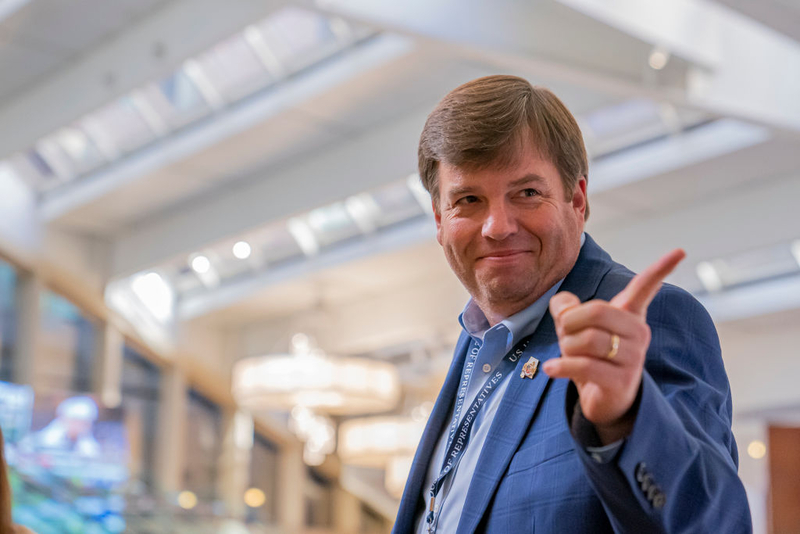
Sneed has held numerous town halls throughout north Alabama during the campaign. He’s criticized Strong for turning down his invites to public speaking events and failing to hold town halls himself — “Dale Strong has refused to hold a real public town since he’s been in office, literally,” Sneed said. At a ribbon-cutting in August, Strong, referring to Sneed, told reporters that he doesn’t “know who the other guy is.”
In an email, responding to Sneed’s criticism, Strong said, “I have held several tele-town halls over the last two years reaching thousands of participants and giving them the opportunity to ask their questions to me directly.”
When it comes to fuel costs, Strong said in an email that the war has shown the United States to be too reliant on foreign oil. “Bad actors like Iran have too much control over our gas prices,” he said. “We need to become more energy independent by producing more oil in the US and building more refining capacity here at home.”
And when it comes to Trump, Strong said he is “running my own race.”
“But I am confident that when voters compare the agenda that Democrats in Congress are pushing to what our Republican majority has achieved such as tax cuts for families, closing our border and increasing funding for our national defense, they will vote to continue our leadership,” he said.
The educational divide
Perhaps the greatest indicator of who chooses a Democrat in the Trump era, according to many political scientists, is educational attainment.
Per a Pew Research Center survey, 55% of respondents with a college degree were Democrats or leaned left. Conversely, 39% aligned themselves with the GOP or are inclined to.
This is a relevant statistic for Huntsville and Alabama’s 5th Congressional District. As reported by Forbes, the city, home to NASA’s Marshall Space Flight Center, has the highest number of engineers per capita in the country.
According to the most recent data from the U.S. Census Bureau, 46.4% of residents in Madison County, of which Huntsville is the seat, have attained a bachelor’s degree — higher than the statewide rate of 28.4% and an increase from that a decade ago at 38.6%.
The other counties completely within the district — Limestone, Lawrence, Morgan and Jackson (only the eastern part of Lauderdale is in district) — have all seen the proportion of their populations with bachelor’s degrees grow in that time.
Seth McKee, a professor at Oklahoma State University whose research centers on politics in the South, said this link between greater educational attainment and Democratic Party affiliation wasn’t always the case; it was the opposite during the political era under President Ronald Reagan.
But starting in the early 2000s, he said, the trend started to reverse, and Trump accelerated it into the wide educational divide seen now.
“Trump’s been a catalyst just because of the way he presents himself,” McKee said. “That populist appeal, that doesn’t really grab on to people with more education. I think more educated people kind of know that this guy’s a clown and a grifter.”
Still, a majority of the 5th Congressional District does not have a bachelor’s degree — but Trump’s command over that base, given his performance in office over his second term, may be beginning to wane, at least in the immediate future.
“If you can’t perform, you’re going to disenchant people who otherwise would support you,” McKee said. “But longer term, I don’t know how much of an effect it will have.”
An urbanizing region
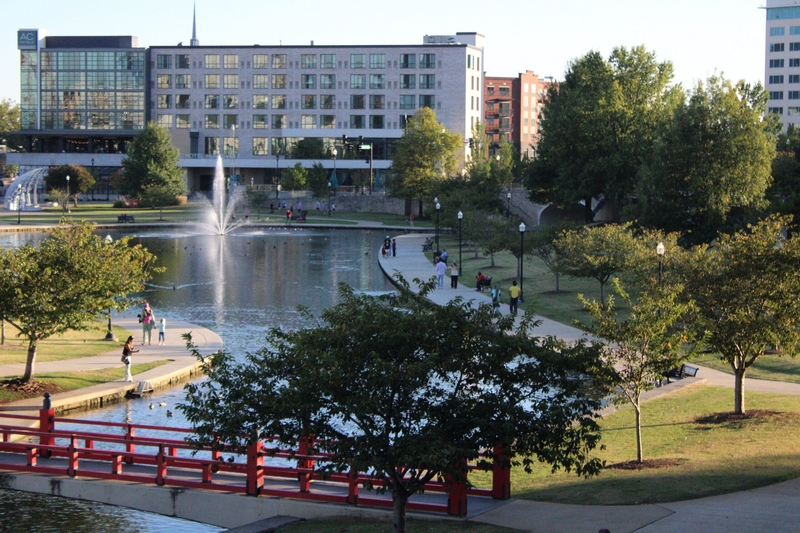
That educational divide reinforces the ongoing rural-urban divide in American politics, McKee said. There is an incentive for those with higher education degrees to leave rural areas for economic opportunity in cities.
“The higher educated are going to be more likely to be in thriving metropolitan centers, a new economy, if you will,” McKee said. “So when you look at rural areas that are not growing, they tend to have lower education.”
This correlation between educational attainment and urbanization has borne out in Huntsville, which in 2021 overtook Birmingham to become Alabama’s largest city. The surrounding counties in the district have seen a population increase as well.
David Damore, a political scientist at UNLV and co-author of “Blue Metros, Red States: The Shifting Urban/Rural Divide in America’s Swing States,” said that with urbanization, as that seen in the Huntsville area, there is generally a more Democratic-leaning electorate that forms, what he calls the presence of density and diversity.
“You’re exposed to lots of different viewpoints compared to a rural space that’s much more homogeneous. You tend not to have one dominant group who controls all the politics,” Damore said. “There’s coalition building, a lot more willingness to work with others who aren’t like you.”
The dynamic of urbanization in the South creating a more Democratic electorate has already happened in other parts of the region, such as in Georgia and North Carolina, though Florida is certainly, at the moment, an outlier.
But as of now, north Alabama, at least in Congress, is still red. But Democrats remain hopeful in the Huntsville area. Democratic Rep. Marilyn Lands flipped House District 10 blue in 2024, giving Alabama Democrats their first net seat gain in the Alabama Legislature in decades.
“We have so much growth here, so many people moving in from other states and even other countries,” Lands said. “It is changing very, very rapidly here.”
Whether it’s changing fast enough to turn the 5th Congressional District blue in November is an open question. For Sneed, the answer is a confident yes.
“We’re going to win,” Sneed said. “That change is coming, if we’ll just go out and fight for it and grab the reins.”
Key Points box written by Editor Brian Lyman.
Montgomery