Pause, plan and protect: responsible development in the face of AI data centers
Oct 12, 2026 | 5:00 am ET
Description
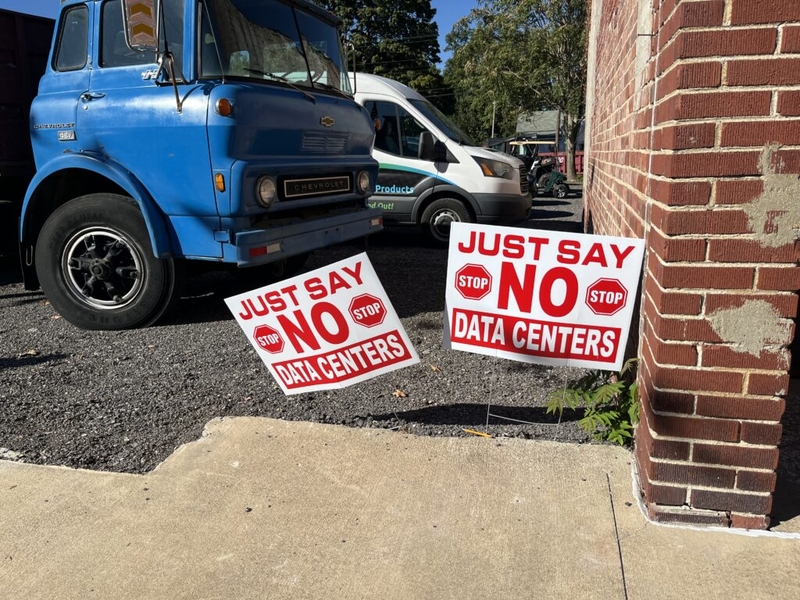
Signs on the Newport courthouse square in west central Indiana signal opposition to data centers on Oct. 4, 2026. (Photo by Niki Kelly/Indiana Capital Chronicle)
It felt like a gut punch when Jacob Coxon, a researcher with Anthropic focused on expanding artificial intelligence capabilities, publicly resigned to underscore the threat to humanity AI posed and the reckless nature in which the U.S.’s largest tech firms are advancing it. Rather than disputing those claims, executives from Anthropic, OpenAI, Google, and Microsoft all emphasized the need to pace AI’s development within the bounds of safety. In other words, we need AI to work for us — not against us.
“If the AI we build is not helping humanity and under human control, it’s not worth pursuing,” said Satya Nadella, CEO of Microsoft.
Despite community pushback, the rapid buildout of AI infrastructure in Indiana is mirroring the reckless advancement of AI capabilities that Bill Gates, Elon Musk, Sam Altman and Dario Amodei have raised alarm bells about. According to CNBC, Indiana ranks 4th among states for data center build attractiveness and a recent report by Good Jobs First revealed that Amazon alone benefited from $561 million in Indiana sales tax exemptions in 2025.
Even if the panacea of a safe AI that uplifts humanity and human health is realized, we must also build its infrastructure sustainably to protect the air we breathe, the water that gives life and minimize the climate pollution that magnifies the societal challenges we face. At a time when AI advancement seems to be spinning beyond our control, there are things we can do to affect local outcomes. The framework of pause, plan and protect describes how residents and local officials can shape beneficial investment.
It is critical to take time or pause to understand the long-term resource demands and environmental impacts of AI data centers. A single AI data center may exceed the energy demands of a city the size of Indianapolis and both their cooling systems and new gas power generation can be significant water users. Without careful study and monitoring of things like river flow and the water table, communities won’t know the impact to local wells, agriculture, aquatic ecosystems and other areas that rely on a plentiful water supply. Transparent information about water discharge is also critical to make sure harmful substances are removed before returning to the water cycle.
In many instances data centers are extending the life of the costliest and dirtiest form of energy — coal. Coal not only impacts our health and environment, its extended use also increases our electricity bills. Off grid power, such as the reciprocating gas engines proposed for Meta’s data center campus in Boone County, is both noisy and dirtier than grid-connected energy. And massive resources of energy and water will need to be supported by additional infrastructure. What will be the comprehensive costs of that infrastructure and who will pay for it? Communities deserve to know how AI data centers will be powered, the impact to their air, water, and health, and who will pay for the comprehensive infrastructure costs associated with it. If you don’t know the answers to these questions, it’s a good time to pause any approvals until you have answers.
Proactive planning to attract the type of development communities want can attract more sustainable investments. Setting clear expectations through ordinances and public communication, that maximize new clean energy, preserve sensitive natural areas, and require transparency around water use and discharge, lets developers know what is expected. In Minnesota, a new Google data center is supported by 1,600 megawatts of renewables, 300 MW of long-term storage, and a $50 million investment in small local batteries that will help control costs and make the grid more resilient. A plan to attract wanted investment will bring better results than responding to unwanted projects.
Enforceable protection and safeguards are needed to ensure a planned investment delivers on its commitments. In addition to a strong ordinance, communities should build monitoring into their agreements and developer commitments. State requirements through the Indiana Department of Environmental Management lack robust monitoring so monitoring must be done by reputable third parties approved of by the community. Air quality, water discharge, aquifer levels, stream flows, investment commitments and anything else developers commit to need effective monitoring and accountability measures. Monitoring accompanied by incentives for fulfillment, accountability for failure and a legal path for enforcement, provides needed protection in the face of irresponsible or failed developments.
At a time when many feel we are under attack from AI and the data centers that support it, it’s critical that we take time to pause to understand the impacts of new data center development; plan to attract the type of sustainable investment communities want; and protect communities through strong ordinances, monitoring, and enforcement. There is much that we cannot control when it comes to the rollout of AI, but in Indiana, through our local government structure and strong community engagement, we can shape development and investment outcomes.
Indianapolis, IN