A quote for the age of revolution, in 1968 and today
Oct 10, 2026 | 10:00 am ET
Description
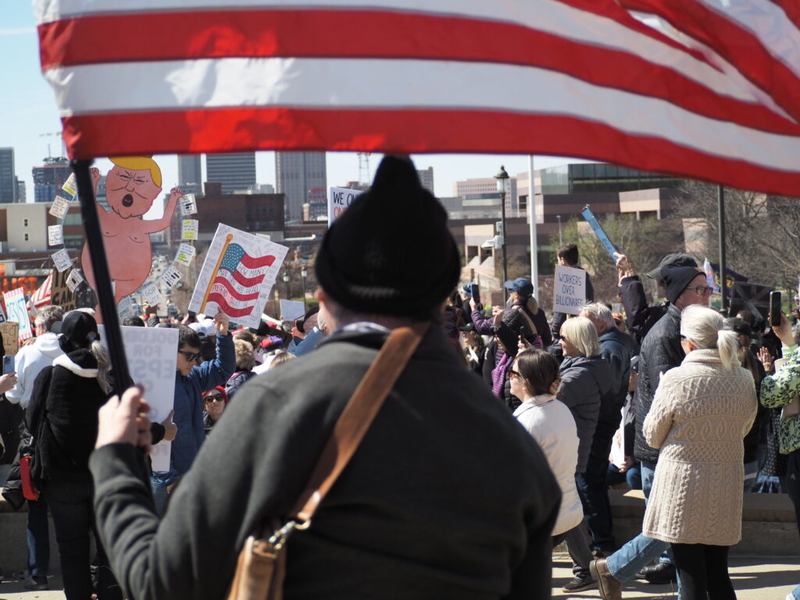
David Russell sat holding an American flag on the steps of the Iowa Capitol as part of the "No Kings" protest in Des Moines March 28, 2026. (Photo by Robin Opsahl/Iowa Capital Dispatch)
John Glenn, American hero for being the first U.S. citizen to fly into space, decided to stay at the hotel instead of going to the victory speech of Robert F. Kennedy, who had just won the 1968 California presidential primary.
He sat there, watching the candidate complete his remarks, sharing the room with his wife, other members of the Kennedy family, and five of the Kennedy children. Glenn heard the speech and wrote, “Then came the madness and chaos after his shooting.”
President Lyndon Johnson flew the Kennedy family and the Glenns back to Washington, D.C. on Air Force One. The following night, RFK died. Glenn and Susie Markham, a neighbor close to the children, told them that their father had passed.
He said later, “It was one of the hardest things, I have ever had to do.”
The next day, Glenn walked into the senator’s study and found on the desk speeches and writings, and a book by Ralph Waldo Emerson. One quote from Emerson, which RFK had marked in the book’s margin as being of interest, captured Glenn’s attention and seemed so relevant then and to today’s times as well. We will come to that quote, but first a few observations from someone who’s been watching elections since before 1968.
I am not sure to how to describe this election season. Sometimes, with all the anger, rage and hostility, it almost seems like we are having a national temper tantrum. Negative ads attack the character the candidate’s opponent more than a difference on issues. There is something deeper behind the storm clouds than just another routine election.
The current president is a skilled in-fighter when confronting his political opponents. In this election, indeed, he is extraordinary in his ability to provoke his adversaries in responding to his allegations. For example, he will tear down the Kennedy Center and build arches that block the view from Arlington Cemetery and put a sniper’s nest and a national defense center in it, as well as commencing a tariff war with Canada. To these assertions and others, national Democrats respond, demand action or explanation, accomplishing two of his political goals. First, President Trump fires up his own supporters to turn out to vote and, second, he muddles the opposition’s reasons for calling for change by talking about his issues, not theirs.
Today, at best, the Democrats want to focus on inflation and affordability. Trump sees a danger of ultra liberals (read communists) taking over the government and ruining an already strong economy. In one form or another, these four issues are what we will decide in November.
While all of those or some of them may cause a tilt to the red or swing to the blue, the impact of a decision by our voters will weigh heavily on the form and function of the very future of our government. Ratification or disapproval of the president’s economic and war powers will be seen as approval or disapproval of the way President Trump has shaped and utilized the power of the government.
Should the president’s desire to modify or even change the concept of sharing functions between three different branches of government, the Congress, the Judiciary and the Executive Branch, be affirmed and further power drained from the legislative branch flowing to him? Should we retain the concept of the separation of powers, with three co-equal branches of government?
Which side is seen as prevailing in the election when the results are tabulated will, in large measure, provide an answer to the question. Trump’s candidates do well, his stock rises and his leadership is confirmed. Perform poorly, Democrats advance and a challenging Congress awaits him.
What makes Emerson’s quote, which Glenn located that solemn morning almost 60 years ago in Kennedy’s study, somewhat astounding is its applicability to the choice in front of us, we the keepers of this democracy in our time.
“If there is any period one would desire to be born in, is it not the age of revolution, when the old and the new stand side-by-side and admit of being compared? When the energies of all men are searched by fear and by hope, when the historic glories of the old can be compensated by the rich possibilities of the new era, this time like all times is a very good one if we but know what do with it.”
Des Moines, IA