Want to take a stand for Banned Book Week? Start next time you’re at the ballot box
Oct 09, 2026 | 8:25 pm ET
Description
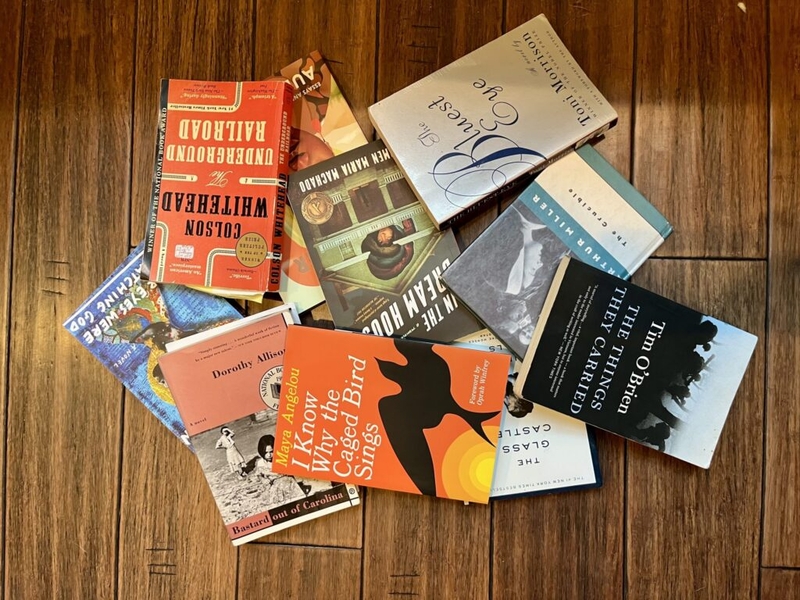
Banned and restricted books. (Photo illustration by Sarah Ladd/Kentucky Lantern)
This Banned Books Week (Oct. 4-10), Marylanders should pay attention to what is happening on our local school boards. In Harford County, for example, a court will hear arguments later this month about the school board’s decision to yank “Flamer” from all library school shelves.
“Flamer” tells the story of Aiden, a Filipino American teenager spending the summer at Boy Scout camp before his first year of high school. He is struggling to figure out who he is. He’s embarrassed. He’s bullied. He prays. He tries to square his faith, which is central to him, with his realization that he is attracted to other boys. At one low point, he thinks about ending his life. Near the end, a letter arrives from his best friend back home, hand-lettered on the page: “There is nothing wrong with you.”
The semi-autobiographical, vividly illustrated graphic novel by Mike Curato has been lauded by critics as “a book that will save lives.” One Horn Book reviewer wrote that it speaks to kids going through exactly what Aiden does, adding, “I wish I had had this book fifty years ago.”
For a time, “Flamer” was available to Harford County students who might want to read it. No student was required to. And any parent who didn’t want their kid to read it could say so.
Then a Harford parent asked that “Flamer” be removed from school libraries after seeing a Fox News report about it. She hadn’t read the book but feared it might “plants seeds in the heads of children.”
Under the 2024 Maryland Freedom to Read Act, schools to have a process for reviewing such objections. A committee including parents, school personnel and students was trained on legal standards. Every member read the book, took notes, and weighed the parent’s concerns against its content and literary value. They discussed its age-appropriateness and community standards. Then they voted to keep it in high school libraries, noting the parent remained free to tell the school her child was not allowed to borrow the book. The superintendent agreed.
The parent — who still had not read “Flamer” — appealed to the local school board. She was not asking for the right to decide whether her child could read “Flamer.” She already had that right. She sought a ruling that no one else’s child could read it.
The local board granted her request. Unlike the committee — which read the book, considered the objection, applied legal standards and explained its reasoning — the board did none of those things. After a hearing held without public notice, it voted 5-3 to pull “Flamer” from every school library in the county. The decision called the book “pervasively vulgar” but didn’t say how members reached that conclusion. The record suggests members reviewed selected passages without context, but not who chose them or which ones. The board declined to release the record of its deliberations, claiming they were privileged.
Board members’ own words from other meetings are telling. One said the book should be removed because of its “demeaning reflection on the Church.” (The Freedom to Read Act forbids removing books “because of partisan, ideological, or religious disapproval.”) Another said that if the committee chose to keep the book, she would revisit the entire review process because “parents do not want their kids exposed to these books.”
Community members appealed to the State Board of Education, which took the rare step of reversing the local board’s decision as arbitrary and unreasonable. It found no evidence that board members had read the book, let alone engaged with the committee’s reasoning. The local board has challenged that decision in state court. A judge will decide the legal question.
The rest of us should ask a related one: Who is serving on our local school boards and what are their priorities? In 2024, the Maryland Library Association reported that book challenges in the state had risen more than 130% since 2019. And in some local school boards, book challengers have found a receptive audience.
Most of us don’t follow school board races closely. It’s hard to know what a candidate stands for, and the stakes can feel small. They aren’t. Local boards decide whether a teenager in a small town can find a book about someone like him, or a book about someone nothing like him, which may be just as important.
Parents can decide what their own kids should read. But that is different from deciding for everyone else. When we vote for school board members, we are choosing who understands the difference.
Annapolis, MD