El-Sayed talks corporate money, healthcare, artificial intelligence at Lansing town hall
Oct 09, 2026 | 5:51 pm ET
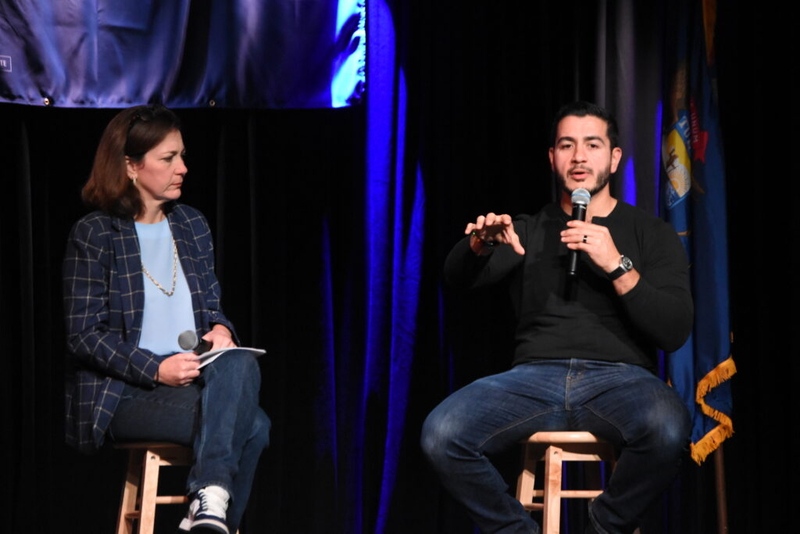
Description
U.S. Senate candidate Abdul El-Sayed and End Citizens United President Tiffany Muller discussed corporate influence at a town hall in Lansing on Oct. 9. (Photo by Katherine Dailey/Michigan Advance)
Corporate influence in politics and its ripple effects on issues ranging from data centers to healthcare, was the focus of a town hall Friday in downtown Lansing hosted by Democratic U.S. Senate candidate Abdul El-Sayed, who was joined by End Citizens United President Tiffany Muller.
“Because of Citizens United, because of the way that our politics works, we’ve also allowed these huge corporations to hop over the firewall that is supposed to protect our politics from the power of the biggest players in our economy to buy politicians too,” El-Sayed told a largely enthusiastic audience. “It’s hard for Congress to be that check on corporate power when they’re so busy cashing their checks, right?”
End Citizens United is a Democratic-aligned political action committee seeking to overturn the 2010 landmark U.S. Supreme Court decision Citizens United v. Federal Election Commission, which greatly expanded the ability of corporations, labor unions and other outside groups to spend money on political campaigns.
El-Sayed, whose campaign refrain often includes a call-and-response cheer of “money out of politics,” tied that to another key platform of his campaign — healthcare reform and Medicare for All.
He explained to the crowd how he envisions Medicare for All — healthcare that covers individuals from birth to death with no premium, no copay and no deductible, eligible anywhere that is needed to get healthcare without limits based on in-network providers.
“And it buys you out of ever having to worry about getting debt,” he said. “Because here’s the thing about it: almost everybody in this economy has this experience where you get sick and you’re like, ‘Damn, I have to see a doctor.’ You know why? Because you know it’s going to come with a bill, even if you’re insured.”
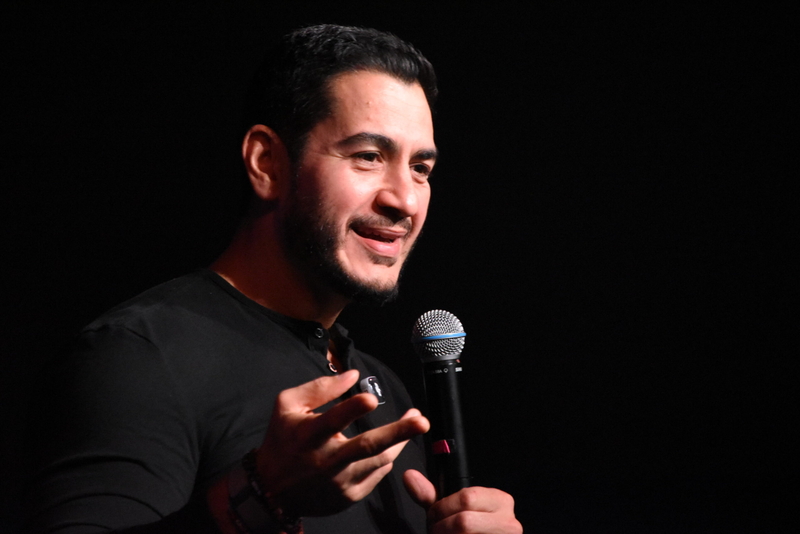
Muller also noted that, in response to a recent poll from End Citizens United, about 60% of respondents said that they had experienced government corruption — tying their rising health costs to the electoral influence of healthcare corporations.
“When we asked why, they said, ‘Well, my healthcare costs are going up, but members of Congress are cashing out to health insurance companies, they’re coming after Social Security all to pay off Wall Street banks’,” she said. “This tie between corruption and economic pressure is something that voters not only feel but deeply understand, and it’s something you talk about all the time.”
El-Sayed was also critical of his opponent, Republican Mike Rogers, for taking corporate money while serving in the U.S. House of Representatives and then “advising the very same corporations he was regulating just before.”
“He saw his boss Donald Trump make $2.2 billion while he was in office, and he says, ‘You know what? I might as well get while the getting is good’,” El-Sayed said of Rogers. “Well, who do you think gets got? We do. We’re the ones paying the higher prescription drug prices. We’re the ones paying the higher utility rates. We’re the ones paying the higher premiums for insurance. We’re the ones paying for gas. We’re the ones paying more for groceries.”
At a Thursday night debate, El-Sayed and Rogers traded barbs about their own respective stock holdings, especially in relation to companies funding data center development.
El-Sayed noted at Friday’s town hall that his own retirement account is invested in a mutual fund, which is managed independently of him and his work — differently than stock trading that he seeks to ban for members of Congress.
“It gets even more funky because if you’re personally trading stock and you have insider information, you can then start to short stocks or long stocks based on how regulations you vote on shape those stocks,” he said.
William Lawrence, the Democratic nominee for Michigan’s 7th Congressional District, which includes Lansing, opened the event by explaining how his refusal to take corporate money in his campaign allows him to be an effective check on policies promoted by major corporate donors.
“It’s because I’m not taking any money from data center developers that I can afford to stand strong for a moratorium on data center development,” Lawrence said. “Because I’m not taking any money from health insurance corporations that I can afford to fight hard for Medicare for All. It’s because I’m not taking any money from Wall Street firms that I can afford to stand alongside our neighbors, fighting back against unjust evictions here in the Lansing area, pushed by those Wall Street firms. And you know what I’ve learned time and time again is that when you stand alongside people and fight for them, they will fight for you.”
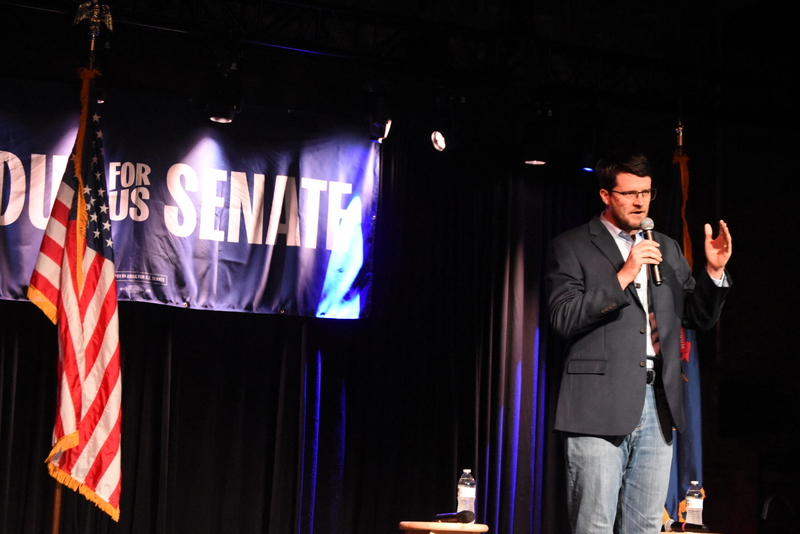
Artificial intelligence and the data centers that power them were also a hot topic at the town hall after an audience member said he is skeptical of El-Sayed’s anti-data center platform.
“The issue with AI, the tech that is being built off the back of data centers, is that it is incentivized to pick the lowest hanging fruits, which is other people’s jobs, and the process by which it’s happening may not be sustainable on its own terms, and we are in the circumstance where we are watching a tech transition happen, even if this takes off faster than the whole time horizon of a work life, which could create massive technological changes in our society that we are not ready for,” El-Sayed said in response to the question. “AI shouldn’t be able to fire a weapon, shouldn’t be able to fire you, shouldn’t be able to prior authorize your healthcare and tell you what healthcare you don’t need or shouldn’t need.”
Muller again linked the issue of artificial intelligence to money in politics.
“What we have also seen is that AI right now is spending over 200 million dollars to influence the midterm elections because what they want are people in Congress who won’t bother putting in any of these regulations, any of this oversight, or making sure that the people are protected, or that any of this could happen,” she said. “They want people who will just rubber stamp so that they can keep lining their pockets and driving up their profits, and they think $200 million can buy it, and you know that’s a lot of money.”
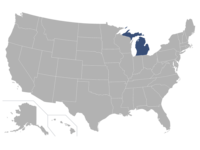
Lansing, MI