2 Oregon state-backed rail projects cost more than $70 million. They’re still mostly idle.
Oct 09, 2026 | 8:45 am ET
Description
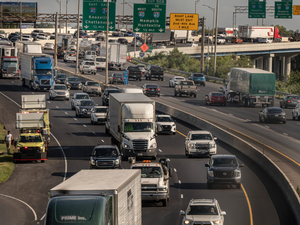
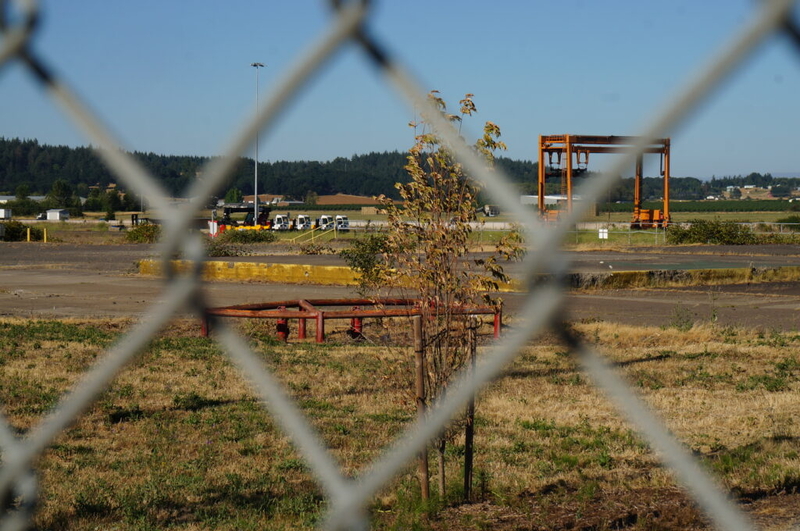
The Mid-Willamette Valley Intermodal Center in Albany sits idle off of Interstate 5. State and Linn County leaders promised it would get trucks off the highway and move hay and grass seed to Puget Sound ports by rail. (Alex Baumhardt/Oregon Capital Chronicle)
It’s been nearly 10 years since the Oregon Legislature approved a $5.3 billion package of taxes and fees to fund transportation over the following decade, including $50 million in grants to build two rail shipping centers in the Willamette Valley and eastern Oregon that promised to reduce truck emissions, boost agricultural exports and save farmers money.
They continue to sit mostly idle, with those lofty promises unfulfilled.
Erik Havig, statewide policy and planning manager at the Oregon Department of Transportation, presented an update on the projects Thursday afternoon to the five-member Transportation Commission that oversees the department. One of the facilities is still only partially constructed, and the other is finished but functionally dormant.
“Unfortunately, they ran into some operational challenges,” Havig explained.
Behind schedule, over budget, state-backed rail projects costing $70 million sit idle
The now-shuttered Malheur Enterprise chronicled for years the failings of the Treasure Valley Reload Center in Nyssa, and the Oregon Capital Chronicle in 2024 followed up with reports on missteps in Treasure Valley and the Mid-Willamette Valley Intermodal Center in Millersburg.
The Treasure Valley Reload Center, once running, was supposed to save onion growers $2 million per year in transportation costs to Midwest and East Coast cities. But by 2024, it was $18 million over budget and more than two years behind schedule.
Today, only the rail infrastructure is complete. Malheur County, lacking funding to finish the build, is entering into an agreement with the Wyoming Colorado Railroad to finish construction, lease the center and then buy it from the county, according to Matt Noble, a spokesperson for the transportation department.
The Mid-Willamette Valley Intermodal Center off Interstate 5 promised to move hay and grass seed to ports in Seattle and Tacoma via rail, taking up to 150 semi-trucks off Interstate 5 each day. It was finished in November of 2022 — 10 months late and $10 million over budget. Today, a home roofing company uses it to move a few train cars of materials each week, Havig told the commissioners.
Linn County officials are talking with a company called Orion to eventually move biodiesel from Gulf states through the facility, Havig said. The fuel would be offloaded from trains and put on trucks to go out through the Northwest.
Havig told transportation commissioners that Orion is still waiting to complete some of its containment systems and get all required local permits, but that Linn County Commissioner Roger Nyquist told Oregon transportation officials that he is hoping operations will begin either this year or early next. Nyquist was among the officials who pitched the Willamette Valley project for state funding and has faced criticism of its failings over the years.
“He’s probably hoping to,” Commission Chair Julie Brown said, joking that “he (Nyquist) avoids me.”
‘Good reasons at the time’
Brown joined the commission in 2018 and is the only remaining member of the five-member governor-appointed board who vetted and ultimately approved plans for the two rail projects.
But on Thursday, she and Commissioner Lee Beyer, who as a state senator at the time voted to approve funding for the projects, explained that they had thought there was a compelling need for the rail centers.
“There were good reasons for it at the time from my perspective. We had talked for years, decades, about trying to get containers off of the road and onto the rails for environmental advantages and economic advantages,” Beyer said.
Industry experts warned early on that both rail centers would fail if they did not account for several major challenges, including the Willamette Valley center being in a poor location. It’s not far enough from Washington seaports to make rail cost-effective, those experts warned.
They also cautioned that both rail centers would need the buy-in of two monopoly railroad companies — both of which are mostly uninterested in collaboration on public projects — to commit to agreements on demand, rates and logistics for moving product. Neither Union Pacific nor BNSF made long-term or explicit agreements to cooperate with the facilities.
“I think the lesson learned, I thought at the time, was: Don’t build a railroad project (…) without having more input from the shippers,” Beyer said.
Since then, more than $70 million in public money — including significant investment from Linn and Malheur counties — has been spent or committed to the projects, and the experts’ warnings have been borne out.
State Rep. Greg Smith, R-Heppner, who championed the funding for the rail facilities in the $5.3 billion House Bill 2017, and who was eventually hired as a consultant by nonprofit economic development groups supporting both Linn and Malheur counties to help them go after the state grants and manage the rail projects, declined to comment to an email sent to his legislative address Thursday evening and did not provide an alternative email address. He did not respond to a text Thursday afternoon from the Capital Chronicle, either.
Smith, who is running for reelection in November, officially ended his work with Linn County in July 2019, after earning between $150,000 and $200,000 according to John Pascone, president of the Linn County Economic Development Group. Smith’s consultancy took in $15,000 a month from 2018 to 2022 for economic development work in Malheur County and for managing the Treasure Valley Project, according to reporting from the Malheur Enterprise.
Salem, OR