Denver’s 1876 tax rolls shed light on Colorado’s Gilded Age inequality
Oct 09, 2026 | 5:45 am ET
Description
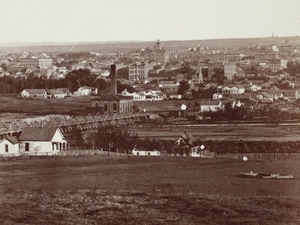
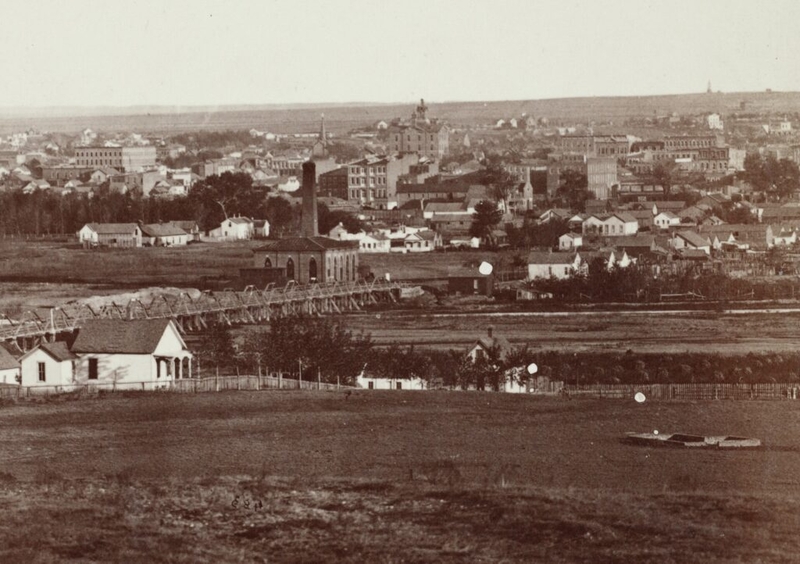
Denver is pictured in a photograph dated between 1875 and 1879, including a bridge over the Platte River and the Denver City Water Company's Holly water works. (Courtesy of Denver Public Library Special Collections, X-18534)
With the arrival of a major east-west railroad in Pueblo in early 1876, Colorado’s second city entertained hopes of surpassing Denver in commercial importance — but tax records published later in the year shed light on how far the Mile High City’s would-be rival would have to go to catch up.
The total assessed value of all real and personal property in the city of Pueblo in 1876 was $1,654,588, the Pueblo Chieftain reported. Though it claimed a population roughly half as large as Denver’s, Pueblo’s total wealth was only about one-sixth of the wealth held in the new state capital, where the assessed taxable property in 1876 exceeded $9.1 million.
A complete list of the “heaviest tax-payers in Arapahoe County,” published in the Denver Times on Oct. 11, 1876, shows much of this wealth concentrated in the hands of the city’s pioneer elite.
The Kansas Pacific Railway, which provided Denver’s main railroad connection to the east, topped the list with $387,240 in taxable assets. Other early Colorado railroads and businesses, including the Daniels, Fisher & Co. department store, also featured prominently.
Denver’s richest man was former territorial Gov. John Evans, remembered today in large part for his role in the 1864 Sand Creek Massacre. Before, during and after his stint as governor in the 1860s, Evans had prospered from investments in railroads and real estate, and in 1876 Arapahoe County assessed his net worth at $167,580.
How large would an equivalently sized fortune be today? As calculated based on historical inflation rates, Evans’ net worth had a purchasing power equal to about $5.4 million in 2026 dollars — but as a measure of wealth, adjusted to the size of the U.S. economy in 1876, it was more like $84.8 million, according to a tool used by economic historians.
Alongside Evans, many of the other top names on Denver’s 1876 tax rolls still have a familiar ring today. Two other railroad barons, Walter Cheesman and David Moffat, ranked among the city’s richest men, as did Samuel Elbert, another former territorial governor, and William Byers, publisher of the Rocky Mountain News. The list included at least two prominent Black entrepreneurs from Colorado’s pioneer days, Edward J. Sanderlin and Barney Ford.
This wealthy Denver business elite was closely associated with Colorado’s dominant Republican Party — ties that had long fueled accusations of rampant corruption by the “Denver Ring,” as its political opponents dubbed it.
After the GOP narrowly prevailed in the first state elections on Oct. 3, Democratic newspapers blamed their defeat on a financial disadvantage: “The Denver Ring … spared no money and consequently a vigorous campaign could be waged,” complained the Colorado Banner in Boulder, “when Democrats who had no money, could only rely upon the common sense of the people.” Both parties also traded accusations of outright bribery of voters.
Gilded Age corruption
In Colorado and beyond, the 1870s inaugurated what Mark Twain christened the Gilded Age, a decades-long period of rising wealth inequality and political corruption.
In addition to national and regional railroad companies, some of the biggest corporate entities on Denver’s tax rolls were the city’s early public service corporations: the Denver Gas Company, Denver City Water Company, and Denver City Railway Company, which reported a combined $119,440 in assets (about $60 million in today’s dollars). All three had been granted monopoly rights with little oversight or regulation, further enriching a small handful of politically-connected shareholders that included Evans, Cheesman, Moffat and Byers.
With “no remuneration” demanded for their franchises and “no reservations as to future control of rates or services,” wrote historian Clyde Lyndon King in a 1911 treatise on Denver’s public service corporations, these early utilities went on to fleece the public through a combination of high rates, massive tax exemptions and other privileges. Calls for reform would eventually lead to the creation of a Public Utilities Commission in Colorado and many other states.
Denver, CO