With New ‘Deportation Judges’ Working Remotely, NYC Immigrants Struggle For a Fair Hearing
Oct 09, 2026 | 5:00 am ET
Description
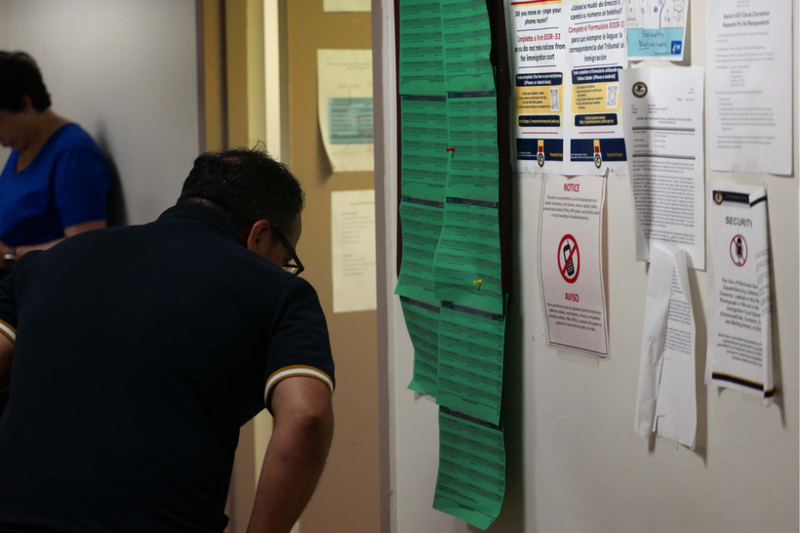
A man looks at a long docket outside a courtroom at 26 Federal Plaza. / Camara Porter / AdMedia
The people waiting to see Immigration Judge Laurie Samuels inside a Manhattan courtroom filled the waiting area and spilled out into the hallway, forming a line that stretched around the corner. Some clutched manila folders filled with their paperwork. A woman sent a message on WhatsApp: “We’re inside.” A toddler curled up on a plastic chair and cried softly, while a little girl in a red party dress and black patent leather Mary Janes slept next to her mother.
Samuels, whose docket included nearly 200 cases that Friday morning in September, could see none of that. Like many of the new immigration judges in New York and around the country, she was working remotely from an undisclosed location. The new judges are part of a hiring surge by the Department of Justice, which launched a recruiting campaign encouraging lawyers to serve as “deportation judges.”
Over three days in September, New York Focus observed proceedings before 23 judges at 26 Federal Plaza, one of the busiest immigration courts in the United States. Ten of them — almost all new hires — appeared via video, rather than in person at the dais. One, who said he was based in south Florida, presided over a docket in which immigrants were directed to a secretive courtroom on the third floor, while a Department of Homeland Security attorney participated in person in another room.
Since the Covid pandemic, a significant share of hearings have been conducted via teleconferencing. But former judges told New York Focus that, with the exception of the Covid-era, judges have almost always worked from physical courtrooms and lived within commuting distance.
The move toward remote judges is only one small change amid an upheaval in the country’s immigration courts under President Donald Trump. Others, like Immigration and Customs Enforcement’s push to arrest people at their hearings and the administration’s efforts to keep people locked up while their cases proceed, have surely been more consequential.
But inside 26 Federal Plaza, the increasing prevalence of judges conducting proceedings via video conferencing, as dozens of anxious people fill their courtrooms, is an unmissable sign of the administration’s efforts to speed up deportations by any means possible.
Some longtime court watchers say the shift has sometimes made it harder for people to communicate with the judges who decide whether they will be deported, and prevented judges from reviewing documents people bring with them. It’s also unfair, according to some former immigration judges, attorneys, and immigrants who have cases with remote judges.
“If I have to come in, why doesn’t the judge have to come in?” said immigration attorney Victor Ocampo, standing in the hallway outside Samuels’s courtroom. Ocampo said he had to wake up at 5:30 am to get to court by 8 to meet his client, who is from Ecuador. Samuels’s assistant ended up telling them they could leave without even seeing the judge.
Ocampo said he had no idea where Samuels was.
“I just know she’s not in there,” he said, gesturing toward the courtroom.
A Moroccan man who appeared via video told Samuels that he had tried to change his court proceedings to Chicago, where he now lives. Samuels knows Chicago well; she spent her legal career there before becoming an immigration judge, with about 20 years in private practice and a decade as an administrative law judge. New York Focus could find no indication in public records that Samuels has relocated. A person who looks identical was reached by phone at a number listed on her state attorney registration but, through her assistant, denied being an immigration judge.
“On its best day, it’s still meaningfully different than appearing in court.”
—Devon Thurman, Georgia Tech School of Public Policy
Samuels told the Moroccan man he had to be in New York City in person in five days, unless he could get his venue changed.
“I work now,” he said through an Arabic interpreter. “I can’t go to New York.”
She suggested he go to the courthouse in Chicago to ask for help but denied his request for more time to do that.
“No, that’s the time I’m giving you,” she said. “I have to be consistent.”
The Justice Department’s Executive Office of Immigration Review, which runs the country’s immigration courts, did not answer questions about how many judges are working remotely. A spokesperson defended the arrangement.
“All immigration judges, whether they conduct hearings in person or internet-based, are independent adjudicators and decide all matters before them on a case-by-case basis, according to U.S. immigration law, regulations, and precedent decisions,” the spokesperson, Kathryn Mattingly, said.
Samuels and the other new remote judges typically appear in their courtrooms on television screens. Their heads and shoulders — covered in black judicial robes — float against an official blue background emblazoned with the seal of the Executive Office of Immigration Review. A camera points toward the courtroom, allowing the judge a view of the attorneys on both sides and the people inside the courtroom waiting their turn to speak.
Samuels’s docket often lists dozens of people. Her legal assistant, who is at the courthouse in person, clutches a printout of the docket and tells people when they can enter the courtroom, or leave without actually seeing the judge.
“I don’t know what happened,” Sandra, a mother in her 20s from Colombia, told New York Focus in Spanish after being sent away. “I didn’t understand anything.”
A Spanish-speaking attorney who overheard the interaction explained to her that because the judge had already established the deadline for her to submit evidence to fight deportation, she was allowed to leave after checking in with the legal assistant. The attorney said she should consult her lawyer, whom the woman hadn’t heard from recently and who hadn’t shown up that day.
As she gathered her 6-year-old daughter and started for home, Sandra said it was lucky that she had found out about the hearing at all. She only spotted it because she checks the EOIR website constantly.
Not all immigration judges are allowed to work remotely. The privilege appears to be reserved for new hires, as the EOIR almost entirely ended accommodations for other employees to work remotely at the start of the second Trump administration.
According to a New York Focus review of hiring announcements, the administration has hired more than 300 new permanent immigration judges. Current listings show open positions paying up to $209,000 a year. It has fired more than 125, according to the National Association of Immigration Judges, and more than 100 have left voluntarily.
Of the 37 judges assigned to Federal Plaza in January 2025, only 16 remain, and the Trump administration has appointed 26 new judges there.
“A lot of times it takes you six months to a year, maybe two years even, before you have the experience level to really function on your own.”
—Holly D’Andrea, National Association of Immigration Judges
The new judges generally have far less experience with immigration law than judges hired earlier, who typically had backgrounds working for the Department of Homeland Security or as attorneys representing immigrants, according to the judges’ official biographies. Appearing remotely, hundreds of miles away from their colleagues, means it’s harder for the new judges to ask questions and learn on the job, said National Association of Immigration Judges President Holly D’Andrea.
“A lot of times it takes you six months to a year, maybe two years even, before you have the experience level to really function on your own,” D’Andrea said.
Mattingly said the agency requires that new judges receive “extensive classroom-based training and on-the-job training,” and all judges attend annual trainings.
Still, courtwatchers say remote judges are at an inherent disadvantage when it comes to navigating complicated cases. Jun Reiss, the assistant detention coordinator at St. Peter’s Church, who frequently watches immigration court, recalled a recent situation in which an elderly Bangladeshi woman who showed up with no attorney asked the judge to review the folder full of documents she had brought with her to shed light on her case. But the judge, who was appearing remotely, had no way to do so
“It was the prime example of why it’s such a bad thing,” Reiss said of judges working remotely. “They were getting so frustrated with each other, and it was all because they weren’t in the same room.”
Devon Thurman, a political scientist at Georgia Tech and a researcher with the Deportation Data Project who studies video appearances in immigration court, has analyzed EOIR data and found that respondents who appear via video are significantly likelier to be ordered deported than those who appear in person. While watching such appearances, she observed what she terms “judicial frustration,” situations in which an audio or video lag or disrupted connection caused the judge to become irritated with the respondent or their attorney.
“On its best day, it’s still meaningfully different than appearing in court,” she said of the technology.
Thurman analyzed recent EOIR data at the request of New York Focus and found that the share of respondents appearing remotely at 26 Federal Plaza has fallen in the last two years, even as fully remote judges have taken the bench. The analysis showed that nearly 90 percent of respondents in front of Samuels appeared in person.
Several immigration attorneys told New York Focus it didn’t make much difference to them if a judge appeared remotely.
“I don’t think it matters that much, because sometimes we appear virtually,” said Caroline Stephenson, an attorney who had a client on Samuels’s docket in September. “It’s more efficient. I get to represent people from all over the country.”
At the same time, Stephenson said, a judge sitting in their home office, hundreds of miles away from their courtroom, might be less able to appreciate the gravity of their decisions.
“When you can see people in front of you, it may give you a different perspective,” she said. “You realize this is not a number, but people with lives, challenges, families, struggles — the same that we all have.”
Albany