Feds unlikely to change abortion pill policy before next year
Oct 08, 2026 | 10:38 am ET

Description
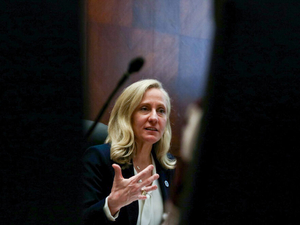
U.S. Health and Human Services Secretary Robert F. Kennedy Jr. announced a safety review of abortion medication last spring, following an anti-abortion pressure campaign urging the U.S. Food and Drug Administration to overturn a Biden-era rule allowing abortion pills to be prescribed via telemedicine. (Photo by Max Nesterak/Minnesota Reformer)
The U.S. Food and Drug Administration said late Wednesday that it expects to complete its long-awaited safety review of abortion pills by mid-December and issue a report evaluating the results by March 2027.
The agency disclosed the information in a court-mandated status report it submitted in the federal lawsuit Louisiana v. FDA. The timeline aligns with recent reporting that the Trump administration intends to delay controversial decisions around abortion until after the midterm elections.
U.S. Health and Human Services Secretary Robert F. Kennedy Jr. announced the review last spring, following an anti-abortion pressure campaign urging the FDA to overturn a Biden-era rule allowing abortion pills to be prescribed via telemedicine. More than a year later, national anti-abortion leaders are criticizing the administration for delaying action, and have signaled they would reject a review that finds medication abortion safe if they don’t find it to be thorough enough.
“The FDA’s court-ordered update on its abortion-drug study is alarming,” said Susan B. Anthony Pro-Life America President Marjorie Dannenfelser in a written statement released late Wednesday night. “Instead of the promised gold-standard study, the FDA is trying to peddle fool’s gold.”
The Trump administration has used the ongoing study to delay several federal lawsuits related to medication abortion regulation. Louisiana, as well as Missouri and Texas, sued the federal government, arguing that federal policies allowing mifepristone to be prescribed via telehealth and distributed by mail undermine state abortion bans. Six months ago, a federal district court in Louisiana granted the FDA’s motion to stay proceedings in the case until the government completed its review of the current mifepristone-misoprostol regimen.
The FDA says it is comparing the safety profile of medication abortion to the safety profile of surgical abortion and analyzing a variety of data sources within, and outside of, the FDA’s Sentinel system, a distributed database related to medical product safety.
The agency says it is also reviewing mifepristone’s Risk Evaluation and Mitigation Strategy (REMS), a drug-safety program the FDA uses for certain drugs. That includes reconsidering the agency’s 2023 decision allowing for telehealth abortion.
“Following completion of its study and review, FDA will decide whether changes to the Mifepristone REMS Program are necessary and, if applicable, initiate any such changes in accordance with established processes,” reads the status report submitted by the U.S. Department of Justice.
Mary Ziegler, a law professor at the University of California, Davis, expects the FDA’s review to be guided by politics rather than science.
“I think the fact that the Trump administration has not yet issued new restrictions on mifepristone is primarily because Republicans think it’s dangerous to do that politically,” Ziegler said. “I think if they do impose new restrictions, it’ll be to cater to the base.”
Anti-abortion groups urge attorney general to halt mailing of abortion pills
Anti-abortion groups have urged the administration not to wait until the study is complete to take action on abortion drugs, and warned they would not accept inaction even after the study is complete. They’ve also said they will continue to pursue abortion-pill restrictions in the states.
“The Pro-Life Movement is prepared to reject a methodologically flawed review where the agency has simply gone through the motions to rubber stamp the current REMS, or lack thereof,” said John Mize, CEO of Americans United for Life, in a written statement.
His group was involved in a movement-wide effort to produce and promote research on medication abortion, analyzing commercially available Medicaid insurance claims data. White papers produced by the Ethics and Public Policy Center and the Foundation for the Restoration of America found that about 11% of patients who took mifepristone experienced serious adverse events, which is 22 times higher than what’s on the current drug label for mifepristone. The papers, which were not published in peer-reviewed scientific journals, used a broader definition of serious adverse event than what the FDA uses.
Anti-abortion leaders told Stateline they have been expecting the FDA to conduct its own analysis of Medicaid insurance claims data as part of its review. They say the agency should not only use its internal systems, calling them insufficient.
“I’m certainly hopeful that the FDA is using more robust data sources like an insurance claims database,” said Dr. Christina Francis, CEO of the American Association of Pro-Life Obstetricians and Gynecologists, which was a plaintiff group in a previous lawsuit challenging the FDA’s regulation of abortion pills, which the U.S. Supreme Court dismissed over standing issues.
The Indiana OB-GYN said the FDA’s review is “long overdue” and said her practice has seen complications from abortion pills “at least on a monthly basis.”
Ushma Upadhyay, a professor at the University of California, San Francisco, who has co-authored several studies showing low rates of serious adverse health risks for medication and telehealth abortion, said it would be difficult to draw conclusions about telehealth abortion just from insurance claims data.
“Insurance claims are an excellent way to understand safety of many medications, and I also think it is useful in understanding the safety of medication abortion, but not specifically telehealth, because most of the telehealth abortion providers do not accept insurance,” Upadhyay said.
Ziegler said the results of the safety review are unlikely to change the debate over abortion pills.
“Mifepristone is one of the most studied, most politicized drugs in the country,” she said. “Obviously it’s not being studied because it hasn’t been studied.”
Stateline reporter Sofia Resnick can be reached at [email protected].