Salt Lake City Council members agree to slow down sale of land near Great Salt Lake to the state
Oct 08, 2026 | 7:04 am ET
Description
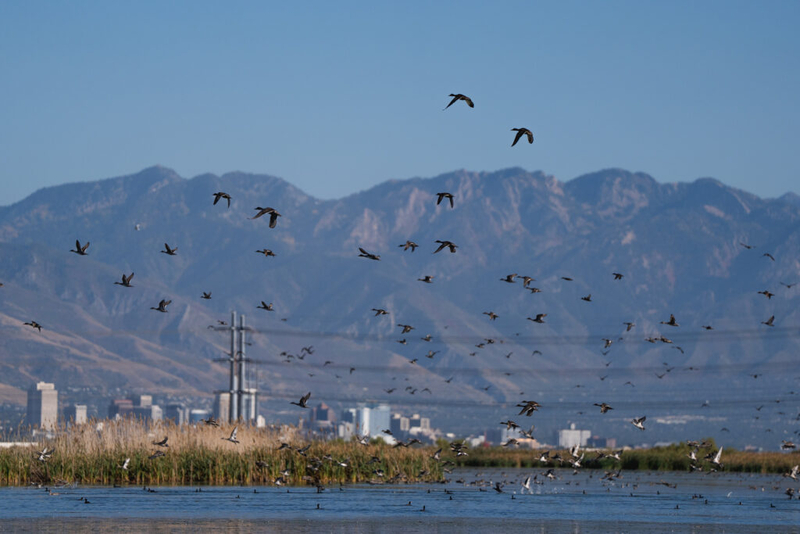
Birds take flight over the Great Salt Lake, with downtown Salt Lake City visible in the background, on Friday, Sept. 27, 2024. (Photo by Spenser Heaps for Utah News Dispatch)
Salt Lake City Council members hope to pause before advancing a proposed sale of 900 acres of land between the Salt Lake City International Airport and wetlands.
While the interested buyer is the Utah Department of Natural Resources and its Wildlife Resources division, environmentalists worry that selling the land could be the first of many missteps leading to harm to the Great Salt Lake and migrating birds.
Details on the sale are still unconfirmed, according to a report from city staff, including the price of the land. The council still has to approve other processes before the deal is finalized as well, so a vote wasn’t expected at their Tuesday evening meeting.
But, after dozens spoke opposing the sale without more in-depth studies, council members said they would take extra steps before making a decision.
After hearing the comments, Councilmember Dan Dugan said there are conflicts between the management plan proposed by the Department of Natural Resources and federal clean water policy. Also, he said, the city should analyze all options before approving a land transfer.
“Does it require the city to transfer the land to the state, or can we do that ourselves by just transferring it to another one of our departments using (Federal Aviation Agency) money to manage that?” Dugan said. “Can we do it ourselves without giving someone else that responsibility and also that authority to do something that we may not all agree with?”
Chelsea Duke, wildlife lands coordinator at the Utah Division of Wildlife Resources, said during the meeting that the agency’s goal in the acquisition is “to protect, conserve, and enhance the wetlands around the Great Salt Lake.”
Utah’s strategy to fight invasive reeds at the Great Salt Lake? Play the long game and look upstream
The division’s team of full-time biologists would manage the area in conjunction with the state-owned 660 acres adjacent to the land, known as the Blackhawk Waterfowl Management Area, she said, and would work with state, federal, private and nonprofit representatives to restore the wetlands and mitigate invasive species in the system, particularly phragmites, a reed that crowds out native species and draws a tremendous amount of water.
“Our waterfowl management areas are managed in a way to help waterfowl and other migrating bird species,” Duke said, “These properties are closed to public access during specific times of year to protect nesting birds and provide crucial rest areas. Because our (waterfowl management areas) are primarily for wildlife it is also crucial that they remain protected from development.”
If the division were to buy the parcels, Duke said, it is required by state law to write a habitat management plan with input from local government officials, neighboring landowners and others.
But Ren Griffith, policy advocate for the conservation organization Utah Audubon Council, said that protection from development “is only half the question.”
“The other half is what kind of habitat this land will be. For three decades, the airport has kept this property closed to hunting and trespassing, and it has become a place where migrating birds can rest undisturbed,” she said.
When asked whether hunting would be allowed in the area, the Utah Division of Wildlife Resources said it “hopes to expand waterfowl hunting opportunities and protect the wildlife habitat in the area through this purchase,” according to the city staff report.
If the acquisition goes through, the agency would add the parcel to its Blackhawk Waterfowl Management Area, which has remained closed to the public since it was purchased because it doesn’t have any usable, safe public access points.
“Public access points, parking, motor vehicle restrictions, grazing, and other management decisions will be developed once the property is purchased and (the Division of Wildlife Resources) writes the habitat management plan for the entire (waterfowl management area),” the agency said in its response to Salt Lake City staff.
The Utah Audubon Council supports transferring the land to the Department of Natural Resources with a permanent conservation easement for all 900 acres with some specific terms, Griffith said, like the creation of a hunting-free wildlife rest area within “a meaningful share of the property.”
Neighbors of northwestern Salt Lake City also worry that the sale could essentially undo decades of their land advocacy and negotiations.
Adam Von Maack, representing Gillmor Livestock Corporation, which is owned by a family that has farmed and ranched in the area since 1896, said the family had endured multiple land takeovers from the city as the airport expanded.
After a decade of planning processes, they understood the city had made renewed commitments to “principles of stewardship, respect for agriculture, and your continued protection of this significant city-owned property,” he said. The sale would “break faith” with the residents in the area.
“You created this mitigation site to replace sensitive lands destroyed by your runway expansion. You took that land from your neighbors to do it, and now you turn your back on it because it’s inconvenient,” Von Maack said.
“The state bought the Blackhawk without usable public access. This transaction seeks to solve their access problem and the airport’s management burden, while neighbors inherit the consequence,” he said. “It also allows the state to bully your area constituents into accepting area policies they spent generations working alongside you reject. Selling to the state removes your ability to protect this land, your constituents, and the city’s documented priorities.”
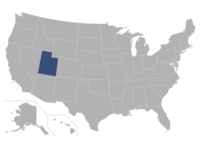
Salt Lake City, UT