Doctors know how to treat ectopic pregnancy in Oklahoma. So why are patients still dying?
Oct 08, 2026 | 6:30 am ET
Description
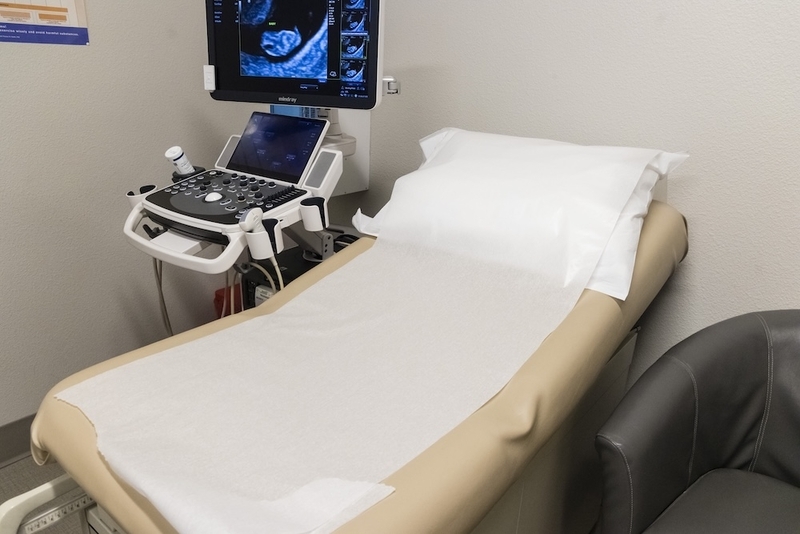
An exam room at Stanton Healthcare, an anti-abortion crisis pregnancy center in Meridian, Idaho, is pictured. (Photo by Otto Kitsinger for States Newsroom)
An ectopic pregnancy is not supposed to be a death sentence.
As an emergency physician, I know exactly what is at stake when a patient comes into the ER with one. An ectopic pregnancy occurs when a pregnancy implants somewhere it can not grow safely, usually in a fallopian tube. If it continues to grow, the tube can rupture and cause catastrophic internal bleeding.
We know what to look for. We know how to treat it. And when we act in time, patients survive.
And yet, a new ProPublica analysis has revealed that deaths from ectopic pregnancy in the United States have nearly doubled, from about 100 between 2014 and 2019 to almost 200 between 2020 and 2025. The increase occurred nationwide, but the climb was much steeper in states with strict abortion bans.
Leitaea Lowrimore, of Oklahoma, sought care at three hospitals across two states as her pain and bleeding worsened, yet did not receive immediate treatment even as doctors acknowledged a possible ectopic pregnancy.
“There were a few times I asked my husband if I was going to die,” she later said in a lawsuit, filed in Arkansas, challenging that state’s abortion ban.
As an emergency physician, what is so maddening about a case like hers is that the medicine is not mysterious.
Ectopic pregnancy was once extremely life threatening. In 1880, mortality was estimated at 72% to 90%. By 1990, it had fallen to just 0.14%, thanks to more than a century of advances in diagnosis and treatment.
The problem is not that doctors do not know how to treat ectopic pregnancy. The problem is that too many feel forced to hesitate before they do it.
A few years ago, my colleagues Esther Choo, Monica Saxena, and I surveyed 150 board-certified emergency physicians across the country.
In states with restrictive or semi-restrictive abortion laws, like Oklahoma, 24% reported delays in managing suspected or confirmed ectopic pregnancies. More than half said they had changed their practice to stay within what they understood the law to allow, including ordering additional tests or delaying definitive treatment. Among doctors reporting delays, 58% said they now needed a higher level of diagnostic certainty before acting.
These doctors have not forgotten how to practice medicine. They are practicing differently because the law has changed around them.
Treating an ectopic pregnancy is legal in every state. Abortion bans, in states such as Oklahoma, often include exceptions to preserve the life of a pregnant patient, with some explicitly excluding ectopic pregnancy.
But saying care is technically legal is not the same thing as making doctors feel able to provide it.
Early ectopic pregnancies are not always easy to diagnose. An ultrasound may not immediately show where a pregnancy has implanted. Hormone levels may need to be followed over time.
Emergency physicians are constantly weighing probability, risk, and the consequences of waiting. That is normal medical judgment.
Abortion bans add another calculation that has nothing to do with medicine: What happens to me if I am wrong? Will my hospital support me? Could a prosecutor second-guess the care I provide?
In emergency medicine, waiting for absolute certainty is not always the safer choice. Sometimes waiting is the most dangerous thing we can do.
ProPublica also found that in Texas, a state with one of the country’s most restrictive abortion bans, the number of patients experiencing substantial blood loss from an ectopic pregnancy increased by about 29% between 2018-19 and 2023-24.
The rise in deaths began before the 2022 Supreme Court decision that held the U.S Constitution does not confer a right to abortion. No single analysis can prove the abortion bans that followed that ruling caused every delay or death, but alongside physicians reporting changes in their practice, it is impossible to dismiss the chilling effect as hypothetical. And we should expect findings like this in any state with a total abortion ban.
Lawmakers often point to exceptions in abortion bans as proof that emergency care is protected. But an exception on paper is not the same thing as access to care in practice.
If physicians are ordering extra tests, waiting for greater diagnostic certainty, or delaying treatment for a condition they know how to manage because they are afraid of crossing a legal line, then the exception is not working. It has utterly failed.
I know education matters because I have spent time providing emergency physicians in states with abortion bans with state-specific guidance about what care the law allows.
We are working with doctors, including at the University of Oklahoma School of Community Medicine, to make sure emergency physicians understand what they are empowered to do, even under a total abortion ban. But education is a workaround, not a cure. No amount of training can erase the fear created by vague laws backed by severe penalties.
That is the fundamental problem with these laws. Emergency medicine does not operate in perfect certainty. Doctors make urgent decisions based on evidence, risk, and the patient in front of us. A legal exception that only feels safe once a patient is unquestionably, catastrophically ill is not a meaningful exception at all.
An ectopic pregnancy should never have to rupture before a doctor feels protected enough to act. We already know how to treat these patients. The question is whether our laws will let us do it before they get sicker.

Oklahoma City, OK