Poll: Majority of voters oppose data center construction anywhere in Maryland
Oct 08, 2026 | 12:01 am ET
Description
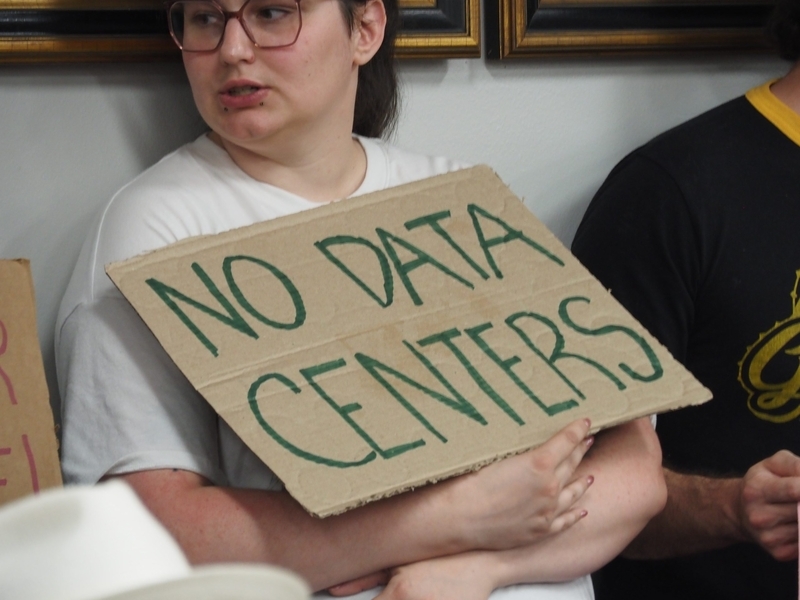
A data center opponent in Arkansas. In Maryland, a new poll shows an overwhelming majority of voters oppose building data centers anywhere in the state. Most are skeptical of any possible benefits, and said they believe more harm than good will come from the facilities and technology. (File photo by Ainsley Platt/Arkansas Advocate)
A majority of Maryland voters are opposed to building data centers in the state and have a dim view of artificial intelligence, which they believe will have a negative impact on society, a new poll shows.
Half of those surveyed in the poll released Thursday by the Institute of Politics at the University of Maryland, Baltimore County were asked about support for data centers being built anywhere in Maryland and the other half were asked about a data center near their community. In both cases, nearly 8 in 10 were opposed.
“What I think is really striking is that people don’t like it across the board, whether it’s next to them or some other place in the state,” said Mileah Kromer, director of the poll. “It doesn’t matter where it’s at, they don’t want it here in the state.”
The survey is based on interviews with 776 Marylanders who said they were likely to vote. The survey, conducted from Sept. 22-27, has a margin of error of plus or minus 3.5%.
Overwhelmingly, voters said data centers would negatively impact the costs of household utilities, quality of life, as well as water and air quality.
While supporters argue that data centers would have positive impacts on the economy, state tax revenue and jobs, voters in the UMBC poll were skeptical.
Nearly half said they believed the impact of data centers on the state economy and tax revenue would be mostly negative, while 37% said data centers would have a mostly negative impact on employment compared to 26% who said it would be mostly positive.
Just 23% of those surveyed said they believed AI would have a positive impact on society.
Moore job approval remains flat
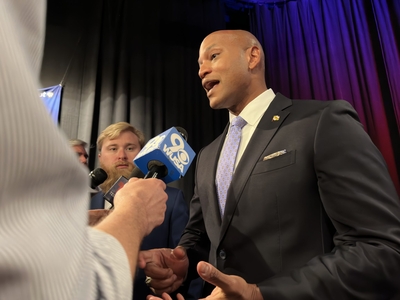
The poll also showed that Maryland Gov. Wes Moore may be on track to win a second term, even as voters expressed mixed opinions on his job performance.
Forty-nine percent of likely voters in the poll said they approve of the job done by Moore. Those same voters are also unhappy with the direction of the state and overall economic conditions, but so far are not pointing a finger at Annapolis.
“I think it’s really difficult to have a higher approval rating than that with these types of economic attitudes,” Kromer said of Moore. “That is, to me, what was probably holding down his numbers. People get upset with leadership when the economic conditions are not what you’d hope they’d be. I think that’s probably what’s what’s happening here with with Gov. Moore.”
Todd Eberly, a political science professor at St. Mary’s College of Maryland, agreed.
“Everything is nationalized these days, and we do have a national economy,” he said. “When gas prices are high, they’re high everywhere. When energy prices are high, they’re high everywhere. The problem with 3% inflation is it’s hitting people everywhere, not just in the state of Maryland.”
The poll Thursday found 49% of Marylanders approved of Moore’s performance, while 42% said they disapproved and 8% said they did not know. Those numbers are essentially flat compared to a poll in April, when 48% of voters approved of Moore’s performance and 42% disapproved.
Eberly said Moore’s approval numbers likely remained unchanged because so much of what is driving the economic pain is the result of decisions affecting the entire country.
“There is a lot of general dissatisfaction,” Eberly said. “It’s being expressed in this poll as dissatisfied with Maryland, but I think it speaks to the fact that people in general are uncomfortable with the direction of things in the country right now.”
In Maryland, registered Democratic voters account for just over half of the state’s more than 4 million registered voters, while Republican and unaffiliated voters account for about a quarter each. And Moore’s approval numbers are bolstered by Democrats, 70% of whom said they approved of his work. Disapproval stood at 88% among Republicans and 49% among unaffiliated voters.
A UMBC poll released earlier in the week showed Moore, the first Black governor in the state’s history, who is seeking a second term, with a 27-point lead over Republican challenger Dan Cox roughly one month before the election.
Poll: Voters oppose redistricting ballot question when presented ‘meat of the political outcome’
“This is sort of where [former Gov.] Martin O’Malley’s approval rating was when he was seeking a second term in his rematch against Bob Ehrlich, and O’Malley won by like 13 points,” Eberly said.
Moore entered office in 2023 with a job approval hovering at 64%, which was 35 points higher than those who said they disapproved. Today, that gap is seven points.
‘Maryland does not exist in a separate universe’
A plurality of Marylanders said they are unhappy with the direction of the state: Roughly 49% said the state is on the wrong track compared to 37% who believe it is headed in the right direction.
In March, the UMBC poll found 59% said the state was on the wrong track and 30% said it was moving in the right direction.
Again, Republicans and unaffiliated voters are the most unhappy with 90% and 55% respectively saying the state is on the wrong track. Half of Democrats said the state is moving in the right direction.
Economic conditions are top of mind for those voters, with 81% saying the economy has been poor or fair. Just 17% described it as excellent or good.
“Marylanders are angry and upset, but so are voters across the nation,” Eberly said. “Maryland does not exist in a separate universe from the rest of the country, despite what some people think sometimes.”
Kromer’s poll offered a look into factors shaping the views on the economy, asking voters what they think of when assessing the economy:
- 94% complained about the prices of everyday goods and services;
- 90% said their personal finances;
- 86% said the increased cost of housing;
- 84% said state taxes and fees;
- 74% said interest rates;
- 67% said state unemployment rates and job reports;
- and 41% said the stock market.
Annapolis, MD