Nearly $19M to help save Nebraska prairie, state bird, dancing chickens
Oct 07, 2026 | 4:59 pm ET
Description
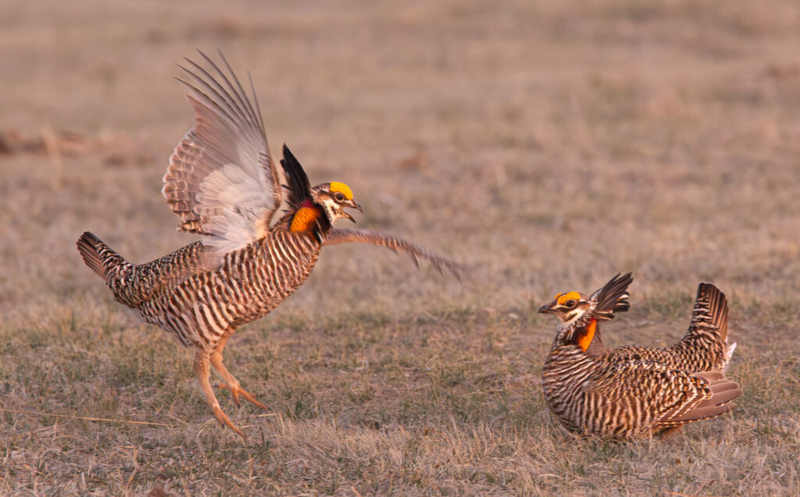
The love dance of the greater prairie chicken is a tourist magnet and relies on grassland habitat. A multimillion-dollar initiative is starting to help save Nebraska prairies. (Courtesy of Brady J. Karg)
LINCOLN — A nearly $19 million financial boost is coming to help rescue Nebraska grasslands.
“Unprecedented” is how the state grant coordinator, Laura Rubeck, described the investment by the U.S. Department of Agriculture’s Natural Resources Conservation Service to help Nebraska landowners implement conservation practices that maintain productive and tree-free grasslands.
Additional partners in the conservation program dubbed Growing and Expanding Nebraska’s Grasslands Cores include the Grand Island-based Rainwater Basin Joint Venture and a coalition of public and private partners such as Nebraska Game and Parks.
Their aim is to keep grasslands productive and working for both agricultural and wildlife by reversing what is known as woody encroachment, particularly by eastern red cedar and other trees whose “invasion” harms rangelands by reducing forage production and increasing wildfire risk.
Preserving Nebraska prairie is important for many reasons, Rubeck said, not the least of which is to protect wildlife whose existence relies on grasslands.
“If we don’t start taking care of our grasslands, we are going to be losing out on wildlife habitat,” she said.
The impact is widespread, she added: “We are all interconnected.”
Meadowlarks, butterflies, dancing chickens
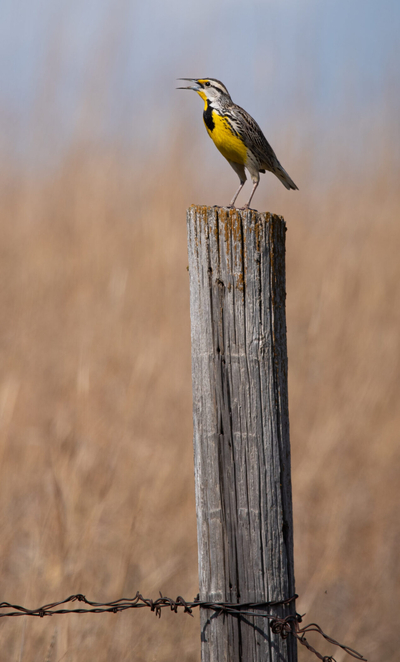
The conservation initiative announced this week should be music to the ears of western meadowlark fans — as the Nebraska state bird is among creatures at stake.
Consider also the loggerhead shrike, a feathered friend known for its raptorlike predator habits. Burrowing owls, regal fritillary and monarch butterflies are among other species to benefit from protective measures, Rubeck said.
Tourism efforts also are in jeopardy in a state without adequate grasslands, she added, noting, for example, out-of-state business and visitors who come to see the whimsical mating dance of the greater prairie chicken.
As says Sarah Sortum of Calamus Outfitters on the Great Plains Ecotourism Coalition website: Prairie chickens gather at ancient breeding grounds each spring as males passionately spar for dominance and mating rights.
“By stomping the ground, erecting pinnae feathers, flutter jumping and sounding their trademark booming call, they connect age to age on the sweeping prairie,” wrote Sortum.
Rubeck, of the Rainwater Basin Joint Venture, says she’s never heard of a Nebraskan who doesn’t like the flute-like whistle or warble of the western meadowlark song.
“So do we want to hear more of this or less?” she asked.
Roughly 100,000 acres
Program coordinators said the nearly $19 million in USDA funding will be available through 2030 to eligible Nebraska landowners who apply. Participation is voluntary.
The grants are to support management practices on roughly 100,000 acres of grassland statewide. Target core grassland areas are identified under the Great Plains Grassland Initiative.
The funds come as the United Nations has declared 2026 the International Year of Rangelands and Pastoralists. So across the world as well as in Nebraska, she said, efforts are stepping up to inform people about the importance of conserving grasslands.
“We’re definitely hoping to make a big impact on restoring grassland,” she said of the Nebraska initiative.
Lincoln, NE