Three years after October 7, Jewish voters need reassurance from our Democratic leaders
Oct 07, 2026 | 6:00 am ET

Description
Getty Images
As we approach this third anniversary of Oct. 7, 2023 — the deadliest attack on Jews since the Holocaust, followed by a war that has caused enormous Palestinian civilian suffering — American Jews are living through a period of deep trauma and dramatically elevated antisemitism here at home.
For generations, American democracy has given its citizens a voice at the ballot box to help shape our country’s future. And for more than 70 percent of Jews, those decisions have largely aligned with the Democratic Party. Jewish voters like myself have helped build the progressive coalitions that protect and champion immigrants, the LGBTQ+ community, reproductive rights, and our planet.
So why are my congregants expressing such discomfort about this upcoming election?
Many of us want to support leaders like Abdul El-Sayed, Michigan’s Democratic nominee for U.S. Senate. His platform on healthcare, reproductive freedom, and social justice resonates deeply with our Jewish tradition. We agree with much of his domestic agenda and are not looking for a reason to walk away.
In fact, the reason I speak out is because of the serious concerns about Mike Rogers and the Republican Party, including support from a major donor who has said only Christians should hold positions of political leadership. I am concerned when I hear the rhetoric motivating Mike Rogers’ platform and believe there is far more distance between his campaign’s focuses and the Jewish community’s core concerns than there is potential in Abdul El Sayed’s campaign to begin to use language that acknowledges the Jewish community’s concerns.
I graduated with Abdul from Andover. I know he understands what it means to live in diversity and to use language that includes everyone. I know him to be an intelligent person, and I know that he is aware of the impact of his words. Holding someone accountable is not the same as writing them off. Abdul is the candidate whose politics are much closer to my own which is precisely why I’m urging him to do better, to grow his tent in a meaningful way.
My appeal to Abdul comes from a sincere desire (dare I say prayer) to have the Jewish narrative centered on Jewish voices, and to expect any candidates who want our votes to be responsive to its potential voters’ concerns.
While antisemitism has always been a horrifying part of the Jewish experience in the U.S., antisemitic acts have skyrocketed since October 7. Criticism of the Israeli government — criticism that many Jewish Americans and Israelis share — has often crossed into the demonization of Jewish people as a whole, and has enabled people to invoke centuries-old antisemitic tropes.
When we hear candidates like Abdul describe only the country of Israel with language like “bloodthirsty” and “evil,” or when his campaign sends fundraising emails on October 7 about Israel without even mentioning Hamas’s brutal massacre or the hostages, it frankly frightens us.
For our community, this fear isn’t abstract. We have seen where the demonization and scapegoating of Jews can lead. This physical threat hit right in our own backyard in March, when a terrorist rammed his truck into Temple Israel in West Bloomfield and opened fire while 140 children were inside.
When antisemitic violence is happening on our doorstep, words carry enormous weight. Political leaders have a duty to model how public disagreement over Israel can happen without invoking rhetoric that Jews experience as threatening and dangerous. If our politicians won’t loudly denounce such hate and take actions as simple as speaking in defense of our community without humanizing terrorism against our community, it’s little wonder that many Jewish voters don’t know where to turn.
That is why clergy and synagogue leaders across our state have launched Nonnegotiable Michigan. We are giving political leaders — including El-Sayed — an open door and opportunity to affirm five baseline commitments to Jewish voters:
- Jewish safety, including for Zionist Jews. Believing in the right of Jewish people to self-determination is not an automatic endorsement of Israel’s current government. Leaders must hold accountable those who hurl the word “Zionist” at anyone as a slur or attack.
- The right of Jews to define their own identity. We reject any attempt to force us into political litmus tests or superimpose tropes of evil onto our community.
- Jewish sovereignty in Israel. We reject eliminationist language that seeks to return our people to statelessness and powerlessness.
- The full participation of Jews in American political life. We refuse to be excluded from protections for vulnerable groups or forced into silence just to remain included in progressive spaces.
- An affirmative vision for peace. True Jewish values paint a prosperous vision for peace in the Middle East, including a two-state solution that grants both Israelis and Palestinians the right to self-determination and respective sovereignty.
We invite Abdul to sit down with our Jewish community, listen with an open heart, and show us he wants to give all of us the same dignity and protection that every other coalition in Michigan deserves. We want to be part of building a better future for Michigan and our country — and we desperately need leaders who will stand up for our safety and humanity along the way.
Our votes must be earned. But also, our community, like all Michiganders, must be kept safe. Election or no, we’re urging Dr. El-Sayed to stop using harmful language that, time and again, has led to violence and will again. It’s the most fundamental thing he can do as a leader in the party we love.
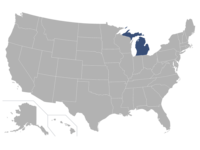
Lansing, MI