SC governor candidates agree on abortion, differ on gambling and Medicaid
Oct 07, 2026 | 4:00 am ET

Description
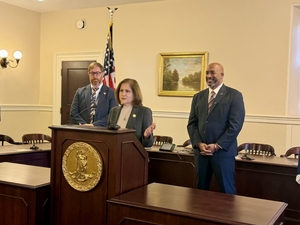
Democrat Jermaine Johnson and Republican Alan Wilson debate Tuesday, Oct. 6, 2026, in the studio of WIS-TV, a Gray Media station, in Columbia, South Carolina. The studio was closed to the public and other media. (Screenshot of the livestream from Gray Media)
COLUMBIA — In the only scheduled gubernatorial debate before the election, Democrat Jermaine Johnson and Republican Alan Wilson sparred Tuesday night over questions about data centers, Medicaid expansion, and a state hate crime.
Perhaps more surprising is where they agreed.
In a state where legislators debate abortion every session — sometimes several times a year — both agreed the state’s abortion restrictions should go no further. Both pledged they “would not seek to make them even more restrictive.”
The contest pits Johnson, a state representative since 2020 who opposed all GOP anti-abortion laws, with Wilson, the state attorney general since 2010 who’s defended them in court.
When the nominees were asked if the 2023 state law, which bans abortions six weeks into a pregnancy, is “strong enough,” Wilson sought clarification.
So, “leave the exceptions in place?” he asked to the show-of-hands-only question.
“Correct,” replied WIS-TV moderator Judi Gatson, causing both to raise their hands.
The Legislature’s most strident abortion foes want to go a lot further. In April, senators advanced legislation that not only banned abortions from the onset of a pregnancy but also deleted exceptions and threatened to send women to prison for two years for seeking an abortion. The bill, which divided the GOP, never got a floor vote.
But there’s a strong chance the legislation will return next year.
Wilson’s team confirmed after the debate that he believes the six-week law should stand. It allows exceptions for a fatal fetal anomaly and allows victims or rape or incest to get an abortion until the 12th week of pregnancy.
Gambling
Two other show-of-hands-only questions showed opposing views on gambling.
The odds of SC legalizing more gambling could change with next governor
Asked if they would support allowing casinos in South Carolina if voters approved a “statewide referendum,” only Johnson raised his hand.
On the flip side, only Wilson raised his hand when Gatson asked who would oppose casino gambling “even if voters support it.”
The questions assume the Legislature passes a law putting the question on a general election ballot, with the earliest possibility being November 2028. In South Carolina, there’s no such thing as a voter-led ballot referendum. Only supermajority approval by both chambers can put a question on November ballots. And that’s highly unlikely for a question involving casinos.
Historically, legislators have been reluctant to alter South Carolina’s anti-gambling laws. That’s changed in the last few years, with increasingly more Republicans willing to legalize sports betting, authorize a casino, or even bring back forms of video gaming.
One thing that’s stopped gambling bills from gaining traction is Gov. Henry McMaster’s opposition. Overriding his guaranteed veto would take supermajority approval, which supporters haven’t had.
Wilson’s answers Tuesday are further indication he would continue to be a veto threat, at least when it comes to casinos. At a GOP primary debate in April, Wilson said he “could never be against the faith community and the law enforcement community when it comes to this.”
Data centers
On data centers, Johnson and Wilson argued, even though their positions were very similar.
Both said communities should decide whether a data center becomes their neighbor.
“That’s why,” Johnson said, he introduced a resolution in April calling for a moratorium on all data centers in South Carolina. The legislation never received a vote. Wilson blasted the proposal as taking away choice from a community that may want a data center for the property taxes it pays.
“If you don’t want a data center, you don’t have a data center,” he said. “But if you are a community who sees the value or benefit of a data center, then we should provide you with a statutory and regulatory framework, guardrails” that require them to generate their own energy and mitigate noise, light, and other pollution.
In a rebuttal, Johnson said that was the purpose of his moratorium — to pause data centers until the General Assembly can create that framework.
Healthcare
On improving access to healthcare, Johnson said expanding Medicaid is a must.
South Carolina is among 10 states that never expanded Medicaid eligibility to cover all adults with incomes up to 138% of the federal poverty level, as intended by the 2010 federal health care law commonly known as Obamacare.
Johnson noted that his mother, who’s diabetic, recently had to have a leg amputated, and that a ZIP code in north Columbia has one of the nation’s highest rates of amputations due to diabetes, as reported by The State newspaper in 2022.
“We have to do this, not just for us, but for the people of South Carolina, for all mothers and sons, and to make sure that everybody gets the healthcare they need,” said Johnson, who lives in rural Richland County.
Wilson, of Lexington County, recalled his family’s own “terrifying” ordeal as his wife Jennifer battled breast cancer, saying he wants “every single family” to have the same access to healthcare. But expanding Medicaid isn’t the answer, he said, repeating South Carolina Republicans’ long-held argument that the state can’t afford it.
He pointed to North Carolina’s experience as evidence: The neighboring state’s expansion took effect Dec. 1, 2023. Advocates hoped that would change minds in South Carolina. But it was not the example they anticipated. In April, North Carolina legislators passed a $319 million bailout to keep the program afloat through the end of June after failing to pass a state budget last year. The bailout created new Medicaid copays and added eligibility restrictions to stem even bigger cost increases.
The massive federal tax policy law signed by President Donald Trump in July 2025 made Medicaid expansion more expensive for states. South Carolina hospitals are set to take a multimillion-dollar annual cut starting in 2028 due to one of the law’s tax changes. But the law’s biggest cost-cutting measures don’t apply to South Carolina.
Hate crime
South Carolina remains one of only two states without a specific hate crime law.
Asked how they would work with the Legislature to get one passed, Wilson said he supports legislation that would allow prosecutors to add prison time to the sentences of people convicted of committing a crime due to their victim’s race, gender or sexual orientation.
“So, if you were killed because you’re gay, or killed because you’re a conservative person on a public college campus, we can prosecute you and we can enhance that penalty by even more. So, I’m open to that,” Wilson said, adding that he’d have to “talk to the Legislature when I become governor.”
That so-called enhanced-penalty legislation is what the GOP-dominated House has passed twice since 2021. The most recent version that cleared the House would have added up to five years in prison and a $10,000 fine to the sentence of a hate-motivated violent crime.
But the Senate has never taken a floor vote on the legislation.
Johnson, who believes “we absolutely need a hate crime,” accused Wilson of being dishonest.
“Now, I don’t know why my opponent just said all those words up here, but we all know that he has stood against a hate crime law here in South Carolina,” he said. “We see these counties all over South Carolina enacting their own ordinances in the counties, and he has issued opinions against them.”
AG’s opinion says only SC legislators can create a hate crime. But 2 dozen local laws still stand.
That’s a “categorically false” misrepresentation, Wilson shot back.
Johnson was referring to an opinion from the attorney general’s office last October that hate crime ordinances in municipalities across South Carolina would likely be struck down if someone challenged them. The ordinances may violate the state constitution’s ban on local governments creating criminal law, the analysis concluded. The opinion was sought by the city attorney for Greenwood.
That was a legal opinion on the constitutionality of local ordinances, Wilson said, not his opinion on statewide legislation.
Who’s ‘new’?
Both candidates talked about changing the status quo and working to make life more affordable.
Johnson said he’d usher in a “new South Carolina,” while Wilson said he represented a “new generation of leadership.”
McMaster, who was attorney general prior to Wilson, leaves the governor’s office as the longest-serving and, at 79, the oldest governor in state history. Wilson is 53. Johnson is 41.
Both candidates questioned the other’s ability to actually create change.
Johnson repeatedly referenced “24 years,” which is how long there’s been a GOP trifecta at the Statehouse. Wilson, who’s completing his fourth term as attorney general, is part of an administration ruled by one party, he said.
The last Democratic governor, Jim Hodges, lost his 2002 bid for re-election. Republicans gained the majority in the Senate following the 2000 election, when one Democrat switched parties. That was six years after Republicans gained control of an evenly divided House because a Democrat voted for a Republican speaker. Republicans have been growing their majorities since. The 2024 election gave the GOP supermajorities in both chambers.
Wilson pointed to Johnson’s track record: Of the 70 bills he’s sponsored, none passed. “How can you bring transformative change as an outsider, but you can’t even get bills passed” as a legislator, Wilson said.
“When you’re a Democrat, it is not about getting bills passed. It is about working with everybody and being the co-sponsor” on legislation that becomes law, Johnson said.
Not on the debate stage were two third-party candidates for governor: United Citizens candidate Michael Addison and Green Party candidate Walid Hakim.
Columbia